
DISCIPLINE LEARNERS WITHOUT CANING: 7 POWERFUL STRATEGIES EVERY TEACHER SHOULD KNOW
Discipline learners without caning by understanding their behaviour, listening to their concerns and using practical, positive strategies that help build responsible learners.

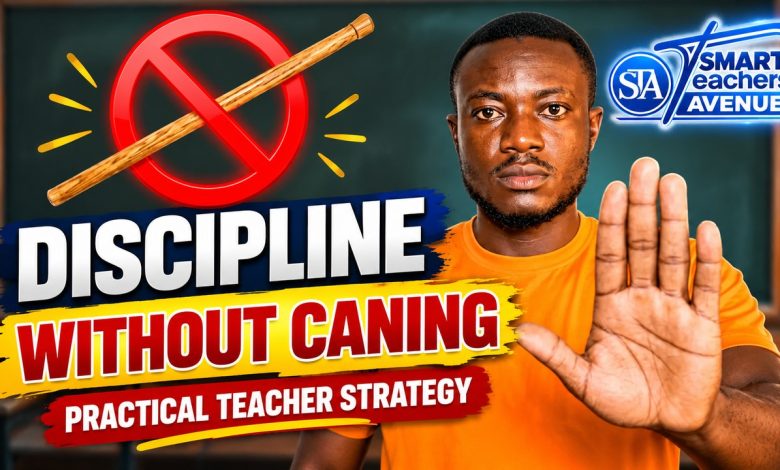
Teachers face different behavioural challenges in the classroom. Some learners repeatedly disrupt lessons, refuse instructions, fight with classmates or struggle to follow school rules. When these behaviours persist, it can be tempting to reach for the cane.
However, discipline learners without caning by first understanding what may be driving their behaviour. In a recent video, Mr. Atta Smart, an educational psychologist and financial educator at Smart Teachers Avenue, encourages teachers to move beyond physical punishment and adopt approaches that help them understand and guide their learners.
His message is clear: not every behavioural problem can be solved through punishment. Sometimes, a learner needs guidance, patient listening, closer attention and support.
WHY TEACHERS SHOULD DISCIPLINE LEARNERS WITHOUT CANING
Maintaining discipline is an important part of effective teaching. Learners need boundaries, clear expectations and consequences when they break school rules.
However, discipline should not be confused with inflicting pain.
Caning may stop a particular behaviour temporarily, but it does not necessarily help a learner understand why the behaviour is inappropriate or how to make better choices in the future.
A more constructive approach combines firm boundaries with guidance, accountability and support.
Mr. Atta Smart encourages teachers to understand the learner before deciding how to respond to misconduct.
This means looking beyond the behaviour itself and considering the circumstances that may be contributing to it.
DISCIPLINE LEARNERS WITHOUT CANING BY UNDERSTANDING THEIR BACKGROUND
One of the most important messages in Mr. Atta Smart’s video is that teachers should make an effort to understand their learners’ backgrounds.
A learner’s behaviour may be influenced by several factors, including difficulties at home, emotional distress, peer pressure, learning challenges or experiences within the school environment.
For example, a learner who frequently becomes aggressive may be struggling with a problem that has not been identified.
Another learner who repeatedly refuses to participate in class may be experiencing learning difficulties, embarrassment or a lack of confidence.
These possibilities do not excuse harmful behaviour. Instead, they remind teachers that effective intervention begins with understanding what is happening.
1. Understand the learner before choosing a disciplinary response
Before deciding how to respond to repeated misconduct, take time to establish what happened.
Ask questions calmly. Find out whether the behaviour is new or recurring, whether particular situations trigger it and whether the learner understands the expectations.
Avoid immediately labelling a child as stubborn, troublesome or hopeless.
A learner’s behaviour should be addressed, but the learner should still be treated with dignity.
Understanding the circumstances can help a teacher choose a response that addresses the problem rather than merely reacting to it.
DISCIPLINE LEARNERS WITHOUT CANING BY LISTENING TO THEM
Teachers often spend considerable time explaining what learners should do. However, listening is equally important.
Mr. Atta Smart encourages teachers to get closer to their learners, spend time with them and understand what may be happening in their lives.
A calm conversation can sometimes reveal information that would otherwise remain hidden.
Instead of confronting a learner angrily in front of the class, consider speaking privately when appropriate.
Ask questions such as:
- What happened before this incident?
- Is something troubling you?
- What made it difficult to follow the instruction?
- What could you do differently next time?
- What support would help you improve?
Give the learner an opportunity to respond without unnecessary interruption or humiliation.
Listening does not mean accepting every excuse. It means gathering information before deciding on the appropriate response.
2. Build a relationship that encourages honest communication
Learners are more likely to approach a teacher when they believe their concerns will be taken seriously.
Teachers can build this trust by being consistent, respectful and approachable.
Make time for brief conversations. Recognise improvements, even when they are small, and follow through on promises.
When learners know that a teacher is interested in their well-being as well as their academic performance, it can become easier to discuss problems before they escalate.
DETAILED LESSON PLANS & SCHEMES OF WORK
Get detailed lesson plans and Schemes of Work for Nursery, KG, Primary, JHS and SHS to help you prepare, plan and teach effectively.
READ RELATED RESOURCES HERE: GES PROMOTION ARREARS PAYMENT: 5 CRUCIAL UPDATES TEACHERS SHOULD KNOW
DISCIPLINE LEARNERS WITHOUT CANING USING 7 PRACTICAL STRATEGIES
Understanding learners is an important starting point, but teachers also need practical ways to manage behaviour and maintain order.
The following strategies can help educators establish clear expectations while treating learners fairly.
3. Establish clear rules and consistent consequences
Learners should understand the classroom rules, why they exist and what happens when those rules are broken.
Keep expectations clear and age-appropriate.
For example, rules may require learners to respect others, follow instructions, avoid fighting and take responsibility for their actions.
Apply the rules consistently rather than changing the consequences according to a learner’s popularity, family background or academic performance.
Consequences should be proportionate, educational and consistent with school policy.
4. Reinforce positive behaviour
Discipline should not focus exclusively on what learners do wrong.
Teachers should also recognise responsible behaviour.
Praise a learner who resolves a disagreement peacefully, completes an assigned task or follows instructions after previously struggling to do so.
Specific feedback is more useful than vague praise.
For example, saying, “You listened to your classmates and waited for your turn to speak,” identifies the behaviour worth repeating.
Positive reinforcement helps learners understand what appropriate conduct looks like.
5. Use calm correction instead of angry confrontation
When a learner misbehaves, a teacher’s response can influence what happens next.
Shouting, insults and public humiliation may intensify a disagreement instead of resolving it.
Where possible, respond calmly, identify the unacceptable behaviour and explain what needs to change.
For example, a teacher might say, “Interrupting your classmates is not acceptable. Please allow them to finish, and then you can contribute.”
This approach maintains authority without turning the situation into a personal confrontation.
6. Help learners understand the consequences of their actions
Learners need opportunities to reflect on how their behaviour affects others.
If a learner damages another person’s property, for example, an appropriate response may include taking responsibility and helping to repair or replace the damaged item where suitable and feasible.
If a learner hurts a classmate, the teacher can guide the learner to recognise the harm caused and take appropriate steps towards making amends.
The objective is not simply to impose a penalty. It is to help the learner develop responsibility, empathy and better decision-making skills.
END-OF-TERM EXAMINATIONS FROM CRECHE TO SHS
Get quality End-of-Term Examination Questions with Marking Schemes for learners from Creche to SHS, carefully prepared to support effective assessment.
7. Work with parents and guardians
Teachers do not always have all the information needed to understand a learner’s behaviour.
Where concerns persist, communicating respectfully with parents or guardians may help the school identify patterns and coordinate support.
Share specific observations rather than making broad accusations.
For example, explain when the behaviour occurs, how frequently it happens and what steps the school has already taken.
Parents and teachers can then discuss practical ways to support improvement.
The conversation should focus on helping the learner rather than blaming the family.
8. Refer learners for additional support when necessary
Some behavioural difficulties may require more support than a classroom teacher can provide alone.
Persistent aggression, significant emotional distress, repeated conflict or sudden changes in behaviour may indicate a need for further assessment or intervention.
Depending on the school’s structure, the teacher may consult the headteacher, guidance and counselling coordinator, school-based support team or another appropriate professional.
Follow the school’s established referral procedures and safeguarding requirements.
Teachers should not attempt to diagnose psychological conditions without the appropriate qualifications.
9. Teach the behaviour you want to see
Learners do not always know how to manage anger, resolve disagreements or express frustration appropriately.
These skills can be taught and practised.
Teachers can use role-play, class discussions, cooperative activities and guided problem-solving to help learners develop respectful ways of interacting.
For example, when two learners disagree, guide them to explain their perspectives, listen to each other and identify a fair solution.
Repeated practice helps learners understand that discipline involves learning appropriate behaviour, not merely avoiding punishment.
READ RELATED RESOURCES HERE: GES PROMOTION EXAMINATION INDEX NUMBERS 2026: IMPORTANT UPDATES AND CANDIDATE LISTS

DISCIPLINE LEARNERS WITHOUT CANING WHILE MAINTAINING CLASSROOM AUTHORITY
Some teachers may worry that avoiding caning will make learners disrespectful or difficult to control.
However, positive discipline does not mean allowing learners to do whatever they want.
Teachers can maintain firm boundaries without using physical punishment.
The key is to establish expectations, respond consistently to misconduct and help learners understand their responsibilities.
For example, a teacher dealing with repeated classroom disruption can:
- State the classroom rule clearly.
- Address the behaviour promptly and calmly.
- Apply an appropriate, school-approved consequence.
- Speak privately with the learner to understand the cause.
- Agree on a plan for improving behaviour.
- Monitor progress and involve the appropriate school personnel if needed.
This approach combines accountability with an opportunity to learn and improve.
Firm discipline and respectful treatment can work together.
WHY CANING ALONE MAY NOT SOLVE THE PROBLEM
The central message of Mr. Atta Smart’s video is that teachers should not assume that every behavioural challenge can be resolved through physical punishment.
A punishment may interrupt an action without addressing the circumstances that contributed to it.
If a learner repeatedly disrupts lessons because of an unresolved problem, the behaviour may continue unless that problem is identified and appropriately addressed.
Likewise, a learner who struggles to regulate emotions may need guidance and structured support to develop better responses.
Teachers should therefore consider whether their disciplinary approach is producing lasting improvement or simply stopping behaviour temporarily.
The goal is to create an environment where learners understand expectations, take responsibility and develop the skills needed to make better choices.
WHAT SHOULD TEACHERS DO WHEN A LEARNER’S BEHAVIOUR BECOMES SERIOUS?
Positive discipline does not require teachers to ignore dangerous behaviour.
If a learner threatens another person, engages in serious aggression or creates an immediate safety risk, the teacher should take appropriate steps to protect everyone involved.
Follow school procedures, seek assistance from the appropriate school authorities and document serious incidents where required.
Where necessary, involve parents or guardians and refer the learner for additional support.
Physical punishment should not be treated as the default response to serious misconduct. Teachers should use the approved school procedures and safeguarding measures that apply to the situation.
The priority is to maintain safety, address the behaviour and ensure that the learner receives appropriate guidance.
DISCIPLINE LEARNERS WITHOUT CANING: THE ROLE OF EVERY TEACHER
Every teacher has an opportunity to influence how learners understand responsibility, respect and acceptable behaviour.
This responsibility goes beyond completing the syllabus or preparing learners for examinations.
It also involves modelling the values that learners are expected to demonstrate.
When teachers respond to misconduct calmly, apply fair consequences, listen to concerns and seek help when needed, they demonstrate practical ways of resolving problems.
These approaches will not produce immediate results in every case. Some learners may require sustained support, consistent boundaries and collaboration among teachers, parents and other professionals.
Nevertheless, a thoughtful and structured response gives teachers more options than relying on physical punishment alone.
READ RELATED RESOURCES HERE: END-OF-TERM EXAMINATION QUESTIONS: 7 POWERFUL REASONS TEACHERS SHOULD GET READY NOW
WATCH MORE PRACTICAL TEACHING GUIDANCE ON SMART TEACHERS AVENUE
Mr. Atta Smart encourages teachers to explore more practical resources on the Smart Teachers Avenue YouTube channel.
The platform shares content on professional ethics, learner behaviour, financial education for teachers and other issues affecting educators and school owners.
Teachers who want additional guidance on managing challenging classroom behaviour can explore the relevant videos and apply strategies that fit their learners’ needs, school policies and professional responsibilities.
Smart Teachers Avenue also shares resources for school owners, including practical guidance on improving school enrolment, as well as content for teachers interested in building wealth while remaining in the classroom.
Educators can follow the platform, share useful resources with colleagues and participate in discussions about practical ways to improve teaching and learning.
FINAL WORD: DISCIPLINE SHOULD HELP LEARNERS IMPROVE
The message from Mr. Atta Smart is a useful reminder that effective discipline requires more than punishment.
Teachers should take time to understand learners, listen to their concerns, establish clear boundaries and use appropriate strategies to guide behaviour.
When problems persist, they should work with parents, school leaders and relevant support professionals rather than assuming that harsher punishment will solve the issue.
The goal is not merely to stop misbehaviour. It is to help learners become more responsible, respectful and capable of making better decisions.
Teachers, before deciding how to discipline a learner, take a moment to understand what may be behind the behaviour. A thoughtful response can open the door to a better solution.
Share your experience and ideas in the comments. Your strategy could help another teacher take the first step.
Follow Smart Teachers Avenue on Facebook, TikTok and YouTube for practical teacher development, professional growth and financial education.
YOU CAN CONTACT US ON ↓
📞 Phone: +233 503910155 / +233233910155
📧 Email: info.teachersavenue@gmail.com
💬 WhatsApp: Click Here To WhatsApp Us
Follow Smart Teachers Avenue and Stay connected with us for daily educational resources, financial education, teaching tips and school leadership insights.
📘 Facebook – FOLLOW HERE
🎵 TikTok – FOLLOW HERE
▶️ YouTube – SUBSCRIBE HERE
✈️ Telegram Channel – JOIN HERE
👥 Telegram Community Chat: – JOIN HERE
👥 Facebook Community Chat: – JOIN HERE
WhatsApp Channel – FOLLOW HERE for daily updates, teaching resources and exclusive educational content.
Join our growing community of teachers across Ghana and beyond who trust Smart Teachers Avenue as their preferred platform for teaching resources, professional development, financial education and school leadership.