

GES CIRCULAR ON 20% DEPRIVED AREA ALLOWANCE: 7 KEY THINGS TEACHERS SHOULD KNOW
What teachers should know about the reported GES data-verification exercise, deprivation indicators and the deadline stated in the circulating document.

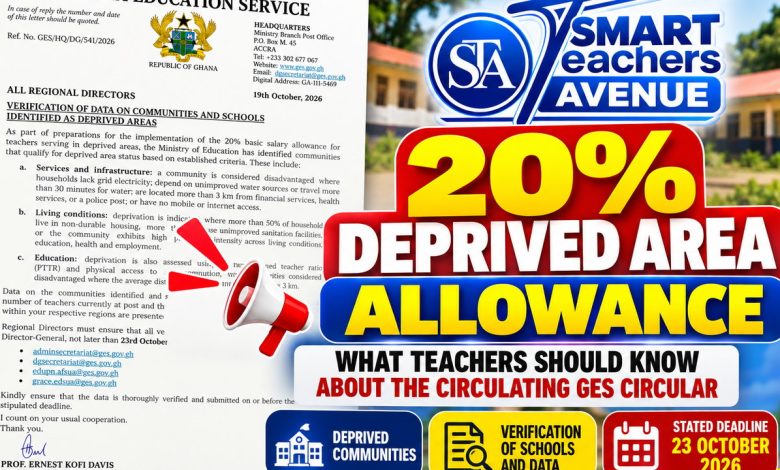
A circular circulating among teacher groups in Ghana is drawing attention to the proposed 20% Deprived Area Allowance, with a reported data-verification exercise focusing on communities and schools considered deprived.
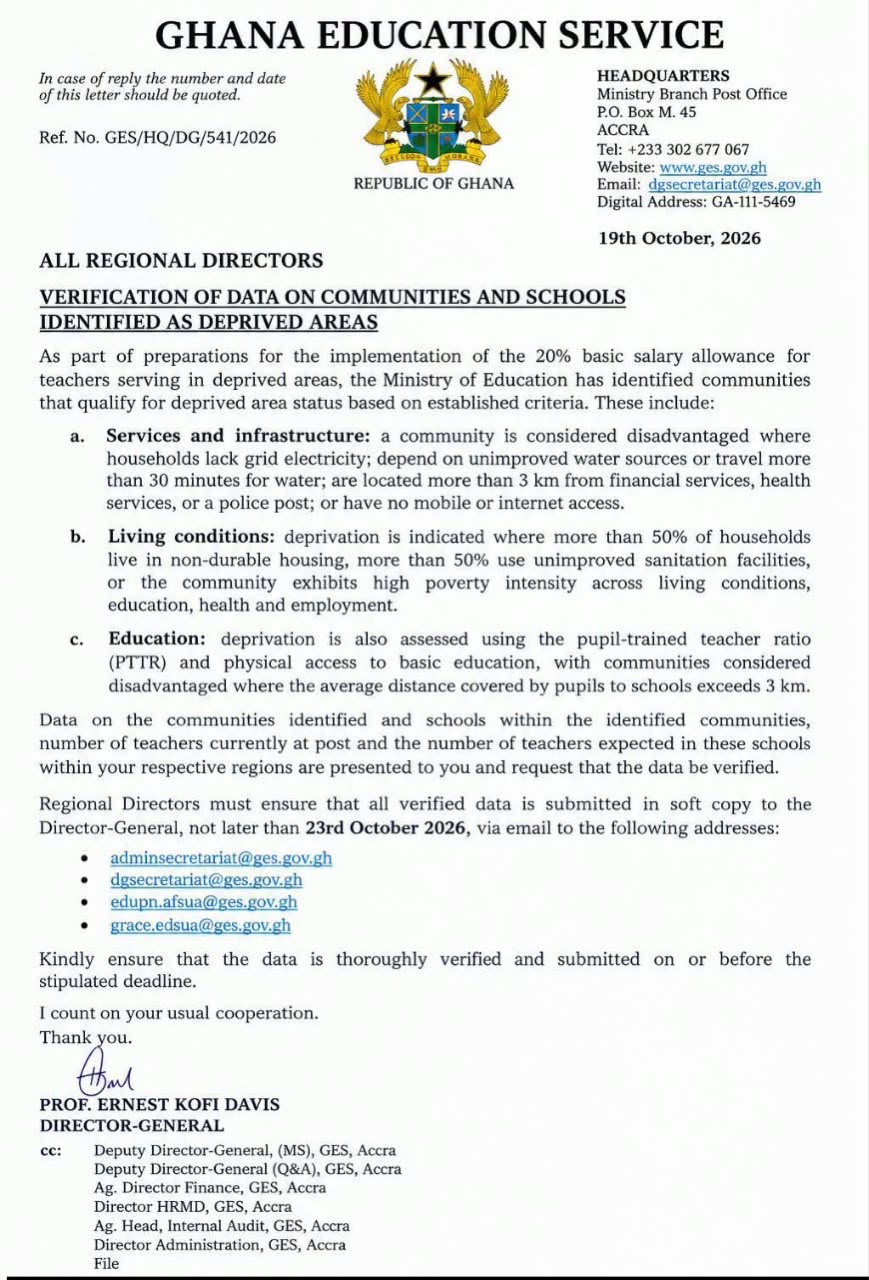
The document, dated 19 October 2026 and bearing the reference number GES/HQ/DG/541/2026, is titled Verification of Data on Communities and Schools Identified as Deprived Areas. It states that regional authorities are being asked to verify information on communities and schools that may qualify for the proposed allowance.
The circulation of the document comes amid ongoing discussions about the government’s plan to introduce an additional 20 per cent of basic salary for eligible teachers and other professionals serving in deprived and underserved areas.
President John Dramani Mahama previously announced the proposed incentive, explaining that it was intended to encourage professionals to accept postings to areas that have difficulty attracting and retaining workers. The government indicated that implementation would be subject to the necessary approvals. Information Services Department.
Editorial note: Smart Teachers Avenue has not independently authenticated the specific circular referenced in this report. The details below describe what the circulating document states and should not be interpreted as confirmation that a teacher or school has been approved for payment.
WHAT THE CIRCULATING GES CIRCULAR SAYS ABOUT THE 20% DEPRIVED AREA ALLOWANCE
According to the document, the Ministry of Education has identified communities that may qualify for the proposed 20% Deprived Area Allowance for teachers serving in deprived areas.
The circular indicates that the relevant data must be verified to help determine which communities and schools meet the stated criteria.
This reported exercise is consistent with the broader policy discussions already taking place. In October 2026, the Education Minister spoke publicly about the need to validate data on deprived schools and communities before determining eligible beneficiaries and geographical areas. Ghana News Agency.
However, the existence of a proposed allowance and an ongoing validation process does not, on its own, establish that every school in a rural community will qualify.
DETAILED LESSON PLANS & SCHEMES OF WORK
Get detailed lesson plans and Schemes of Work for Nursery, KG, Primary, JHS and SHS to help you prepare, plan and teach effectively.
1. THE CIRCULAR GIVES 23 OCTOBER 2026 AS THE DATA-SUBMISSION DEADLINE
The circulating document is dated 19 October 2026 and states that the requested verification data should be submitted to the Director-General by 23 October 2026.
It lists the following email addresses for the submission:
These are the contact details printed on the document, not independently verified submission instructions. Regional education authorities should confirm the appropriate channels and any applicable instructions before acting on them.
The short interval between the document’s stated date and deadline makes timely verification important for regional and district education administrators if the exercise is confirmed.
2. THE PROPOSED 20% DEPRIVED AREA ALLOWANCE IS NOT A NEW DISCUSSION
The proposed 20% Deprived Area Allowance has been part of the government’s public commitments concerning teachers and other professionals serving in underserved communities.
In September 2026, President Mahama announced a planned additional 20 per cent of basic salary for eligible professionals accepting postings to deprived and underserved districts. He said the measure would take effect after the necessary approvals were completed. Information Services Department.
Subsequent public statements have highlighted the need to establish which teachers and geographical areas qualify.
This distinction matters to teachers: a public commitment to introduce an allowance is not the same as a final list of approved schools, a completed eligibility process or confirmation that payments have begun.
END-OF-TERM EXAMINATIONS FROM CRECHE TO SHS
Get quality End-of-Term Examination Questions with Marking Schemes for learners from Creche to SHS, carefully prepared to support effective assessment.
3. THE DOCUMENT LISTS INFRASTRUCTURE AND ACCESS TO ESSENTIAL SERVICES
The circular lists several indicators relating to services and infrastructure that may help identify deprived communities.
These include conditions involving:
- Access to grid electricity.
- Access to improved drinking water.
- Distance or travel time to water sources.
- Distance from financial, health, police and postal services.
- Availability of mobile network and internet connectivity.
These indicators reflect some of the practical challenges experienced by people living and working in underserved communities.
For teachers in remote locations, access to electricity, communication networks, healthcare and reliable transport can affect their ability to work effectively and manage their personal lives.
Nevertheless, teachers should not treat any single indicator as an automatic qualification for the 20% Deprived Area Allowance. The applicable assessment method and final eligibility decisions must be established through the authorised process.
READ RELATED RESOURCES HERE: HOW TO AVOID LOANS AS A TEACHER: 7 POWERFUL STEPS TO BUILD FINANCIAL FREEDOM
4. HOUSING, SANITATION AND POVERTY ARE ALSO MENTIONED
The circulating document also refers to living conditions, including the proportion of housing that is not durable, sanitation conditions and high poverty intensity.
These considerations are important because deprivation is not defined by distance alone. A community may face several overlapping disadvantages, including poor housing, limited sanitation, inadequate services and high levels of poverty.
The combination of these conditions can make it more difficult to attract and retain qualified teachers.
The final administrative criteria will determine how these indicators are measured, weighted and applied when deciding which schools or communities qualify for the allowance.
5. EDUCATIONAL ACCESS AND STAFFING CONDITIONS FORM PART OF THE LISTED CRITERIA
The circular also lists education-related indicators, including pupil-trained-teacher ratios, access to basic education and situations where pupils travel more than three kilometres to attend school.
These factors draw attention to the wider educational challenges that may exist in deprived communities.
A school may be operating under difficult conditions because of its location, limited access to essential services or challenges in providing equitable access to education.
However, the listed indicators should not be confused with a final determination of eligibility. A teacher’s entitlement will depend on the official criteria and the school’s eventual classification under the approved arrangements.
READ RELATED RESOURCES HERE: 2026/2027 CAPITATION GRANT: 5 IMPORTANT UPDATES EVERY BASIC SCHOOL MUST KNOW
6. TEACHERS SHOULD WAIT FOR CONFIRMED ELIGIBILITY INFORMATION
The circulation of the document has raised interest among teachers who want to know whether their current postings will qualify for the proposed 20% Deprived Area Allowance.
Teachers should distinguish between three separate issues:
The proposed policy: The government has publicly discussed the additional 20 per cent incentive.
The verification exercise: The circulating document describes a process for checking data on potentially deprived communities and schools.
Final eligibility and payment: These require authoritative confirmation of the approved criteria, qualifying locations, eligible teachers and implementation arrangements.
Teachers should therefore avoid concluding that they will automatically receive the allowance simply because their school is in a rural area or because it appears on a list circulating through WhatsApp.
For reliable information, teachers should consult their district or regional education directorates and look out for official announcements from the Ghana Education Service and the Ministry of Education.
7. WHAT THIS COULD MEAN FOR TEACHERS IN RURAL AND HARD-TO-REACH COMMUNITIES
If implemented as proposed, the 20% Deprived Area Allowance could provide an additional financial incentive for eligible teachers serving in difficult locations.
For teachers working in communities with limited electricity, poor road networks, inadequate housing, weak communication infrastructure and restricted access to essential services, such an incentive could be significant.
The broader policy objective is to encourage professionals to accept and remain in postings where recruitment and retention have been difficult.
The practical impact, however, will depend on how the government defines qualifying areas, how eligibility is verified, which teachers are covered and when payments commence.
Teachers will need clear and consistent information so that expectations are based on confirmed arrangements rather than assumptions.
WHAT TEACHERS SHOULD DO NOW
Teachers who want to follow developments concerning the 20% Deprived Area Allowance should:
- Follow official communications from the Ghana Education Service and the Ministry of Education.
- Ask their district or regional education directorate for clarification when necessary.
- Keep their appointment, posting and assumption-of-duty documents readily available.
- Avoid sharing unverified claims that a particular school has been approved for payment.
- Wait for the authorised eligibility criteria and implementation details before making financial decisions based on the allowance.
Regional and district authorities should also clarify any verification requirements and submission instructions through established administrative channels.
READ RELATED RESOURCES HERE: THE HIDDEN REASONS WHY MANY BUILDINGS REMAIN UNCOMPLETED
SMART TEACHERS AVENUE’S TAKE
The proposed 20% Deprived Area Allowance remains an important issue for teachers, particularly those serving in rural and underserved communities.
The circulating circular describes a data-verification exercise involving communities and schools identified as potentially deprived. Its stated deadline is 23 October 2026.
The broader policy commitment and the need to validate eligibility have also been discussed publicly by government officials. However, Smart Teachers Avenue has not independently authenticated the specific circular, and the document alone does not confirm that individual schools or teachers have been approved for the allowance.
Teachers should follow verified announcements for clarification on qualifying schools, eligibility requirements and payment arrangements.
Smart Teachers Avenue will continue to highlight developments affecting teachers’ welfare, professional growth and working conditions as reliable information becomes available.
Stay connected with Smart Teachers Avenue for updates on teacher welfare, education policies and professional opportunities in Ghana.
Share your experience and ideas in the comments. Your strategy could help another teacher take the first step.
Follow Smart Teachers Avenue on Facebook, TikTok and YouTube for practical teacher development, professional growth and financial education.
YOU CAN CONTACT US ON ↓
📞 Phone: +233 503910155 / +233233910155
📧 Email: info.teachersavenue@gmail.com
💬 WhatsApp: Click Here To WhatsApp Us
Follow Smart Teachers Avenue and Stay connected with us for daily educational resources, financial education, teaching tips and school leadership insights.
📘 Facebook – FOLLOW HERE
🎵 TikTok – FOLLOW HERE
▶️ YouTube – SUBSCRIBE HERE
✈️ Telegram Channel – JOIN HERE
👥 Telegram Community Chat: – JOIN HERE
👥 Facebook Community Chat: – JOIN HERE
WhatsApp Channel – FOLLOW HERE for daily updates, teaching resources and exclusive educational content.
Join our growing community of teachers across Ghana and beyond who trust Smart Teachers Avenue as their preferred platform for teaching resources, professional development, financial education and school leadership.







One Comment