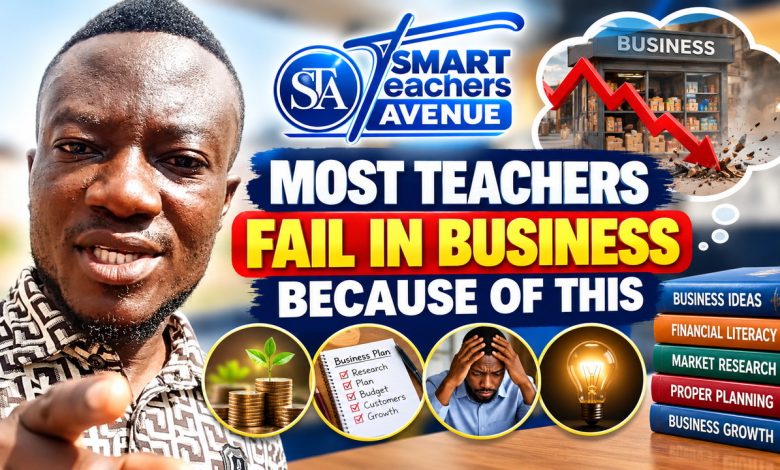
MOST TEACHERS FAIL IN BUSINESS BECAUSE OF THIS
Many teachers start businesses hoping to earn extra income, but the right information, planning and financial management can help them avoid costly mistakes.

Many teachers want to start a business to earn extra income, support their families, pay bills and build a more secure financial future. Yet some businesses struggle or collapse before they achieve their intended goals.
Why does this happen?
One major reason is that some teachers start businesses without enough information, proper planning or a clear understanding of the customers they want to serve.
Having a good business idea is important. Having the right information to turn that idea into a sustainable business is just as important.
For teachers in Ghana who are already balancing lesson preparation, classroom responsibilities, marking and family commitments, a business needs more than enthusiasm. It needs a realistic plan, proper financial management and the willingness to learn.
If you are a teacher planning to start a business, this article could help you avoid some common mistakes before you invest your hard-earned money.
WHY TEACHERS FAIL IN BUSINESS: THE INFORMATION GAP
One of the reasons teachers fail in business is that they sometimes begin with excitement but without adequate preparation.
A teacher may hear that someone is making money from selling clothes, food, mobile phone accessories, data bundles or cosmetics. The teacher becomes interested and decides to start the same business.
But there is an important question to ask first: Does this business make sense for my situation, customers, location and available capital?
What works for one person may not work in the same way for another.
The successful business owner may have established customers, a reliable supplier, experience in the industry or enough capital to manage slow sales. A new business owner may not have these advantages.
That is why teachers need to look beyond stories of success and understand what it takes to run the business.
Business success is not just about choosing what to sell. It is about understanding how to sell it, who will buy it, what it costs and how the business will make a profit.
DETAILED LESSON PLANS & SCHEMES OF WORK
Get detailed lesson plans and Schemes of Work for Nursery, KG, Primary, JHS and SHS to help you prepare, plan and teach effectively.
5 REASONS TEACHERS FAIL IN BUSINESS
1. TEACHERS FAIL IN BUSINESS WHEN THEY START WITHOUT RESEARCH
Before starting a business, find out whether people actually need the product or service you intend to offer.
Do not invest simply because a friend says the business is profitable.
For example, if you want to sell provisions, clothing or food, investigate the demand in your intended market. Find out who your likely customers are, what they currently buy, what competitors charge and what would make them choose your business.
You can begin with simple conversations, customer surveys and observation. You do not need an expensive research project to ask useful questions.
Market research helps business owners understand customers, competition, pricing and demand before committing too much money. The U.S. Small Business Administration’s business planning guide explains practical ways to research a market and prepare for a new business.
2. TEACHERS FAIL IN BUSINESS WHEN THEY MIX BUSINESS MONEY WITH PERSONAL MONEY
This is a common financial-management problem.
A teacher may use business money to pay household expenses, school-related costs, transport fares or other personal bills without recording the withdrawals.
When it is time to restock, the capital is no longer available.
The business may appear to be making sales, but the owner cannot clearly explain how much money has been earned, spent or retained.
To avoid this problem, keep business money separate from personal money as much as possible. Record daily sales, expenses, stock purchases, debts and withdrawals.
Remember that sales are not the same as profit. A business can sell many items and still make little profit if its costs are too high.
END-OF-TERM EXAMINATIONS FROM CRECHE TO SHS
Get quality End-of-Term Examination Questions with Marking Schemes for learners from Creche to SHS, carefully prepared to support effective assessment.
3. TEACHERS FAIL IN BUSINESS WHEN THEY CHOOSE A BUSINESS THAT DOES NOT FIT THEIR SCHEDULE
Teaching is a demanding profession. Teachers have lessons to prepare, students to assess, records to update and other responsibilities to fulfil.
A business that requires constant personal supervision may be difficult to manage alongside a full-time teaching job.
This does not mean teachers cannot run successful businesses. It means they need to choose carefully.
A teacher with limited time might consider a business that can operate by appointment, accept orders online, use a trusted assistant or run during clearly defined hours.
Possible options include educational resources, digital services, carefully managed online sales, tutoring where appropriate, or supplying products based on customer orders.
Every option has its own risks and requirements. The important thing is to choose a model that fits your available time, skills and resources.
READ RELATED RESOURCES HERE: GES CIRCULAR ON 20% DEPRIVED AREA ALLOWANCE: 7 KEY THINGS TEACHERS SHOULD KNOW
4. TEACHERS FAIL IN BUSINESS WHEN THEY IGNORE CUSTOMER NEEDS
Your business does not exist simply because you want to earn money. It exists to provide something that customers are willing to pay for.
If customers are not buying, do not immediately assume that they do not appreciate your efforts.
Investigate the problem.
Is the price too high? Is the product difficult to obtain? Are customers dissatisfied with the quality? Are you selling something they do not need? Do people know your business exists?
Ask customers for feedback and use what you learn to improve your offer.
A business that listens to customers is better positioned to adjust its products, services and marketing.
READ RELATED RESOURCES HERE: HOW TO AVOID LOANS AS A TEACHER: 7 POWERFUL STEPS TO BUILD FINANCIAL FREEDOM
5. TEACHERS FAIL IN BUSINESS WHEN THEY EXPECT QUICK PROFITS
Some businesses need time to attract customers and build trust. Others experience seasonal demand or periods when sales are slow.
If a teacher expects to become profitable immediately, the first difficult month may create unnecessary pressure.
Before starting, estimate your initial costs, recurring expenses, expected sales and the minimum amount you need to sell to cover costs.
Start at a manageable scale where possible. Test demand before investing heavily, and avoid borrowing money without a realistic repayment plan.
A business plan does not guarantee success, but it helps you think through costs, customers, operations and possible risks before making major decisions.
HOW TEACHERS CAN START A BUSINESS WITH THE RIGHT INFORMATION
The good news is that teachers do not have to figure everything out through costly mistakes.
There are practical steps you can take before launching a business.
STEP 1: IDENTIFY A REAL PROBLEM YOU CAN SOLVE
Ask yourself what people around you need.
Do parents need educational materials? Do workers need convenient access to particular products? Are local businesses looking for help with record-keeping, digital marketing or online promotion?
Your skills, location and existing network may reveal opportunities worth investigating.
Do not choose a business simply because it is popular. Look for a genuine customer need that you can serve effectively.
STEP 2: KNOW YOUR START-UP CAPITAL AND COSTS
Write down what you need to get started.
Consider stock, transport, packaging, equipment, internet access, marketing and other operating expenses. Also consider how much money you may need to keep the business running before sales become consistent.
Avoid committing money you need for essential household expenses.
Start with figures you can explain and update them as you learn more about the business.
STEP 3: LEARN BEFORE YOU INVEST HEAVILY
Speak with people who already operate the business you are considering. Ask what they wish they had known before starting, what their major costs are and what challenges they face.
Look for reliable training, practical guides and qualified business advisers.
In Ghana, the Ghana Enterprises Agency provides support and business advisory services for micro, small and medium-sized enterprises. Its resources may help you identify guidance relevant to your business idea.
Do your own checks before paying for any course, mentorship programme or business opportunity. Verify what is being offered and be cautious of anyone promising guaranteed profits.
STEP 4: TEST THE BUSINESS BEFORE EXPANDING
You do not always need to begin with a large shop, a large quantity of stock or an expensive office.
Where the business model allows it, start with a small test. Take a limited number of orders, offer a sample service or test demand with a manageable amount of stock.
Measure the results.
Are people buying? Are you covering your costs? Are customers returning? Can you manage the workload alongside teaching?
Use the answers to decide whether to continue, adjust or expand.
STEP 5: KEEP RECORDS AND REVIEW YOUR PROGRESS
A simple notebook or spreadsheet can help you track sales, expenses, stock, debts and profit.
Review your figures regularly. If the business is losing money, investigate why rather than continuing to invest blindly.
You should be able to answer three questions:
- How much money has the business received?
- How much has it spent?
- How much remains after the costs of running the business?
These records can help you make better decisions and identify problems early.
READ RELATED RESOURCES HERE: TEACHERS, ARE YOU WATCHING OVER YOUR STUDENTS OUTSIDE THE CLASSROOM?
BUSINESS IDEAS TEACHERS CAN EXPLORE
There is no single business that is right for every teacher. Your best option depends on your skills, location, time, capital and the customers you can reach.
Here are some ideas worth researching:
Educational products and services: Teaching and learning materials, revision resources, educational printing or tutoring where permitted and appropriate.
Digital services: Graphic design, content writing, data analysis, social media support or basic digital services for individuals and small businesses.
Online and order-based sales: Clothing, stationery, accessories, household products or other items with demonstrated customer demand.
Food and local products: Snacks, packaged foods or locally sourced products, subject to relevant safety and business requirements.
Agricultural and community-based ventures: Poultry, crop production or other ventures where the teacher has suitable knowledge, support, time and access to a market.
These are possibilities to investigate, not guaranteed money-making opportunities. Before choosing one, assess demand, start-up costs, competition and how you will manage it alongside your teaching responsibilities.
THE MOST IMPORTANT STEP: ASK FOR GUIDANCE BEFORE YOU START
Sometimes, the difference between a costly mistake and a better business decision is having access to the right information at the right time.
Teachers already have valuable skills: communication, organisation, planning, problem-solving and the ability to learn. These skills can support entrepreneurship, but they do not replace the need to understand the specific business you want to enter.
You do not have to know everything before you begin. You do, however, need to be willing to ask questions, do research, keep records and learn from evidence.
That is the purpose of this conversation.
TEACHERS, WHAT BUSINESS DO YOU WANT TO START?
At Smart Teachers Avenue, we want to help teachers explore business opportunities with better information and more realistic expectations.
Tell us in the comment section: What business do you want to start as a teacher?
Are you interested in selling clothes, starting a provision shop, selling data bundles, farming, offering digital services, producing educational materials or trying something else?
Share your business idea with us.
We will use your responses to develop more practical content about business selection, start-up planning, customer research, pricing, financial management and the challenges you should prepare for.
Your idea may also help another teacher who is considering the same path.
Starting a business should not mean walking blindly into avoidable mistakes. Let us learn, ask questions and make better-informed decisions together.
Share your experience and ideas in the comments. Your strategy could help another teacher take the first step.
Follow Smart Teachers Avenue on Facebook, TikTok and YouTube for practical teacher development, professional growth and financial education.
📞 Phone: +233 503910155 / +233233910155
📧 Email: info.teachersavenue@gmail.com
💬 WhatsApp: Click Here To WhatsApp Us
Follow Smart Teachers Avenue and Stay connected with us for daily educational resources, financial education, teaching tips and school leadership insights.
YOU CAN CONTACT US ON ↓
📘 Facebook – FOLLOW HERE
🎵 TikTok – FOLLOW HERE
▶️ YouTube – SUBSCRIBE HERE
✈️ Telegram Channel – JOIN HERE
👥 Telegram Community Chat: – JOIN HERE
👥 Facebook Community Chat: – JOIN HERE
WhatsApp Channel – FOLLOW HERE for daily updates, teaching resources and exclusive educational content.
Join our growing community of teachers across Ghana and beyond who trust Smart Teachers Avenue as their preferred platform for teaching resources, professional development, financial education and school leadership.