CLASSROOM MONITORING AND SUPPORT: 7 POWERFUL WAYS TO IMPROVE TEACHING
Classroom Monitoring and Support: Discover 7 practical ways teachers can move around the classroom, observe learners, provide timely assistance, and improve classroom understanding and performance.

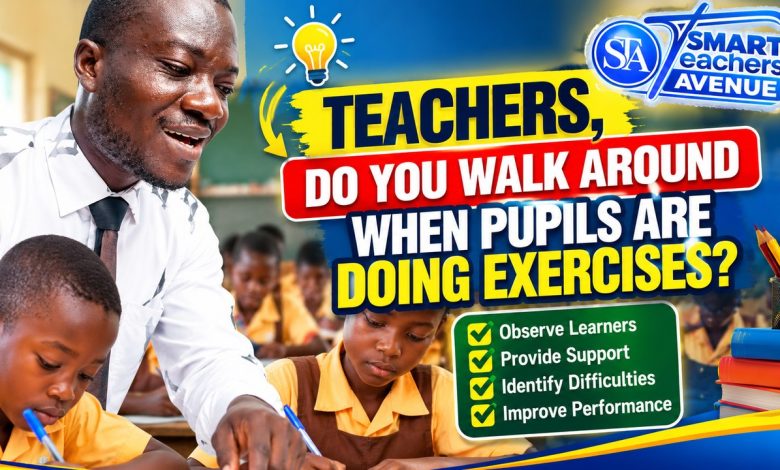
Giving exercises is an important part of teaching, but classroom monitoring and support are equally essential for effective learning. Teachers should not simply give pupils classwork and remain seated throughout the lesson. They must actively observe learners, identify difficulties, and provide assistance where necessary.
Effective teaching involves more than explaining a topic and assigning exercises. It requires teachers to pay attention to how pupils respond to instructions, approach activities, and apply what they have learned.
Through regular classroom monitoring and support, teachers can identify learning difficulties early, encourage participation, and help pupils develop a better understanding of classroom activities.
The simple habit of moving around the classroom can make a meaningful difference in the teaching and learning process.
WHY CLASSROOM MONITORING AND SUPPORT MATTER IN EFFECTIVE TEACHING
Classroom monitoring and support help teachers understand whether pupils are following the lesson and completing assigned activities correctly.
When a teacher moves around the classroom, it becomes easier to notice pupils who are struggling, losing concentration, or misunderstanding instructions.
Rather than waiting until pupils submit their work, teachers can identify problems while learning is still taking place.
This approach also communicates an important message to learners: the teacher is interested in their progress and is available to help them improve.
1. CLASSROOM MONITORING AND SUPPORT HELP IDENTIFY LEARNING DIFFICULTIES EARLY
Not every pupil understands a lesson at the same pace. Some learners may understand instructions immediately, while others may require further explanation or individual attention.
By moving around the classroom, teachers can observe how pupils approach their exercises and identify mistakes before they become persistent learning problems.
For example, a teacher who has asked pupils to solve Mathematics questions can move from desk to desk to check their working steps.
If a pupil is using the wrong method, the teacher can provide guidance before the pupil completes the entire exercise incorrectly.
This makes classroom monitoring and support a practical way of addressing learning difficulties as they arise.
2. CLASSROOM MONITORING AND SUPPORT ENCOURAGE PUPIL PARTICIPATION
Pupils are more likely to remain engaged when they know their teacher is paying attention to their work.
A teacher who moves around the classroom can encourage learners to concentrate, attempt difficult questions, and participate actively in assigned tasks.
Some pupils may hesitate to ask questions in front of their classmates. However, when the teacher approaches their desks, they may feel more comfortable explaining the difficulties they are experiencing.
This personal interaction can help create a more supportive learning environment.
Classroom monitoring and support therefore involve more than checking completed exercises. They also help teachers encourage learners who need additional motivation.
DETAILED LESSON PLANS & SCHEMES OF WORK
Get detailed lesson plans and Schemes of Work for Nursery, KG, Primary, JHS and SHS to help you prepare, plan and teach effectively.
3. CLASSROOM MONITORING AND SUPPORT PROVIDE OPPORTUNITIES FOR IMMEDIATE FEEDBACK
Feedback is most useful when pupils can apply it while they are still working on a task.
Instead of waiting until the end of the lesson to mark every exercise, teachers can provide brief explanations and corrections as they move around the classroom.
For instance, if a pupil misunderstands a question in Social Studies, the teacher can clarify the instruction and guide the pupil towards a better answer.
This helps learners recognise their mistakes and understand how to improve their work.
However, teachers should avoid simply giving pupils the correct answers. Where appropriate, they should ask guiding questions that encourage learners to think independently.

4. CLASSROOM MONITORING AND SUPPORT HELP TEACHERS ASSESS UNDERSTANDING
An exercise can show what a pupil has written, but observing the pupil while working can reveal how well the pupil understands the task.
Teachers can use classroom monitoring and support to assess learners’ progress during the lesson.
They can check whether pupils understand the instructions, apply the correct procedures, and complete activities independently.
These observations can also help teachers decide whether to explain a concept again, provide another example, or move on to the next stage of the lesson.
This makes classroom observation an important part of continuous assessment.
END-OF-TERM EXAMINATIONS FROM CRECHE TO SHS
Get quality End-of-Term Examination Questions with Marking Schemes for learners from Creche to SHS, carefully prepared to support effective assessment.
5. CLASSROOM MONITORING AND SUPPORT PROMOTE BETTER CLASSROOM MANAGEMENT
A teacher’s movement around the classroom can help maintain attention and encourage pupils to remain focused on their assigned activities.
When teachers are actively monitoring the class, they can notice distractions, off-task behaviour, and pupils who need redirection.
Early intervention may prevent minor distractions from affecting the learning of other pupils.
However, effective classroom monitoring and support should not be based on intimidation. Teachers should remain approachable, respectful, and fair to all learners.
The objective is to create an environment where pupils feel responsible for their learning and understand that the teacher is available to guide them.
6. CLASSROOM MONITORING AND SUPPORT HELP TEACHERS RESPOND TO INDIVIDUAL NEEDS
Every classroom contains learners with different strengths, abilities, and learning needs.
Some pupils may complete exercises quickly, while others may require additional time or more detailed explanations.
Moving around the classroom gives teachers opportunities to recognise these differences and respond appropriately.
A teacher may provide an additional example to a struggling learner while giving a more challenging question to a pupil who has completed the assigned work.
This helps make classroom activities more responsive to learners’ needs.
READ RELATED RESOURCES HERE: GHANA BASE PAY AGREEMENT 2027 AND 2028: 7 KEY FACTS EVERY TEACHER MUST KNOW
7. CLASSROOM MONITORING AND SUPPORT HELP IMPROVE LEARNING OUTCOMES
When teachers regularly observe pupils, identify mistakes, and provide timely assistance, learners receive more opportunities to correct misunderstandings.
The process also helps teachers evaluate whether their teaching methods are working as intended.
If several pupils make the same mistake, the teacher may need to revisit the explanation or use a different example.
If most pupils complete the exercise correctly, the teacher may proceed with greater confidence or introduce a more challenging activity.
Although classroom monitoring alone cannot guarantee higher academic performance, it can strengthen teaching by helping teachers respond to learners’ actual progress.
HOW TEACHERS CAN PRACTISE CLASSROOM MONITORING AND SUPPORT DAILY
Teachers can make classroom monitoring and support part of their normal teaching routine without introducing complicated procedures.
The following practical steps can help.
Before pupils begin their exercises
Explain the task clearly and ensure that pupils understand what they are expected to do.
Give examples where necessary and invite learners to ask questions before starting.
While pupils are working
Move around the classroom rather than remaining in one position throughout the activity.
Observe pupils’ work, check their progress, and identify those who need assistance.
Pay attention to both the answers pupils write and the methods they use to reach those answers.
When a pupil makes a mistake
Avoid embarrassing the pupil in front of classmates.
Instead, ask a guiding question, clarify the instruction, or demonstrate the correct approach using a similar example.
Allow the pupil to attempt the question again independently.
Before ending the activity
Review common errors and explain important points that pupils may have misunderstood.
Use your observations to determine whether further explanation, additional practice, or a follow-up activity is needed.
READ RELATED RESOURCES HERE: DISCIPLINE LEARNERS WITHOUT CANING: 7 POWERFUL STRATEGIES EVERY TEACHER SHOULD KNOW
CLASSROOM MONITORING AND SUPPORT: A SIMPLE DAILY CHECKLIST
Before concluding a lesson, teachers can ask themselves these questions:
- Did I move around the classroom while pupils were working?
- Did I observe how pupils approached the assigned exercises?
- Did I identify learners who needed additional assistance?
- Did I provide useful feedback where necessary?
- Did I check whether pupils understood their mistakes?
- Did I use my observations to plan the next stage of the lesson?
These questions can help teachers reflect on their practice and identify opportunities for improvement.
COMMON MISTAKES TEACHERS SHOULD AVOID
While classroom monitoring and support are important, teachers should ensure that their approach genuinely helps learners.
Remaining seated throughout the exercise: This can make it difficult to observe pupils’ progress and identify problems as they occur.
Checking only the answers: Correct answers do not always show how well pupils understand a concept. Observe their working methods and reasoning where appropriate.
Helping only struggling pupils: Teachers should monitor the whole class, including learners who complete activities quickly and those who appear confident.
Giving answers instead of guidance: Immediate assistance should encourage understanding rather than make pupils dependent on the teacher.
Embarrassing pupils when they make mistakes: Corrections should be respectful and constructive so learners remain willing to participate.
Waiting until the end of the lesson to identify every problem: When possible, address misunderstandings during the activity so pupils have an opportunity to improve immediately.
WHAT THIS MEANS FOR TEACHERS
The message is straightforward: giving exercises is not enough.
Teachers must also observe learners, check their progress, and provide support when necessary. Classroom monitoring and support make it easier to identify misunderstandings, encourage participation, and respond to learning needs during the lesson.
This does not mean teachers must stand beside every pupil throughout the entire activity. Rather, they should move purposefully around the classroom, observe learners’ work, and intervene when their assistance can make a difference.
For teachers who want to improve their classroom practice, this is a simple habit worth developing consistently.
READ RELATED RESOURCES HERE: LESSON PLAN VS LESSON NOTES: 7 CRUCIAL DIFFERENCES EVERY TEACHER MUST KNOW
CONCLUSION
Effective teaching goes beyond explaining lessons and assigning exercises. It also involves observing how pupils learn and responding to the difficulties they encounter.
By practising classroom monitoring and support, teachers can identify mistakes early, provide timely feedback, encourage participation, and make classroom activities more responsive to learners’ needs.
The next time you give pupils an exercise, do not simply sit and wait for them to finish. Move around, observe their work, ask questions, and offer assistance where needed.
Small changes in classroom practice can create more opportunities for meaningful learning.
Share your experience and ideas in the comments. Your strategy could help another teacher take the first step.
Follow Smart Teachers Avenue on Facebook, TikTok and YouTube for practical teacher development, professional growth and financial education.
YOU CAN CONTACT US ON ↓
📞 Phone: +233 503910155 / +233233910155
📧 Email: info.teachersavenue@gmail.com
💬 WhatsApp: Click Here To WhatsApp Us
Follow Smart Teachers Avenue and Stay connected with us for daily educational resources, financial education, teaching tips and school leadership insights.
📘 Facebook – FOLLOW HERE
🎵 TikTok – FOLLOW HERE
▶️ YouTube – SUBSCRIBE HERE
✈️ Telegram Channel – JOIN HERE
👥 Telegram Community Chat: – JOIN HERE
👥 Facebook Community Chat: – JOIN HERE
WhatsApp Channel – FOLLOW HERE for daily updates, teaching resources and exclusive educational content.
Join our growing community of teachers across Ghana and beyond who trust Smart Teachers Avenue as their preferred platform for teaching resources, professional development, financial education and school leadership.