

GHANA BASE PAY AGREEMENT 2027 AND 2028: 7 KEY FACTS EVERY TEACHER MUST KNOW
Ghana base pay agreement 2027 and 2028: Understand the 9% total remuneration increase for 2027, the 10% base-pay increase for 2028, and what the agreement means for teachers and public-service workers.

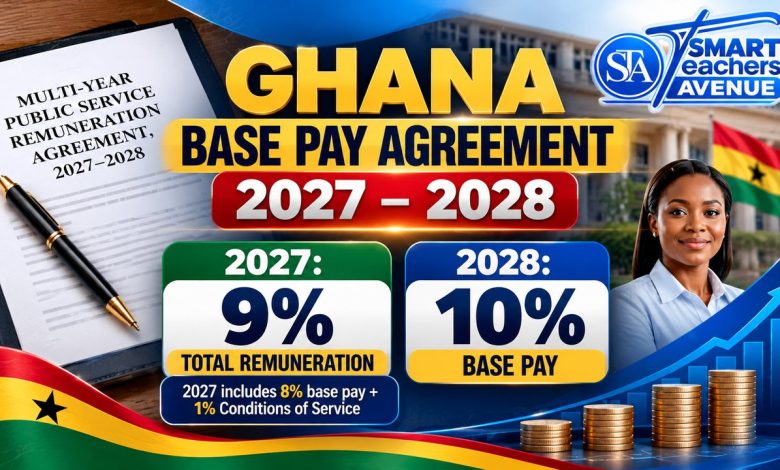
The Ghana base pay agreement 2027 and 2028 has brought an important development for teachers and other public-service workers. The Government of Ghana and Organised Labour have signed a two-year remuneration agreement outlining the pay adjustments scheduled for 2027 and 2028.
The agreement, dated 28 October 2026, establishes a framework intended to provide greater predictability in public-service remuneration while protecting workers’ incomes and supporting fiscal sustainability.
However, one important question remains: What do the agreed percentages actually mean for teachers and other workers?
The signed agreement provides for a 9% increase in total remuneration in 2027, comprising an 8-percentage-point increase in base pay and a 1-percentage-point allocation for Conditions of Service. For 2028, it provides for a 10% increase in base pay.
These figures are important, but workers must understand the distinction between total remuneration and base pay before drawing conclusions about their individual salaries.
GHANA BASE PAY AGREEMENT 2027 AND 2028: WHAT HAS BEEN AGREED?
The agreement was reached through the Public Services Joint Standing Negotiating Committee (PSJSNC).
The Government was represented by the Fair Wages and Salaries Commission (FWSC) and the Ministry of Finance, while Organised Labour represented workers’ unions and institutions within Ghana’s public service.
The document establishes a two-year remuneration framework covering 1 January 2027 to 31 December 2028.
Its main provisions concern remuneration increases, income protection, the review of selected allowances, institutional reforms and the resolution of disputes.
According to the agreement, the arrangement is intended to provide predictability and stability during the proposed transition from the FWSC to the Independent Public Emoluments Commission (IPEC), subject to the applicable legislative processes.
For teachers, the immediate priority is understanding the two different annual adjustments and following official implementation announcements.
GHANA BASE PAY AGREEMENT 2027 AND 2028: THE 2027 PAY INCREASE
Under the agreement, total remuneration will increase by 9% from 1 January 2027.
However, the entire 9% is not designated as a base-pay increase.
The agreement specifically allocates:
- 8 percentage points for an across-the-board increase in base pay.
- 1 percentage point for Conditions of Service.
This distinction matters because base pay and Conditions of Service are not interchangeable.
Workers should therefore avoid interpreting the 2027 agreement as a 9% increase in base pay alone. The document clearly separates the 8-percentage-point base-pay component from the additional allocation for Conditions of Service.
The agreement does not provide a detailed breakdown showing precisely how the Conditions of Service allocation will affect each worker or allowance. Further official information may be required to clarify the practical implementation of this component.
DETAILED LESSON PLANS & SCHEMES OF WORK
Get detailed lesson plans and Schemes of Work for Nursery, KG, Primary, JHS and SHS to help you prepare, plan and teach effectively.
GHANA BASE PAY AGREEMENT 2027 AND 2028: THE 2028 PAY INCREASE
The agreement provides for a 10% across-the-board increase in base pay from 1 January 2028.
Unlike the 2027 provision, which separates the base-pay adjustment from the Conditions of Service allocation, the 2028 provision specifically refers to an increase in base pay.
The 2028 adjustment will be calculated using the applicable base pay as of 31 December 2027.
This means workers should distinguish between the 2027 and 2028 calculations rather than treating the two percentages as identical adjustments.
The 10% figure is the agreed percentage increase in base pay for 2028. It does not mean every worker will receive the same additional amount in Ghana cedis, because workers may have different existing base salaries.
SEVEN KEY FACTS WORKERS SHOULD KNOW ABOUT THE AGREEMENT
1. The agreement covers two years
The remuneration framework runs from 1 January 2027 to 31 December 2028.
This gives the parties a two-year arrangement instead of negotiating a separate annual pay adjustment for each of those years.
2. The 2027 total remuneration increase is 9%
The 9% increase comprises an 8-percentage-point increase in base pay and a 1-percentage-point allocation for Conditions of Service.
Workers should understand this distinction when discussing the agreement or estimating their expected salary adjustments.
3. The 2028 base-pay increase is 10%
The agreement provides for a 10% increase in base pay, effective 1 January 2028.
The adjustment will be calculated using the applicable base pay at the end of 2027.
4. The agreement includes an inflation-related review mechanism
The parties considered inflation and the Government’s inflation projections when agreeing on the 2028 base pay.
The document states that the PSJSNC will reconvene to review the 2028 base pay if year-on-year inflation for December 2027 exceeds the specified trigger linked to the 8% midpoint of the Government’s inflation projection.
This provision is important because economic conditions can change. However, a review does not automatically mean that the agreed increase will be raised. The agreement provides for the parties to reconvene and review the position if the stated condition is met.
Workers should await official clarification and any subsequent decisions if the trigger becomes relevant.
5. Selected allowances will be reviewed
The agreement states that the transitional period will be used to review some allowances.
The purpose is to address distortions in the existing compensation arrangements before the implementation of IPEC.
This is an important area to watch because allowances form part of the broader compensation arrangements affecting public-service workers.
However, the signed document does not list every allowance to be reviewed or specify the individual changes that will result. Workers should not assume that a particular allowance has already been increased, reduced or abolished based on this provision alone.
READ RELATED RESOURCES HERE: DISCIPLINE LEARNERS WITHOUT CANING: 7 POWERFUL STRATEGIES EVERY TEACHER SHOULD KNOW
6. Public-service remuneration reforms will continue
The agreement commits the Government to pursuing a lawful and orderly transition from the FWSC to IPEC.
The proposed reforms include work on a National Emoluments Policy, a National Negotiations Policy and a performance- and productivity-linked pay framework.
These reforms are intended to shape the future administration of public-service remuneration.
The agreement also states that the FWSC and other existing bodies will retain their lawful functions until any transfer of authority takes legal effect.
Therefore, workers should not assume that the institutional transition has already been completed simply because it appears in the agreement.
END-OF-TERM EXAMINATIONS FROM CRECHE TO SHS
Get quality End-of-Term Examination Questions with Marking Schemes for learners from Creche to SHS, carefully prepared to support effective assessment.
7. Organised Labour will be consulted on reforms
The agreement provides for quarterly consultation with Organised Labour on reforms affecting workers.
It also commits the parties to constructive dialogue and peaceful resolution of disputes through established negotiation and lawful dispute-resolution procedures.
These provisions are intended to support industrial harmony during the agreement’s implementation.
For workers, continued consultation will be important in understanding how changes to remuneration, allowances and institutional arrangements are handled.

GHANA BASE PAY AGREEMENT 2027 AND 2028: WHAT DOES IT MEAN FOR TEACHERS?
Teachers are among the public-service workers who need to understand how the agreement’s provisions apply to their remuneration.
The most important point is that the agreement establishes percentage increases, not individual salary amounts for every teacher.
For example, a teacher earning a base salary of GH¢5,000 per month would, purely for illustration, have an 8% base-pay increase calculated as GH¢400, assuming GH¢5,000 is the applicable base salary and the adjustment is applied directly to that amount.
The resulting illustrative base salary would be GH¢5,400 before any other applicable changes or deductions.
This example is not an official salary projection. The actual amount for an individual teacher will depend on the applicable salary base, implementation arrangements and any relevant official instructions.
The 1-percentage-point allocation for Conditions of Service in 2027 must also be treated separately from the 8-percentage-point base-pay increase.
For 2028, the agreed 10% increase will be calculated using the applicable base pay at 31 December 2027.
Teachers should therefore wait for the relevant official salary schedules or implementation guidance before concluding exactly how much their monthly pay will change.
READ RELATED RESOURCES HERE: LESSON PLAN VS LESSON NOTES: 7 CRUCIAL DIFFERENCES EVERY TEACHER MUST KNOW
WHAT THE AGREEMENT DOES NOT YET TELL WORKERS
Although the agreement establishes the main remuneration framework, some practical details are not included in the two-page document.
These include:
- The exact new cedi salary for every teacher’s rank or salary step.
- A detailed breakdown of how the Conditions of Service allocation will be implemented.
- The specific allowances to be reviewed and the final outcome of those reviews.
- The final operational timetable for the proposed transition to IPEC.
- Any subsequent official instructions needed to implement the agreement in individual payroll calculations.
This does not mean that these matters will not be addressed. It means the signed agreement should not be treated as a complete individual salary schedule.
Workers should rely on official communications from the relevant authorities and their recognised unions for further implementation details.
READ RELATED RESOURCES HERE: GES PROMOTION ARREARS PAYMENT: 5 CRUCIAL UPDATES TEACHERS SHOULD KNOW
GHANA BASE PAY AGREEMENT 2027 AND 2028: WHAT SHOULD WORKERS DO NEXT?
Public-service workers should take three practical steps following the agreement.
First, understand the percentages correctly. The 2027 arrangement provides for a 9% increase in total remuneration, comprising an 8-percentage-point increase in base pay and a 1-percentage-point allocation for Conditions of Service. The 2028 arrangement provides for a 10% increase in base pay.
Second, follow official updates. Further communication may explain the implementation of Conditions of Service provisions, allowance reviews and individual salary calculations.
Third, avoid relying on unverified salary figures. Unless a calculation is based on the applicable salary structure and official implementation guidance, it should not be presented as the confirmed new salary of a teacher or another public-service worker.
The agreement sets out the commitments of the parties. Its practical effect on each worker will become clearer as implementation details are communicated.
CONCLUSION: GHANA BASE PAY AGREEMENT 2027 AND 2028
The Ghana base pay agreement 2027 and 2028 establishes a two-year remuneration framework for public-service workers, with an 8-percentage-point increase in base pay and a 1-percentage-point allocation for Conditions of Service in 2027, followed by a 10% increase in base pay in 2028.
It also includes provisions for reviewing selected allowances, responding to a specified inflation trigger and continuing public-service remuneration reforms.
For teachers, understanding the difference between the base-pay increase and the total remuneration increase is essential. The agreed percentages provide a framework, but the precise cedi amount each teacher will receive depends on the applicable salary base and implementation details.
As further official information becomes available, Smart Teachers Avenue will continue to share relevant updates to help teachers stay informed about salary matters, professional issues and developments affecting their welfare.
Stay informed. Understand the agreement. Follow verified updates.
Source: Multi-Year Public Service Remuneration Agreement, 2027–2028, dated 28 October 2026.
Share your experience and ideas in the comments. Your strategy could help another teacher take the first step.
Follow Smart Teachers Avenue on Facebook, TikTok and YouTube for practical teacher development, professional growth and financial education.
YOU CAN CONTACT US ON ↓
📞 Phone: +233 503910155 / +233233910155
📧 Email: info.teachersavenue@gmail.com
💬 WhatsApp: Click Here To WhatsApp Us
Follow Smart Teachers Avenue and Stay connected with us for daily educational resources, financial education, teaching tips and school leadership insights.
📘 Facebook – FOLLOW HERE
🎵 TikTok – FOLLOW HERE
▶️ YouTube – SUBSCRIBE HERE
✈️ Telegram Channel – JOIN HERE
👥 Telegram Community Chat: – JOIN HERE
👥 Facebook Community Chat: – JOIN HERE
WhatsApp Channel – FOLLOW HERE for daily updates, teaching resources and exclusive educational content.
Join our growing community of teachers across Ghana and beyond who trust Smart Teachers Avenue as their preferred platform for teaching resources, professional development, financial education and school leadership.


One Comment