HOW TO PROTECT LAND BEFORE BUILDING: 7 SMART WAYS TO AVOID LAND DISPUTES IN GHANA
How to Protect Land Before Building: Discover 7 practical ways to safeguard your land in Ghana, prevent disputes, and protect your investment even when you are not ready to build, fence, or develop it.

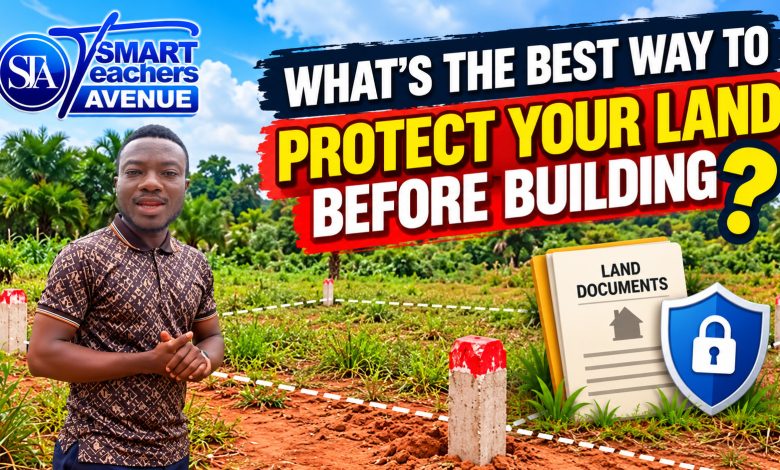
Imagine saving money for years, buying a plot of land, and planning to build your dream home in the future. You leave the land undeveloped because you are not financially ready to start construction.
A few months later, you visit the property and discover that someone has started building on it. Another person claims to own the same land. Suddenly, you are facing disagreements, legal expenses, and the possibility of a long dispute.
Unfortunately, concerns about land ownership and multiple sales make many people in Ghana worry about purchasing property.
This raises an important question: How can you protect land before building when you do not have the money to fence it, begin construction, or carry out expensive physical works?
Some people recommend digging holes, placing boundary markers, or fencing the property. Others argue that proper documentation is enough.
But what should you do when you cannot afford all these measures immediately?
This article explores practical steps that prospective homeowners, teachers, public sector workers, and other landowners can consider to protect their investments while waiting to build.
HOW TO PROTECT LAND BEFORE BUILDING: WHAT SHOULD YOU DO FIRST?
The first thing to understand is that protecting land involves more than placing physical markers on the property.
You need to establish that the land was properly acquired, keep reliable records, confirm its boundaries, and take reasonable steps to monitor it.
A fence may help show where a plot begins and ends, but it does not automatically prove ownership. Similarly, digging holes or placing objects on a plot cannot replace proper documentation and registration.
The safest approach is to combine legal verification, proper records, accurate boundary identification, and reasonable physical monitoring.
Let us examine seven practical steps you can take.
1. HOW TO PROTECT LAND BEFORE BUILDING THROUGH PROPER DOCUMENTATION
Proper documentation is one of the most important steps in protecting land.
When you purchase land, do not depend solely on verbal promises or the fact that you have paid the seller.
Ensure that the transaction is properly documented and that the documents accurately identify the land, the parties involved, and the nature of the interest being transferred.
Depending on the transaction, relevant records may include an indenture or other conveyance documents, a site plan prepared by a licensed surveyor, payment receipts, and supporting ownership documents.
You should also keep copies of correspondence and other evidence relating to the transaction.
However, possessing a document does not automatically mean that the transaction is valid or that the seller had the right to transfer the land.
That is why documentation must be accompanied by independent verification.
Practical tip: Keep your original documents in a secure place. Store scanned copies in a password-protected digital location and maintain a clear record of payments and communications.
2. HOW TO PROTECT LAND BEFORE BUILDING BY CONDUCTING AN OFFICIAL SEARCH
Imagine purchasing land from someone who appears trustworthy, only to discover later that the same property has been sold to another person.
This is one reason buyers should not rely exclusively on documents supplied by a seller.
Before completing a purchase, arrange the necessary checks through the appropriate offices of the Lands Commission. A competent property lawyer can help you determine the searches and verification required for your particular transaction.
An official search can provide information about registered interests and relevant records concerning the property. However, the search must be interpreted alongside the transaction documents and the actual location of the land.
If you have already purchased the property but have not completed the necessary checks, seek professional advice about the steps required to verify and protect your interest.
You can access the official website of the Lands Commission for information about its services.
READ RELATED RESOURCES HERE: CLASSROOM MONITORING AND SUPPORT: 7 POWERFUL WAYS TO IMPROVE TEACHING
3. HOW TO PROTECT LAND BEFORE BUILDING BY CONFIRMING THE BOUNDARIES
Knowing exactly where your land begins and ends is essential.
Some land disputes arise because buyers, neighbouring landowners, or other parties disagree about the location and extent of a plot.
A licensed surveyor can help identify the boundaries and prepare or verify the relevant site plan.
Where appropriate, the surveyor can help establish the boundary points on the ground in accordance with the approved plan and applicable requirements.
Do not simply rely on directions such as, “Your land starts from that tree and ends near the big stone.”
Trees, stones, and other informal landmarks may disappear or be moved over time.
Proper surveying gives you a more reliable basis for identifying the property.
If permanent boundary pillars or other approved markers are installed, do not move them casually. The Lands Commission warns that disturbing pillars on registered parcels can constitute an offence.
4. HOW TO PROTECT LAND BEFORE BUILDING WITHOUT FENCING IT IMMEDIATELY
Not everyone can afford to fence a plot immediately after purchasing it.
Construction materials, labour, transportation, and other expenses can make fencing financially difficult, particularly when the owner is still saving towards a future building project.
If you cannot fence the land now, you can still take other reasonable steps to protect your investment.
First, make sure the transaction has been properly documented and that you have undertaken the necessary verification.
Second, ensure that the plot has been accurately identified and that you know its boundaries.
Third, visit the property periodically to check its condition and observe whether there are signs of unauthorised activity.
Where possible, maintain a good relationship with trusted neighbours or responsible people in the area who may be able to alert you to unusual developments.
You may also consider affordable, lawful ways of keeping the plot identifiable, provided these do not interfere with neighbouring properties or violate local requirements.
However, remember that leaving the land unfenced does not automatically mean you will lose it, and fencing it does not automatically establish legal ownership.
Your circumstances, the nature of your land interest, and the measures you have taken all matter.
5. HOW TO PROTECT LAND BEFORE BUILDING BY VISITING IT REGULARLY
Buying land and disappearing for several years without checking it can leave you unaware of changes taking place around the property.
Regular visits allow you to observe the condition of the land and identify possible problems early.
For example, you may discover that someone has removed boundary markers, dumped materials on the plot, extended a neighbouring structure, or begun clearing the area without your permission.
Early awareness gives you an opportunity to seek advice and respond appropriately.
During your visits, keep dated photographs of the property and its identifiable boundaries where it is safe and lawful to do so.
Maintain a simple record of your visits and any concerns you notice.
Photographs and visit records can help document the condition of the land, although they do not independently establish ownership.
If you live far away from the property, arrange occasional visits with a trusted representative or a suitable professional.
Avoid confrontations with people you suspect of trespassing. If a serious dispute or threat arises, seek appropriate legal assistance and contact the relevant authorities when necessary.
DETAILED LESSON PLANS & SCHEMES OF WORK
Get detailed lesson plans and Schemes of Work for Nursery, KG, Primary, JHS and SHS to help you prepare, plan and teach effectively.
6. HOW TO PROTECT LAND BEFORE BUILDING BY KEEPING YOUR RECORDS UPDATED
Land ownership involves documents, payments, correspondence, and sometimes several administrative steps.
If you fail to organise these records, it may become difficult to establish what happened during the transaction or determine which steps remain outstanding.
Create a dedicated file for your land.
Your file may contain:
- The purchase agreement and relevant conveyance documents.
- The site plan and available survey records.
- Receipts and evidence of payments.
- Relevant search reports and registration documents.
- Correspondence with the seller, lawyer, surveyor, or other parties.
- Dated photographs and records of property inspections.
- Notes of any action taken to resolve concerns about the land.
Keep your contact details and transaction records current where required.
If registration is incomplete, find out what remains to be done rather than assuming that submitting paperwork means the process has finished.
For example, the Lands Commission distinguishes between the acknowledgement of submitted documents and completed registration. An acknowledgement slip should not be mistaken for proof that the registration process has been completed.
This is why checking the status of your application is important.
7. HOW TO PROTECT LAND BEFORE BUILDING BY SEEKING PROFESSIONAL HELP EARLY
Some landowners wait until a dispute has escalated before seeking assistance.
By then, the situation may be more expensive and difficult to resolve.
You do not have to wait until someone begins building on your plot before consulting a professional.
A property lawyer can help you understand your documents, assess the transaction, and advise you on appropriate steps to protect your interest.
A licensed surveyor can assist with boundary identification and related survey matters.
The Lands Commission can provide information about its search and registration services.
If you discover a possible fraudulent sale, unauthorised entry, or threat involving land guards, seek appropriate assistance from the police and other relevant authorities. Do not attempt to resolve dangerous situations through violence or personal confrontation.
Taking action early may help you understand your options before the problem becomes more serious.
READ RELATED RESOURCES HERE: DISCIPLINE LEARNERS WITHOUT CANING: 7 POWERFUL STRATEGIES EVERY TEACHER SHOULD KNOW
WHAT IF YOU CANNOT AFFORD PAPERWORK, FENCING, OR OTHER MEASURES RIGHT NOW?
This is the central concern for many people who purchase land while working towards other financial goals.
A teacher may buy a plot today but need several years to save enough to build. A public sector worker may purchase land while paying school fees, supporting a family, or repaying a loan.
In such situations, it is important to distinguish between measures that establish and protect a legal interest in land and measures that help monitor or identify the property physically.
If your budget is limited, consider the following priorities.
HOW TO PROTECT LAND BEFORE BUILDING ON A LIMITED BUDGET
First, verify what you have already done.
If you have purchased the land, review your existing documents and determine whether the transaction was properly completed. Do not pay for services you have already obtained without checking their status.
Second, identify any outstanding legal requirements.
Ask a qualified property lawyer or the appropriate Lands Commission office what remains necessary for your particular transaction. Requirements and costs may vary according to the land and the type of interest involved.
Third, prioritise essential verification and registration steps.
Do not assume that digging holes, putting up makeshift boundary markers, or leaving objects on the plot is a substitute for legal protection.
If you cannot afford every measure at once, seek advice on which outstanding steps are most important and plan your spending accordingly.
Fourth, arrange affordable monitoring.
Where practical, make periodic visits or arrange for a trusted person to notify you of significant changes. Keep records of what you observe.
Fifth, budget for further protection.
Create a realistic savings plan for any necessary surveying, registration, boundary work, or other appropriate measures that remain outstanding.
There is no universal, zero-cost method that guarantees protection against every land dispute. However, you can make informed decisions and avoid spending money on physical measures while overlooking essential legal issues.
DOES DIGGING HOLES OR FENCING LAND GUARANTEE OWNERSHIP?
No. Neither action automatically guarantees ownership.
Digging holes or placing markers may help identify a plot’s boundaries when carried out correctly and lawfully. Fencing can also make the boundaries more visible and discourage some forms of unauthorised access.
However, neither measure proves that the person undertaking the work legally owns the land.
A person could fence land that belongs to someone else. Similarly, physical markers could be placed on a property without a valid right to occupy or control it.
The legal basis of the transaction remains important.
For this reason, landowners should not choose between paperwork and physical protection as though only one is necessary. They serve different purposes.
Legal verification and documentation help establish and protect your interest; surveying helps identify the land; and appropriate physical measures can help monitor or secure the property.
The right combination depends on the circumstances of the transaction and the property.
END-OF-TERM EXAMINATIONS FROM CRECHE TO SHS
Get quality End-of-Term Examination Questions with Marking Schemes for learners from Creche to SHS, carefully prepared to support effective assessment.
A PRACTICAL LAND-PROTECTION CHECKLIST FOR FIRST-TIME BUYERS
Before you leave your newly purchased land undeveloped, ask yourself the following questions:
- Have I independently checked the seller’s authority to transfer the land?
- Have I obtained and reviewed the relevant transaction documents?
- Have I conducted the appropriate searches?
- Have I confirmed the location and boundaries with a competent surveyor?
- Have I completed the applicable registration requirements?
- Do I know where my original documents and digital copies are stored?
- Have I arranged a practical way to monitor the property?
- Do I know whom to contact if I discover a dispute or unauthorised activity?
If you cannot answer some of these questions, do not panic. Use them to identify the gaps you need to address.
READ RELATED RESOURCES HERE: DISCIPLINE LEARNERS WITHOUT CANING: 7 POWERFUL STRATEGIES EVERY TEACHER SHOULD KNOW
WHAT EVERY TEACHER AND PUBLIC SECTOR WORKER SHOULD REMEMBER
Buying land is a major financial decision. For many teachers and public sector workers, it represents years of saving, sacrifice, and planning for the future.
That is why protecting the investment should begin before construction starts.
Do not allow the desire to own land to push you into accepting unverified documents or relying entirely on verbal assurances.
At the same time, do not assume that you must immediately build a house or construct an expensive fence before taking meaningful steps to protect your interests.
Start by understanding what you purchased, verifying the transaction, identifying the boundaries, completing the appropriate formalities, and arranging reasonable monitoring.
If money is limited, seek professional guidance to prioritise the necessary steps rather than spending on physical works while important legal matters remain unresolved.
CONCLUSION: HOW TO PROTECT LAND BEFORE BUILDING IN GHANA
So, what is the best way to protect land before building?
The most responsible answer is to establish and protect your legal interest first, confirm the property’s boundaries, keep reliable records, and take reasonable steps to monitor the land.
Fencing may be useful. Boundary markers may be useful. Regular visits may also help.
However, none of these measures should replace proper verification and the applicable legal procedures.
If you have purchased land but are not yet ready to build, do not simply leave everything to chance. Find out whether your transaction is secure, identify any outstanding requirements, and make a practical plan to address them.
Your land may be waiting for your dream house, but protecting your investment should not have to wait until construction begins.
Share your experience and ideas in the comments. Your strategy could help another teacher take the first step.
Follow Smart Teachers Avenue on Facebook, TikTok and YouTube for practical teacher development, professional growth and financial education.
YOU CAN CONTACT US ON ↓
📞 Phone: +233 503910155 / +233233910155
📧 Email: info.teachersavenue@gmail.com
💬 WhatsApp: Click Here To WhatsApp Us
Follow Smart Teachers Avenue and Stay connected with us for daily educational resources, financial education, teaching tips and school leadership insights.
📘 Facebook – FOLLOW HERE
🎵 TikTok – FOLLOW HERE
▶️ YouTube – SUBSCRIBE HERE
✈️ Telegram Channel – JOIN HERE
👥 Telegram Community Chat: – JOIN HERE
👥 Facebook Community Chat: – JOIN HERE
WhatsApp Channel – FOLLOW HERE for daily updates, teaching resources and exclusive educational content.
Join our growing community of teachers across Ghana and beyond who trust Smart Teachers Avenue as their preferred platform for teaching resources, professional development, financial education and school leadership.