
BAREKESE DAM: 7 AMAZING FACTS ABOUT THE GHANA DAM SUPPLYING KUMASI’S DRINKING WATER
Barekese Dam is one of Ghana's most important water infrastructure projects, supplying a significant share of Kumasi's drinking water while offering visitors a fascinating look at engineering, history and tourism in the Ashanti Region.

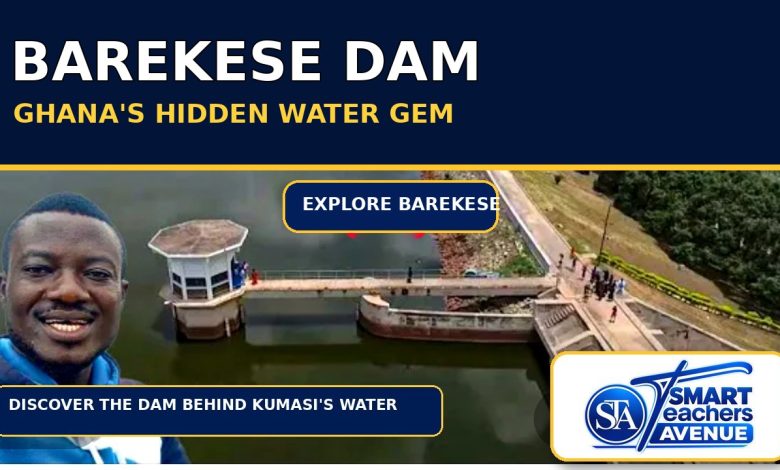
Barekese Dam is one of Ghana’s most important water infrastructure projects, yet many people who depend on its water may know very little about its history, engineering, operations and tourism potential.
Located at Barekese in the Ashanti Region, the dam sits across the Ofin River and supports a major water treatment facility serving Kumasi and surrounding communities.
In a new discovery journey, Smart Teachers Avenue, led by its team member Atta Smart, travelled to the Barekese Dam to explore its environment, walk through parts of the facility, learn about its history and observe how water infrastructure supports everyday life.
The visit revealed an impressive structure, a fascinating engineering environment and an important national asset that deserves greater public attention.
For many residents of Kumasi, the water that comes through their taps has a connection to this facility.
But what makes Barekese Dam so important?
BAREKESE DAM: THE WATER SOURCE THAT SUPPORTS KUMASI
The Barekese Dam is a major source of treated water for Kumasi and its surrounding communities.
The dam impounds water from the Ofin River, which is then conveyed to the Barekese Water Treatment Plant for processing before distribution through the water supply network.
According to information reported by MyJoyOnline in June 2025, the dam supplies approximately 80% of Kumasi’s drinking water.
This makes the Barekese Dam more than a large body of stored water. It is an essential part of the infrastructure that supports homes, schools, businesses, hospitals and other institutions across the metropolis.
The facility is operated by Ghana Water Company Limited, now known as Ghana Water Limited.
Its importance also explains why the protection of the river, reservoir and surrounding environment is necessary for the continued supply of water to the population.
BAREKESE DAM: A HISTORICAL PROJECT ASSOCIATED WITH DR. KWAME NKRUMAH
The history of the Barekese Dam goes back to Ghana’s early post-independence development period.
The project was initiated during the administration of Ghana’s first President, Dr Kwame Nkrumah.
Construction began in 1965, and the dam was completed in June 1969. The project was intended to improve water supply to Kumasi and its surrounding communities.
The Barekese Water Treatment Plant was subsequently commissioned in 1971.
The original development plan also considered electricity generation as part of the project’s intended benefits. However, the hydroelectric component described in the video has not been implemented as originally envisaged.
This historical background makes the Barekese Dam an important example of Ghana’s investment in major infrastructure during the early years of nation-building.
DETAILED LESSON PLANS & SCHEMES OF WORK
Get detailed lesson plans and Schemes of Work for Nursery, KG, Primary, JHS and SHS to help you prepare, plan and teach effectively.
Barekese Dam and Ghana’s early development vision
At the time, expanding access to reliable water was essential to the growth of Kumasi.
As the city developed, demand for treated water increased. The Barekese project therefore became an important addition to the existing water supply infrastructure, complementing the Owabi Water Treatment Plant.
Today, the Barekese Dam remains central to the water supply system serving the city.
BAREKESE DAM: WHAT VISITORS EXPERIENCE AT THE DAM SITE
One of the interesting aspects of Atta Smart’s discovery journey was the opportunity to explore the dam’s physical environment.
From the entrance, the team moved towards the dam site, where visitors could observe the surroundings and learn about the facility.
The environment also appeared to offer recreational opportunities.
During the visit, the team observed a volleyball court and other facilities that could make the location attractive to groups and visitors.
There was also a food service area where visitors could purchase meals, including fried rice, jollof rice, rice and soup, and tilapia.
Students were among the visitors present during the team’s tour.
Their presence showed that the Barekese Dam is not only an important water facility but also a place where educational visits can help people understand water infrastructure and its importance to society.
For students studying science, geography, environmental studies and technology, a visit to such a facility can provide valuable practical exposure.

Barekese Dam as an educational destination
A classroom lesson can explain how dams store water and how treatment plants process it.
However, seeing the structures, pipelines, treatment facilities and reservoir environment can make those lessons easier to understand.
The Barekese Dam therefore offers an opportunity for educational institutions to connect classroom learning with real-world infrastructure.
END-OF-TERM EXAMINATIONS FROM CRECHE TO SHS
Get quality End-of-Term Examination Questions with Marking Schemes for learners from Creche to SHS, carefully prepared to support effective assessment.
BAREKESE DAM: THE TUNNEL THAT LEADS VISITORS INTO THE DAM STRUCTURE
One of the most striking parts of the discovery journey was the team’s exploration of a building that provides access towards the interior section of the dam.
Atta Smart described the entrance as somewhat intimidating because of its appearance and the limited lighting in certain sections.
The team proceeded through the passage, which contained large pipes and other infrastructure associated with the movement of water.
The experience offered a closer look at the engineering systems that support the facility.
The passage eventually led towards an elevated platform from which the team could observe the reservoir.
The climb involved navigating metal stairs and an elongated walkway.
Although the experience appeared challenging, it gave the team a different perspective of the structure.
Instead of viewing the dam only from the outside, visitors could appreciate some of the engineering arrangements that make its operation possible.
What the large pipes at Barekese Dam do
The large pipes observed during the visit form part of the infrastructure used to convey water through the system.
Water must be transported from the source to the treatment facilities and then through transmission and distribution networks before reaching consumers.
These systems require careful engineering, maintenance and monitoring.
The experience therefore highlighted an important point: supplying water to a large city involves much more than collecting water from a river.
BAREKESE DAM: THE RESERVOIR AND ITS IMPRESSIVE SCALE
After navigating the passage and climbing towards the elevated platform, the team obtained a clearer view of the reservoir.
The water occupied an extensive area, creating an impressive view from the team’s position.
The Barekese reservoir is an earth-filled structure with rock protection. Research on the water supply system describes the reservoir as approximately 600 metres long, with an original storage capacity of about 35.3 million cubic metres.
These figures help explain the scale of the infrastructure and the amount of water the reservoir was designed to hold.
The reservoir is also connected to a wider water supply system that includes pumping infrastructure, treatment facilities and transmission pipelines.
For visitors, the size of the reservoir provides an opportunity to appreciate the engineering involved in developing and maintaining a major water supply project.
BAREKESE DAM: HOW MUCH WATER DOES THE FACILITY PRODUCE?
One of the most important questions about the Barekese Dam concerns its water production capacity.
During the video, Atta Smart shared technical information indicating that the treatment facility was producing approximately 109,000 cubic metres of treated water per day at the time of the information cited in the recording.
The video also referred to a higher design capacity of approximately 220,000 cubic metres per day.
These figures should not be confused.
The design capacity represents the amount of water the system was designed to produce under the relevant operating conditions. Actual production depends on the available raw water, treatment infrastructure, electricity supply, equipment condition and other operational factors.
A Greater Kumasi development study published by the Land Use and Spatial Planning Authority lists the Barekese Water Treatment Plant’s capacity at 110,000 cubic metres per day in the data used for that study.
This illustrates why production figures must always be associated with their reporting period and the particular measure being discussed.
Barekese Dam and the water treatment process
Water from the reservoir is processed at the treatment plant before it enters the distribution system.
The treatment process is necessary to make raw water suitable for its intended use.
The facility forms part of the wider infrastructure that delivers treated water through pipelines and storage facilities towards Kumasi and its surrounding communities.
Without these treatment and distribution arrangements, the reservoir alone would not be sufficient to provide safe drinking water to consumers.
READ RELATED RESOURCES HERE: THE MYSTERY OF GHANA’S GOLD-BACKED FISH: ATTA SMART DISCOVERS THE SACRED ANYINASU RIVER IN ASHANTI REGION
BAREKESE DAM: THE WATER TREATMENT CENTRE BEHIND KUMASI’S WATER SUPPLY
After exploring the dam structure, the Smart Teachers Avenue team continued towards the water treatment centre.
This was another important part of the discovery because it showed what happens after water is collected from the reservoir.
The team observed buildings, tanks, pipes and other infrastructure within the treatment facility.
The video also highlighted the presence of Ghana Water Company infrastructure and electrical installations around the site.
Water treatment is a critical stage in the supply process.
Raw water collected from a natural source must undergo appropriate treatment before it can be distributed for public consumption.
The treated water is then conveyed through pipelines to storage and distribution facilities before reaching homes and other consumers.
Why the Barekese Dam treatment centre matters
The treatment centre connects the natural water source to the needs of a growing urban population.
Its operation requires technical expertise, equipment, electricity, maintenance and effective management.
The facility therefore represents an important part of Ghana’s public infrastructure and the professionals responsible for keeping essential services running.
BAREKESE DAM: THE HYDROPOWER PLAN THAT REMAINS UNIMPLEMENTED
Another interesting detail raised during the discovery journey concerns the original intention to use the project for both water supply and electricity generation.
The project was initially conceived with water supply and hydropower as intended benefits.
However, the video explains that the hydroelectric component was not implemented as originally planned.
This is an important part of the dam’s history because it raises questions about how infrastructure projects evolve over time and how their intended purposes can change during implementation.
The dam’s contribution to water supply is substantial, but the electricity-generation component remains a separate historical ambition rather than an operational benefit that visitors should assume is available today.
READ RELATED RESOURCES HERE: AFIA KOBI AMPEM SHS ENGINEERING CLUB: 7 AMAZING INNOVATIONS BY STUDENTS UNDER A GEOGRAPHY TEACHER
BAREKESE DAM: A TOURISM ATTRACTION WITH MORE POTENTIAL
The Barekese Dam is primarily important for water supply, but it also has tourism and educational potential.
The Ashanti Regional Coordinating Council identifies the Barekese Dam among the tourism attractions in the Atwima Nwabiagya North area.
In June 2025, MyJoyOnline reported that the Member of Parliament for Atwima Nwabiagya North had called for the development of Barekese and Owabi dams into tourist destinations.
The Minister of Tourism, Arts and Culture also acknowledged the eco-tourism potential of the sites and discussed improvements such as access roads, information centres, toilets, parking areas and nature trails.
These developments could make the sites more accessible and improve the experience for visitors.
The Barekese Dam already attracts students and other visitors who want to learn about its history and infrastructure.
With appropriate planning, it could become an even more valuable destination for educational tourism and nature-based visits.
What could make Barekese Dam more attractive to visitors?
Several improvements could strengthen its tourism potential:
- Better visitor access and clear directional signs.
- Information boards explaining the dam’s history and operations.
- Safe and clearly marked visitor routes.
- Proper sanitation facilities and parking areas.
- Guided educational tours for schools and institutions.
- Responsible management of the surrounding environment.
Any tourism development must also respect the dam’s primary purpose as a critical public water supply facility.
Visitor activities should be organised in coordination with the relevant authorities to protect the infrastructure and maintain safety.
BAREKESE DAM: HOW TO VISIT FROM KUMASI AND OTHER PARTS OF GHANA
During the visit, Atta Smart also shared practical directions for people interested in exploring the facility.
According to the video, visitors travelling from Kumasi can take transport towards Barekese and ask for the dam.
Those travelling from the northern part of Ghana or through Offinso can also travel towards Kumasi and connect through the appropriate transport route to Barekese.
The video describes the journey from Offinso to Barekese as taking approximately 10 to 15 minutes by road, although actual travel time will depend on the starting point and road conditions.
Visitors should confirm current transport arrangements and access requirements before making the journey.
Because the Barekese Dam is an operational water infrastructure facility, visitors should follow all instructions from the authorities and avoid entering restricted areas without permission.
READ RELATED RESOURCES HERE: YOUNG GHANAIAN ARTIST: 5 INSPIRING THINGS TO KNOW ABOUT GREAT PENCIL’S EXTRAORDINARY TALENT
BAREKESE DAM: THE CHALLENGES OF PROTECTING A CRITICAL WATER RESOURCE
The importance of the Barekese Dam also means that it must be protected.
Water supply infrastructure faces several challenges, including pollution, sediment accumulation, power interruptions and increasing demand.
Recent reporting by MyJoyOnline in April 2026 highlighted operational difficulties affecting water production at the Barekese and Owabi treatment plants.
The report cited electricity fluctuations and sediment-related challenges among the issues affecting production in the Ashanti Region.
This demonstrates that the continued operation of the Barekese Dam requires more than the existence of a reservoir.
The catchment area must be protected, the treatment facilities maintained and the infrastructure supported with reliable power and adequate investment.
Pollution prevention is also important because the quality of raw water influences the treatment process.
Communities, authorities and other stakeholders therefore have a shared responsibility to protect the water resource.
BAREKESE DAM: SMART TEACHERS AVENUE DISCOVERS AN IMPORTANT PART OF GHANA’S INFRASTRUCTURE
The discovery journey led by Atta Smart has brought attention to an important facility that many people may depend on without fully understanding.
Through the Smart Teachers Avenue discovery initiative, the team continues to explore Ghana’s remarkable destinations, historical places, public infrastructure, talented individuals and young entrepreneurs.
The visit to the Barekese Dam provided an opportunity to document an important part of the country’s water supply system and show viewers the scale of the infrastructure behind a service that many people use every day.
It also created an opportunity to highlight the relationship between engineering, education, environmental protection and tourism.
The discovery is a reminder that some of Ghana’s most important stories are not always found in popular entertainment destinations. They can also be found in the public infrastructure, communities and institutions that contribute to everyday life.
READ RELATED RESOURCES HERE: TALENTED STUDENT ARTIST: 7 INSPIRING DISCOVERIES ABOUT A YOUNG GHANAIAN WITH EXTRAORDINARY DRAWING SKILLS
CONCLUSION: BAREKESE DAM IS MORE THAN A RESERVOIR
The Barekese Dam is an important part of Kumasi’s water supply system and a significant infrastructure project in Ghana’s history.
From its development during the Nkrumah era to its role in supplying treated water to a growing urban population, the facility represents decades of investment in public infrastructure.
The discovery journey by Smart Teachers Avenue has provided a closer look at the dam, its reservoir, the engineering structures, the treatment centre and its potential as an educational and tourism destination.
As Ghana continues to expand its cities and develop its infrastructure, protecting facilities such as the Barekese Dam will remain essential.
The next time you turn on a tap in Kumasi, remember that behind that simple action is an extensive system of water sources, treatment facilities, pipelines and dedicated professionals.
Smart Teachers Avenue will continue discovering and sharing the places, people and developments that make Ghana and Africa worth exploring.
Share your experience and ideas in the comments. Your strategy could help another teacher take the first step.
Follow Smart Teachers Avenue on Facebook, TikTok and YouTube for practical teacher development, professional growth and financial education.
YOU CAN CONTACT US ON ↓
📞 Phone: +233 503910155 / +233233910155
📧 Email: info.teachersavenue@gmail.com
💬 WhatsApp: Click Here To WhatsApp Us
Follow Smart Teachers Avenue and Stay connected with us for daily educational resources, financial education, teaching tips and school leadership insights.
📘 Facebook – FOLLOW HERE
🎵 TikTok – FOLLOW HERE
▶️ YouTube – SUBSCRIBE HERE
✈️ Telegram Channel – JOIN HERE
👥 Telegram Community Chat: – JOIN HERE
👥 Facebook Community Chat: – JOIN HERE
WhatsApp Channel – FOLLOW HERE for daily updates, teaching resources and exclusive educational content.
Join our growing community of teachers across Ghana and beyond who trust Smart Teachers Avenue as their preferred platform for teaching resources, professional development, financial education and school leadership.