AFIA KOBI AMPEM SHS ENGINEERING CLUB: 7 AMAZING INNOVATIONS BY STUDENTS UNDER A GEOGRAPHY TEACHER
The Afia Kobi Ampem SHS Engineering Club is turning students' curiosity into practical engineering projects, including drones, model aircraft, rescue boats and innovative designs. Discover the teacher inspiring this remarkable initiative and the support the students need to go further.

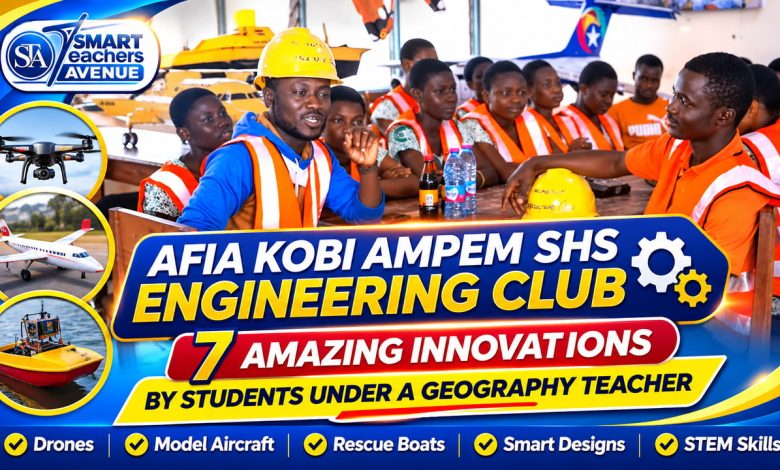
Afia Kobi Ampem SHS Engineering Club is challenging the idea that students must study engineering-related subjects before they can develop an interest in engineering and technology.
At Afia Kobi Ampem Senior High School in the Ashanti Region of Ghana, a Geography teacher has brought students together to explore engineering, technology, creativity and practical problem-solving.
What makes the initiative particularly interesting is the diversity of the students involved. They come from different academic programmes, including General Arts, Home Economics, Business, Geography and General Science.
Yet, they are working together to design and develop model aircraft, drones, boats and other engineering projects.
The initiative is being led by a teacher identified in the interview as Mr Ferdinand, whose personal interest in engineering has become an opportunity to expose young people to practical skills.
AFIA KOBI AMPEM SHS ENGINEERING CLUB: HOW A TEACHER TURNED HIS PASSION INTO A STUDENT MOVEMENT
The story begins with a teacher who has always been interested in working with his hands and understanding how things are designed and built.
During the interview, Mr Ferdinand explained that his interest in engineering started during childhood. He had hoped to pursue a career connected to engineering and aviation, but his educational journey eventually led him into Geography.
Rather than abandoning his interest, he continued learning and developing his knowledge of engineering.
When he joined Afia Kobi Ampem Senior High School, he saw an opportunity to introduce students to practical technology and engineering activities.
His motivation was simple: if he had not received the opportunity to pursue his original dream in the way he had hoped, he could help expose the next generation to possibilities they might otherwise never discover.
That thinking became the foundation of the Afia Kobi Ampem SHS Engineering Club.
He wants to raise young engineers who can contribute to Ghana, Africa and the wider world.
DETAILED LESSON PLANS & SCHEMES OF WORK
Get detailed lesson plans and Schemes of Work for Nursery, KG, Primary, JHS and SHS to help you prepare, plan and teach effectively.
AFIA KOBI AMPEM SHS ENGINEERING CLUB: ENGINEERING IS NOT ONLY FOR SCIENCE STUDENTS
One of the most remarkable aspects of the initiative is its inclusive approach.
The club does not restrict participation to students studying General Science.
Students from different academic programmes are encouraged to join if they have the passion and willingness to learn.
The teacher explained that the club brings together students with different abilities.
Some are better at computer-based design and simulation. Others are interested in electronics, wiring, physical construction and structural development.
By combining these abilities, the students can work together to develop projects that would be difficult for one person to complete alone.
This approach also gives students an opportunity to discover talents that might not be obvious through conventional classroom assessments.
AFIA KOBI AMPEM SHS ENGINEERING CLUB: 7 IMPRESSIVE PROJECTS STUDENTS ARE DEVELOPING
The students are not simply discussing engineering theories. They are exploring practical designs, building models and testing ideas.
Here are some of the projects showcased during the visit.
1. Model rockets and aerospace engineering
The club has an aerospace team working on model rockets.
According to the teacher, the students combine materials and chemicals as part of their rocket-development activities.
Their long-term ambition is to develop the capacity to launch a project into the stratosphere.
This is an ambitious goal that requires further development, technical knowledge, resources and testing.
The models currently being developed are part of the learning process towards that ambition.
2. A proposed room fire-suppression system
Another interesting project is a proposed fire-suppression design for buildings.
The concept involves installing water pipes around a building and positioning nozzles near the ceiling.
In the event of a fire, the system is intended to release water through the nozzles to help control the situation while people wait for emergency responders.
The idea is to explore a potentially more affordable approach using locally available materials, including PVC pipes.
However, this remains a student design concept. It should not be treated as a tested or certified fire-protection system.
Any real installation would require professional engineering assessment, appropriate testing and approval from the relevant fire-safety authorities.
3. A practical model of continental drift
The students have also developed a geographical learning model illustrating the movement of continents.
The model allows students to arrange landmasses like pieces of a jigsaw puzzle.
When fitted together, the continents demonstrate how their shapes correspond with the scientific explanation that Earth’s landmasses were once joined as part of a larger supercontinent.
This project connects Geography with practical model-making.
It also demonstrates how students can turn classroom concepts into learning materials that other students can use.
4. A smart-city design to reduce congestion
Urban planning is another area the students are exploring.
They have developed a model of a proposed smart-city layout designed to address problems associated with congestion and poor spatial organisation.
The design considers the arrangement of markets, shops, roads, parking spaces and pedestrian areas.
For instance, the proposed layout places a central market within a planned area, with different sections allocated for different categories of businesses and transportation.
The objective is to explore how better urban planning could reduce unnecessary movement, traffic congestion, fuel consumption and travel time.
5. Highway accident-reduction concepts
The club is also exploring ways to address road accidents.
During the interview, the teacher discussed the dangers of poor lane separation and unsafe driving practices, particularly on highways at night.
The students are examining possible design solutions to some of these road-safety challenges.
This project shows how engineering activities can be connected to everyday problems that affect Ghanaian communities.
6. Autonomous search-and-rescue watercraft
One of the most fascinating projects showcased was a model search-and-rescue watercraft.
The concept is intended to support rescue operations in situations involving drowning, flooding or missing objects underwater.
The teacher explained that the watercraft is designed to carry sensors and use sonar technology to detect objects beneath the water’s surface.
At the time of the interview, the students were still developing the electronic systems needed to make the craft operate autonomously.
The project demonstrates how robotics, electronics and engineering can be combined to explore solutions to real-life challenges.
7. Drones, model aircraft and unmanned aerial vehicles
Perhaps the most eye-catching part of the Afia Kobi Ampem SHS Engineering Club is its collection of model aircraft and drone-related projects.
The students have developed different aircraft models, including designs inspired by military aircraft and other aviation systems.
The teacher explained that unmanned aerial vehicles can have several applications, including:
- Agricultural monitoring.
- Mapping and surveying.
- Mining operations.
- Law enforcement.
- Delivery services.
- Search and rescue.
- Environmental monitoring.
One of the models showcased was designed with the possibility of carrying sensors or other equipment for different tasks.
The students also demonstrated how a model aircraft could be controlled remotely using a transmitter and receiver.
During the visit, the interviewer was given an opportunity to operate the controls and experience the aircraft’s movement.
This demonstration provided a practical look at how the students are exploring aviation technology.

END-OF-TERM EXAMINATIONS FROM CRECHE TO SHS
Get quality End-of-Term Examination Questions with Marking Schemes for learners from Creche to SHS, carefully prepared to support effective assessment.
AFIA KOBI AMPEM SHS ENGINEERING CLUB: HOW STUDENTS FROM DIFFERENT BACKGROUNDS WORK TOGETHER
The success of the initiative is not based on having students with identical academic backgrounds.
Instead, the club recognises that different students bring different strengths to a project.
Some students work on computer-aided designs and simulations before physical construction begins.
Others focus on the structural components, electronics, wiring and assembly.
The teacher explained that the students first develop their ideas and use design software to simulate how a project may perform.
This helps them identify possible problems and make adjustments before moving into actual production.
The approach gives students an opportunity to understand the relationship between planning, design, testing and construction.
It also encourages teamwork, communication and shared responsibility.
READ RELATED RESOURCES HERE: ERASMUS MUNDUS SCHOLARSHIP 2027: 7 POWERFUL STEPS TO APPLY FOR FULLY FUNDED MASTER’S STUDIES IN EUROPE
AFIA KOBI AMPEM SHS ENGINEERING CLUB: GIRLS ARE ALSO BUILDING THE FUTURE OF ENGINEERING
Another important feature of the initiative is the participation of female students.
During the interview, several girls spoke about their experiences and involvement in the club.
Gloria, who was introduced as the club’s coordinator, described the experience as exciting and rewarding.
She explained that she initially did not imagine herself building some of the projects they were now producing.
But through the activities, she had discovered new interests and abilities.
She also encouraged other girls to consider engineering rather than assuming it is exclusively for boys.
Her message was clear: girls can participate, learn and make meaningful contributions to engineering and technology.
The involvement of students from different academic programmes also challenges the assumption that only students with a Science background can explore engineering.
AFIA KOBI AMPEM SHS ENGINEERING CLUB: THE STUDENTS NEED MORE SUPPORT
Despite the progress showcased during the visit, the club faces several challenges.
The students explained that they need financial assistance, equipment, materials and a larger working space to expand their activities.
Some of the materials required for their projects are expensive or difficult to obtain locally.
The students mentioned items such as motors, propellers and other components that sometimes have to be imported.
They also explained that the existing workspace is too small for the number of students involved.
During the interview, one student indicated that the club had approximately 60 members.
A larger laboratory would allow more students to work together, share ideas and develop their projects in a more suitable environment.
The students are therefore appealing to individuals, companies, organisations and other institutions to support the initiative.
Their needs include:
- Financial assistance for project development.
- Engineering and robotics equipment.
- Motors, propellers and electronic components.
- Computers and design resources.
- A larger and better-equipped laboratory.
- Opportunities to visit engineering institutions and facilities.
- Mentorship and technical guidance.
- Opportunities for further education and professional development.
READ RELATED RESOURCES HERE: YOUNG GHANAIAN ARTIST: 5 INSPIRING THINGS TO KNOW ABOUT GREAT PENCIL’S EXTRAORDINARY TALENT
AFIA KOBI AMPEM SHS ENGINEERING CLUB: THE TEACHER’S BIGGER VISION
For Mr Ferdinand, the ambition goes beyond the projects currently being developed at the school.
He wants the students to have opportunities to progress beyond their current level of exposure.
He appealed to university lecturers, engineering professionals, international institutions, companies and organisations to support the students.
He is particularly interested in creating pathways through which students who complete their secondary education can continue developing their engineering skills.
He also expressed the hope that the initiative could eventually grow into a STEM hub where more young people could access practical learning opportunities and develop their ideas.
This vision is important because students who develop an interest in engineering at the secondary-school level need opportunities to continue learning after graduation.
Without further education, mentorship and access to resources, some of their abilities may remain undeveloped.
The Afia Kobi Ampem SHS Engineering Club therefore represents more than an extracurricular activity. It is an attempt to connect classroom learning with practical skills and future opportunities.
WHAT THIS DISCOVERY MEANS FOR TEACHERS AND SCHOOLS IN GHANA
The story offers an important lesson for teachers and school administrators.
Education should not be limited to preparing learners to memorise information and pass examinations.
Students also need opportunities to explore ideas, ask questions, experiment, collaborate and develop practical solutions.
A teacher does not necessarily need to be an expert in every field before encouraging students to explore new areas.
What matters is the willingness to create opportunities, guide learners and connect them with people who possess the necessary expertise.
The experience at Afia Kobi Ampem Senior High School also shows why schools should recognise talents that may not always appear through conventional academic performance.
A student who may not be the best in a particular examination could have exceptional abilities in design, construction, creativity or problem-solving.
Schools need learning environments where these abilities can be discovered and developed.
AFIA KOBI AMPEM SHS ENGINEERING CLUB: HOW YOU CAN SUPPORT THE STUDENTS
The students and their teacher are appealing to the public to help them take their work to the next level.
Individuals with engineering experience, educational institutions, companies, technology organisations and potential sponsors can contribute in different ways.
Support does not necessarily have to come in the form of money.
Technical mentorship, access to equipment, professional training, laboratory resources and opportunities to visit relevant institutions could also make a difference.
The teacher also emphasised the importance of social support and professional connections in creating opportunities for the students.
For organisations working in engineering, aviation, robotics, technology and STEM education, this initiative may provide an opportunity to engage with young people who are already developing an interest in these fields.
READ RELATED RESOURCES HERE: TALENTED STUDENT ARTIST: 7 INSPIRING DISCOVERIES ABOUT A YOUNG GHANAIAN WITH EXTRAORDINARY DRAWING SKILLS
FINAL THOUGHTS: A TEACHER’S PASSION IS OPENING NEW DOORS FOR STUDENTS
The story of the Afia Kobi Ampem SHS Engineering Club is a reminder that talent can emerge from unexpected places.
A Geography teacher has used his passion for engineering to introduce students from different academic backgrounds to practical technology and innovation.
The students are exploring aircraft models, drones, rescue watercraft, urban planning designs and other engineering concepts.
They still need resources, mentorship, equipment and opportunities to develop their work further.
But their journey has already demonstrated the value of curiosity, teamwork and practical learning.
For teachers across Ghana, the lesson is worth considering: sometimes, the most important thing we can do for a learner is to help them discover what they are capable of becoming.
For the public, the students’ appeal is equally important. They need encouragement and meaningful support to continue developing their ideas.
The next generation of engineers may already be sitting in our classrooms. We must give them the opportunity to discover, create and grow.
Share your experience and ideas in the comments. Your strategy could help another teacher take the first step.
Follow Smart Teachers Avenue on Facebook, TikTok and YouTube for practical teacher development, professional growth and financial education.
YOU CAN CONTACT US ON ↓
📞 Phone: +233 503910155 / +233233910155
📧 Email: info.teachersavenue@gmail.com
💬 WhatsApp: Click Here To WhatsApp Us
Follow Smart Teachers Avenue and Stay connected with us for daily educational resources, financial education, teaching tips and school leadership insights.
📘 Facebook – FOLLOW HERE
🎵 TikTok – FOLLOW HERE
▶️ YouTube – SUBSCRIBE HERE
✈️ Telegram Channel – JOIN HERE
👥 Telegram Community Chat: – JOIN HERE
👥 Facebook Community Chat: – JOIN HERE
WhatsApp Channel – FOLLOW HERE for daily updates, teaching resources and exclusive educational content.
Join our growing community of teachers across Ghana and beyond who trust Smart Teachers Avenue as their preferred platform for teaching resources, professional development, financial education and school leadership.