
THE BIG MISTAKE: WHY TEACHERS STRUGGLE TO BUILD THEIR HOUSES
Why teachers struggle to build their houses often comes down to unrealistic building plans, financial pressure, poor budgeting and the failure to build within their means.

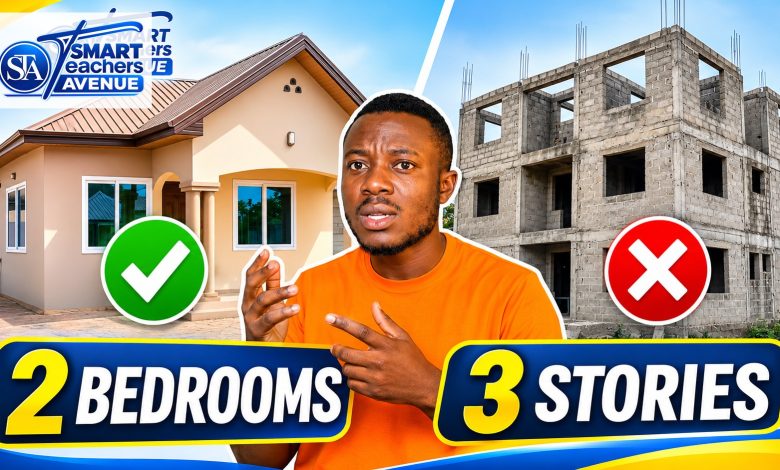
For many teachers, owning a house is one of the biggest dreams in life. But why teachers struggle to build their houses, even after years of working and earning a monthly salary, is a question worth examining.
The dream of owning a house is understandable. However, the approach many people take towards construction can turn what should be a major achievement into years of financial pressure, unfinished projects and frustration.
According to financial educator and Smart Teachers Avenue lead mentor, Atta Smart, one major mistake teachers make is starting construction projects that are far beyond their financial capacity.
WHY TEACHERS STRUGGLE TO BUILD THEIR HOUSES: THE BIGGEST MISTAKE
One of the biggest reasons teachers struggle to build their houses is the desire to start with a building project that is simply too expensive to complete.
Some teachers begin with ambitious plans for large houses, multi-storey buildings or extensive structures without first considering how much money they can realistically invest in the project.
The problem is not necessarily the dream of building a large house. The problem is starting a project without a financial plan that can sustain it.
A building project can consume savings, salaries and other financial resources for years. When the project is bigger than the owner’s capacity, it becomes difficult to make meaningful progress.
This is why teachers need to assess their financial position before laying the foundation.
WHY TEACHERS STRUGGLE TO BUILD THEIR HOUSES WHEN THEY IGNORE THEIR INCOME
Atta Smart points out that teachers must be realistic about their monthly earnings and financial responsibilities.
A teacher earning GH₵3,000, GH₵4,000 or GH₵5,000 a month cannot simply commit the entire salary to construction.
That same income must take care of food, transportation, family needs, bills, emergencies and other responsibilities.
Starting a massive building project without considering these expenses can put a teacher under serious financial pressure.
The question is not simply, “How beautiful do I want my house to be?”
The more important question is, “How much can I comfortably afford to build without putting my entire life under financial stress?”
END-OF-TERM EXAMINATIONS FROM CRECHE TO SHS
Get quality End-of-Term Examination Questions with Marking Schemes for learners from Creche to SHS, carefully prepared to support effective assessment.
WHY TEACHERS STRUGGLE TO BUILD THEIR HOUSES: START SMALLER
Instead of beginning with a huge project, teachers are encouraged to consider a smaller, manageable building.
A two- or three-bedroom self-contained house could be a more practical starting point, depending on the individual’s financial strength, family size and available resources.
Starting smaller does not mean abandoning your dream.
It means giving yourself the opportunity to complete what you start, gain experience and build confidence.
Once you successfully complete a smaller building project, you will have a better understanding of construction, materials, labour, budgeting and the challenges involved.
That experience can become valuable when you decide to undertake a bigger project in the future.
WHY TEACHERS STRUGGLE TO BUILD THEIR HOUSES: BUILD WITH A PLAN
Before construction begins, teachers should take time to understand the cost of the project.
Do not rush simply because you have acquired land or because friends and colleagues are already building.
First, find out how much the materials will cost.
Consider cement, iron rods, blocks, sand, stones, roofing materials, electrical works, plumbing, doors, windows and other essential items.
You must also consider the cost of workmanship. The cost of hiring artisans and paying workers can significantly affect your budget.
When you have a realistic estimate, you can determine what you can afford to do at a particular time.
Rather than starting everything at once, you can plan construction in stages.
This approach helps you make progress without unnecessarily exhausting your income or borrowing beyond your capacity.
WHY TEACHERS STRUGGLE TO BUILD THEIR HOUSES: KNOW THE COST BEFORE YOU START
Having a building plan is not enough.
You need to understand the financial demands of turning that plan into a completed house.
Teachers should make proper enquiries about the prices of building materials and the cost of labour before starting construction.
They should also leave room for unexpected expenses because construction costs can change.
A realistic building budget helps you avoid the frustration of starting a project and abandoning it because you can no longer afford the next stage.
DETAILED LESSON PLANS & SCHEMES OF WORK
Get detailed lesson plans and Schemes of Work for Nursery, KG, Primary, JHS and SHS to help you prepare, plan and teach effectively.
WHY TEACHERS STRUGGLE TO BUILD THEIR HOUSES WHEN THEY DEPEND ONLY ON SALARIES
Building a house using only your monthly salary can be extremely challenging.
Your salary is already responsible for several other needs. Depending entirely on it for construction may slow down your progress and leave little room for emergencies.
This is why Atta Smart also encourages teachers to consider additional sources of income.
A suitable side business can provide extra money to support construction, reduce the pressure on the monthly salary and help a teacher make progress towards homeownership.
However, not every business is suitable for every teacher.
The fact that another person is making money from a particular business does not automatically mean you should invest in it.
You need to understand your strengths, your interests, your available time, your skills and your financial capacity before choosing a business.
READ RELATED RESOURCES HERE: MR YANKS VEGETABLE FARMING JOURNEY: HOW GH₵1 GREW INTO A 20-ACRE FARM
WHY TEACHERS STRUGGLE TO BUILD THEIR HOUSES: CHOOSE THE RIGHT SIDE BUSINESS
Before investing in any side business, take time to understand how it works.
Ask people who are already operating the business.
Find out the capital required, the possible risks, the challenges, the expected returns and the practical steps involved in getting started.
Do not invest your money simply because everyone around you is doing the same thing.
A business that works well for one person may not necessarily work well for another.
Teachers should choose businesses they can understand and manage without allowing them to negatively affect their teaching responsibilities, personal lives or financial stability.
WHY TEACHERS STRUGGLE TO BUILD THEIR HOUSES: THINK LONG-TERM
Atta Smart also encourages teachers to see land and property as long-term investments.
If you have already acquired a plot of land, the next step does not necessarily have to be a large building project.
You can begin with a manageable structure that suits your finances and gradually improve it as your financial situation becomes stronger.
A completed house can serve several purposes.
You may eventually live in it with your family, or you may rent it out and generate additional income.
For teachers who are thinking about retirement and long-term financial security, property can become an important part of their investment plans.
But the journey should be strategic.
You do not have to finish everything in one year. You do not have to compete with anybody. And you do not have to sacrifice your financial peace just to prove that you are building.
WHY TEACHERS STRUGGLE TO BUILD THEIR HOUSES: YOUR FINANCIAL CAPACITY MATTERS
Every teacher has a different financial situation.
Some have additional income. Others have family responsibilities, loans, dependants or other financial commitments.
Your building plan should reflect your own situation, not the lifestyle or construction project of another person.
The smartest building project is not necessarily the biggest one.
It is the project you can realistically manage, finance and complete without destroying your financial stability.
READ RELATED RESOURCES HERE: GES AND SPECIAL OLYMPICS GHANA RENEW PARTNERSHIP TO STRENGTHEN INCLUSIVE EDUCATION
WHY TEACHERS STRUGGLE TO BUILD THEIR HOUSES: THE LESSON TO LEARN
The message from Atta Smart is a reminder that financial decisions require planning, patience and discipline.
Building a house is a major undertaking. It requires more than enthusiasm, a beautiful architectural design or the desire to own property.
It requires a realistic budget, proper research, financial discipline and the ability to make decisions based on what you can afford.
Teachers who want to build should avoid putting themselves under unnecessary pressure.
Start with what your finances can support. Understand the cost of materials. Consider workmanship. Make provision for unexpected expenses. Explore additional income opportunities that match your abilities.
And most importantly, do not start a project simply because you want to impress others.
A modest house that is completed and financially manageable may be a better achievement than a massive building that remains unfinished for years.
READ RELATED RESOURCES HERE: GHANAIAN DRONE INVENTOR BUILDS IMPRESSIVE DRONES AND ROBOTS FROM A SMALL ROOM IN ACCRA
A MESSAGE TO EVERY TEACHER PLANNING TO BUILD
If you have acquired land and are planning to build, take a step back and assess your finances before beginning.
Ask yourself:
- How much money do I earn monthly?
- How much do I spend on my household and other responsibilities?
- How much can I consistently set aside for construction?
- What is the actual cost of the building I want to construct?
- Can I start with a smaller structure and expand later?
- Do I have an additional source of income that can support the project?
These questions can help you make more informed decisions and prevent avoidable financial mistakes.
Your dream of owning a house is valid. But your financial stability matters, too.
Build wisely. Start within your means. Plan for the future.
This discovery and financial education message was shared by Atta Smart, lead mentor of Smart Teachers Avenue, who provides teachers with practical financial education, guidance and strategies for making better financial decisions.
Share your experience and ideas in the comments. Your strategy could help another teacher take the first step.
Follow Smart Teachers Avenue on Facebook, TikTok and YouTube for practical teacher development, professional growth and financial education.
YOU CAN CONTACT US ON ↓
📞 Phone: +233 503910155 / +233233910155
📧 Email: info.teachersavenue@gmail.com
💬 WhatsApp: Click Here To WhatsApp Us
Follow Smart Teachers Avenue and Stay connected with us for daily educational resources, financial education, teaching tips and school leadership insights.
📘 Facebook – FOLLOW HERE
🎵 TikTok – FOLLOW HERE
▶️ YouTube – SUBSCRIBE HERE
✈️ Telegram Channel – JOIN HERE
👥 Telegram Community Chat: – JOIN HERE
👥 Facebook Community Chat: – JOIN HERE
WhatsApp Channel – FOLLOW HERE for daily updates, teaching resources and exclusive educational content.
Join our growing community of teachers across Ghana and beyond who trust Smart Teachers Avenue as their preferred platform for teaching resources, professional development, financial education and school leadership.