2 FINANCIAL MISTAKES TEACHERS MAKE THAT CAN HOLD THEM BACK
FINANCIAL MISTAKES TEACHERS MAKE CAN GO BEYOND HOW MUCH THEY EARN. FROM FAILING TO INVEST TO SAVING WITHOUT A CLEAR FINANCIAL PLAN, TWO HABITS DESERVE A CLOSER LOOK.


For many teachers, receiving a salary brings a familiar question: how can the money cover household expenses, transport, family responsibilities, school needs and other financial commitments until the next payday?
But according to Atta Smart of Smart Teachers Avenue, the conversation about teachers’ finances should go beyond the amount they receive every month. Teachers also need to examine what happens to the money after it enters their accounts.
In a recent Smart Teachers Avenue discussion, Atta Smart identified two financial mistakes teachers should pay attention to: failing to invest and relying on saving without considering how accumulated money might support longer-term financial goals.
His central message is that teachers should not think only about spending their salaries. They should also consider how to manage their income, build financial security and explore additional sources of income.
The discussion raises an important question: are teachers giving enough attention to what their money can do for their future?
FINANCIAL MISTAKES TEACHERS MAKE: WHY INVESTING MATTERS
The first mistake Ata Smart highlights is failing to invest.
According to the speaker, some teachers receive their salaries and immediately begin thinking about what they can purchase. Their attention goes to buying items, meeting expenses and consuming the money, with little consideration for setting aside a portion to support future financial goals.
Of course, teachers have genuine responsibilities. A salary must pay for food, accommodation, transport, family needs and other essential expenses. Spending money on these necessities is not itself a mistake.
The concern arises when every cedi is allocated to immediate consumption and nothing is deliberately set aside for future needs.
A teacher can work for many years, receive regular salaries and still struggle to build financial security if there is no plan for managing what comes in.
Atta Smart therefore encourages teachers to consider investing a portion of their income in opportunities they understand and can reasonably afford.
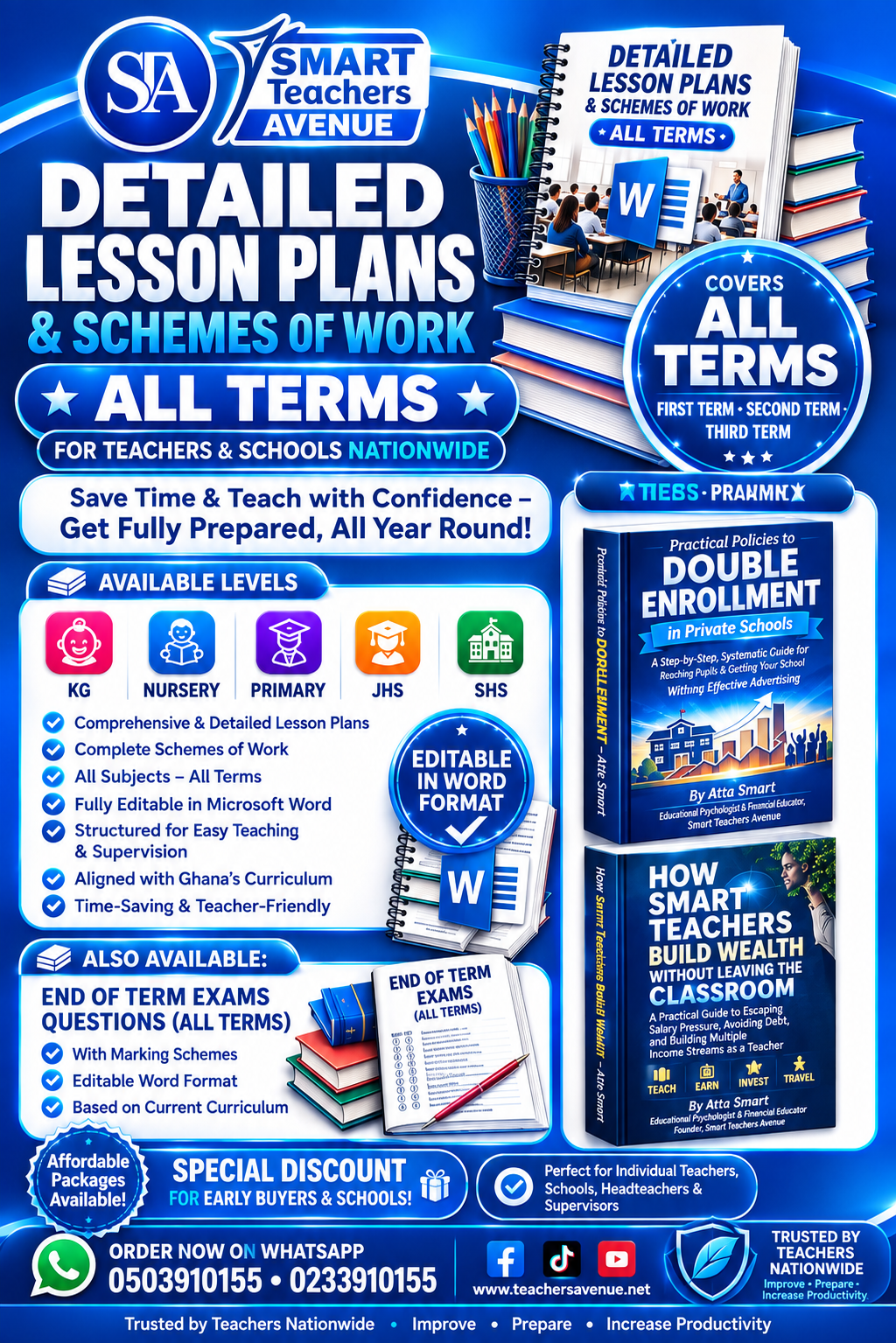
DETAILED LESSON PLANS & SCHEMES OF WORK
Get detailed lesson plans and Schemes of Work for Nursery, KG, Primary, JHS and SHS to help you prepare, plan and teach effectively.
YOUR SALARY SHOULD NOT BE YOUR ONLY FINANCIAL PLAN
A salary provides regular income, but it may not be enough to fund every major financial goal comfortably.
Consider a teacher who wants to acquire land, build a house, prepare for retirement and support their children’s education. Attempting to finance all these goals from monthly salary alone can place considerable pressure on the household budget.
This is why Atta Smart encourages teachers to think about additional income streams.
The idea is not to abandon teaching or to treat a salary as useless. Instead, teachers can explore whether part of their income, after essential expenses and appropriate savings, can be used to build assets or develop a suitable income-generating activity.
For one teacher, that might mean learning about regulated investment products. For another, it might involve developing a marketable skill or carefully planning a small business.
The appropriate choice depends on the person’s financial position, knowledge, available time, responsibilities and tolerance for risk.
READ MORE: HOW TEACHERS CAN EARN EXTRA INCOME BEYOND THEIR SALARY
DO NOT INVEST JUST BECAUSE SOMEONE ELSE IS MAKING MONEY
One important point should not be overlooked: investing does not automatically produce profit.
A business can fail. An investment can lose value. An asset can require maintenance and additional spending before it generates any income.
Teachers should therefore avoid committing money to an opportunity simply because a colleague, friend or person on social media claims to be making substantial returns.
Before investing, ask:
- How exactly does this investment or business generate income?
- What costs and risks are involved?
- How easily can I access my money if an emergency occurs?
- Do I understand the terms and conditions?
- Is the provider properly licensed or authorised where required?
The Securities and Exchange Commission Ghana has warned the public about fraudulent investment schemes, including operations that promise unusually high returns in a short time. Teachers should verify investment providers and avoid opportunities they do not understand. Read the SEC’s investment scam warning.
The lesson is not to rush into investing. It is to learn first, assess the risks and make informed decisions.
END-OF-TERM EXAMINATIONS FROM CRECHE TO SHS
Get quality End-of-Term Examination Questions with Marking Schemes for learners from Creche to SHS, carefully prepared to support effective assessment.
THE SECOND MISTAKE: SAVING WITHOUT A CLEAR FINANCIAL STRATEGY
The second issue raised by Atta Smart concerns saving.
At first, this may sound surprising. Teachers are often encouraged to save, and saving is an important part of responsible money management.
However, the speaker challenges teachers to think about what happens after they have accumulated a substantial amount of money.
Suppose a teacher gradually saves GH¢10,000 or GH¢25,000. What is the purpose of that money? Is it an emergency reserve, money for a planned expense, or capital intended for a future investment?
The answer matters because different financial goals require different approaches.
Saving is not the mistake. The problem is saving without understanding what the money is meant to achieve or what the next step should be.
READ RELATED RESOURCES HERE: TEACHER UNIONS STRIKE CONTINUES AFTER FWSC TALKS END WITHOUT AGREEMENT
SAVINGS AND INVESTMENTS SERVE DIFFERENT PURPOSES
Savings can provide a financial cushion when unexpected expenses arise. They can help teachers manage emergencies without immediately borrowing money or selling assets.
Investments, on the other hand, may help people pursue longer-term financial goals, but they involve different levels of risk, access and potential return.
For this reason, teachers should not assume that every cedi accumulated in savings should immediately be transferred into a business or investment.
A more considered approach is to determine how much should remain accessible for emergencies and upcoming expenses, then assess whether some money beyond those needs can be invested appropriately.
The Bank of Ghana’s financial literacy guidance on savings similarly notes that, after building sufficient capital through savings, individuals may consult a financial adviser about other opportunities, including Treasury bills, fixed deposits and certificates of deposit offered by banks.
READ THE BANK OF GHANA’S FINANCIAL LITERACY GUIDANCE ON SAVINGS.
SHOULD TEACHERS LEAVE ALL THEIR MONEY IN THE BANK?
Atta Smart questions the habit of accumulating money in a bank account without considering other financial options.
His point invites teachers to compare the purpose, terms and potential returns of different financial products rather than assuming that keeping all accumulated money in an ordinary savings account is always the best long-term strategy.
However, this does not mean that money held in a bank is wasted or that banks always offer poor returns. The outcome depends on the account or product, its interest rate, fees, terms and the person’s needs.
Teachers can ask their bank about available options, including fixed deposits, and learn how Treasury bills work. They should compare the terms carefully and understand when the money can be accessed, what returns are offered and what risks or charges may apply.
Treasury bills and fixed deposits are not identical products, and neither should be selected without understanding its conditions.
For official information on Treasury bill rates, teachers can consult the Bank of Ghana’s Treasury Bill Rates page.
The objective is to make savings purposeful while preserving enough financial flexibility for essential needs.
WHY AN EXTRA SOURCE OF INCOME MATTERS
Atta Smart connects investing and financial planning to a wider issue: dependence on a single source of income.
For teachers who have major responsibilities and long-term ambitions, an additional source of income may provide more options. It could help support a financial goal, reduce pressure on monthly earnings or contribute to future savings.
But developing another income stream requires more than identifying a business that appears profitable.
Teachers need to consider their skills, available time, startup costs, likely customers, operating expenses and ability to monitor the activity. They should also consider whether the activity can be managed without neglecting their teaching responsibilities.
A side business is not guaranteed to succeed simply because it is started by a teacher. Careful preparation and financial discipline remain important.
READ MORE: STOP USING YOUR TEACHER SALARY TO BUILD: DO THIS INSTEAD
BECOME A PROBLEM SOLVER
Another important message in Ata Smart’s discussion is the difference between constantly complaining about financial difficulties and actively looking for ways to address them.
Teachers can legitimately advocate for better salaries and improved conditions of service. Financial planning should never be used to dismiss those concerns or suggest that teachers alone are responsible for every difficulty they face.
At the same time, individuals can examine the decisions within their control.
What skills can I develop? What unnecessary expenses can I reduce? What financial knowledge do I need? Is there a service I can provide or a business I can realistically manage?
These questions can help teachers identify practical steps towards improving their financial position.
The objective is not to blame teachers for their circumstances. It is to encourage them to combine legitimate advocacy for better conditions with informed personal financial decisions.
WHAT TEACHERS CAN DO DIFFERENTLY
The discussion points towards several practical steps teachers can begin considering.
1. Give every part of your salary a purpose. Plan for essential expenses, financial commitments, savings and longer-term goals before deciding what is available for discretionary spending.
2. Build and protect emergency savings. Keep an appropriate reserve for unexpected expenses instead of committing all available money to a business or investment.
3. Learn before investing. Understand the product, business model, costs, risks and conditions before committing your money.
4. Review your accumulated savings. Consider what the money is intended for and whether any amount beyond your emergency and near-term needs could be put to work in a suitable financial product.
5. Explore additional income carefully. Start with your skills, knowledge, available time and financial capacity. Do not borrow heavily or risk essential household money to pursue an uncertain opportunity.
6. Keep learning about personal finance. A better understanding of budgeting, debt, saving, investing and risk can help you make more deliberate decisions.
These steps do not guarantee wealth. They provide a more structured way to manage income, prepare for uncertainty and evaluate financial opportunities.
READ RELATED RESOURCES HERE: TEACHER CARE FOR LEARNERS: WHY HOW YOU TREAT A CHILD MATTERS
THE BIGGER MESSAGE: EARN, SAVE, PLAN AND INVEST WISELY
Atta Smart’s message to teachers is that financial progress requires more than receiving a salary. It also requires thinking carefully about how that salary is managed and what role it can play in a broader financial plan.
The two mistakes he highlights—failing to invest and saving without a clear strategy—invite teachers to examine their habits and consider whether their money is supporting both their present needs and their future goals.
Teachers do not have to choose between saving and investing as if the two were enemies. Both can have a place in a sound financial plan, depending on a person’s circumstances.
The more useful question is whether each financial decision has a clear purpose and whether the risks are understood.
A teacher’s salary matters. So do financial knowledge, careful planning, suitable savings and informed investment decisions.
The next step is to examine your own situation and decide what you can improve.
OVER TO YOU
Which of these two financial mistakes do you think affects teachers more: failing to invest or saving without a clear plan for the future?
Share your thoughts in the comment section.
If you are considering a side business, tell Smart Teachers Avenue your country and region, along with the skills or type of business you are interested in. This can help guide a more relevant discussion about possible opportunities.
Private school owners can also comment with their school’s name and location to request information about Smart Teachers Avenue’s resources for improving school enrolment.
SOURCE AND CREDIT
This article is based on a Smart Teachers Avenue video presented by Atta Smart, Educational Psychologist and Financial Educator. It develops the speaker’s discussion of teachers’ financial habits with additional financial-literacy context from the Bank of Ghana and the Securities and Exchange Commission Ghana.
The financial information is educational in nature. Teachers should assess their individual circumstances and verify the terms and risks of any financial product before making a decision.
Share your experience and ideas in the comments. Your strategy could help another teacher take the first step.
Follow Smart Teachers Avenue on Facebook, TikTok and YouTube for practical teacher development, professional growth and financial education.
YOU CAN CONTACT US ON ↓
📞 Phone: +233 503910155 / +233233910155
📧 Email: info.teachersavenue@gmail.com
💬 WhatsApp: Click Here To WhatsApp Us
Follow Smart Teachers Avenue and Stay connected with us for daily educational resources, financial education, teaching tips and school leadership insights.
📘 Facebook – FOLLOW HERE
🎵 TikTok – FOLLOW HERE
▶️ YouTube – SUBSCRIBE HERE
✈️ Telegram Channel – JOIN HERE
👥 Telegram Community Chat: – JOIN HERE
👥 Facebook Community Chat: – JOIN HERE
WhatsApp Channel – FOLLOW HERE for daily updates, teaching resources and exclusive educational content.
Join our growing community of teachers across Ghana and beyond who trust Smart Teachers Avenue as their preferred platform for teaching resources, professional development, financial education and school leadership.