

GHANAIAN DRONE INVENTOR BUILDS IMPRESSIVE DRONES AND ROBOTS FROM A SMALL ROOM IN ACCRA

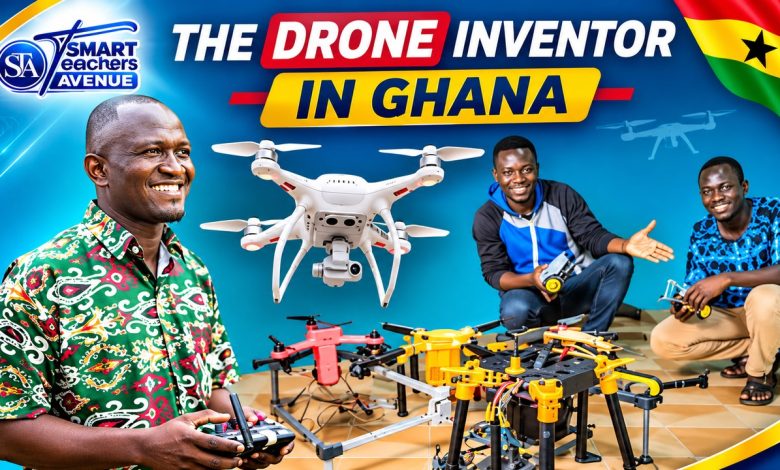
A Ghanaian drone inventor is attracting attention for turning personal curiosity, engineering knowledge and years of experimentation into locally developed drones, robots and other technological projects. His name is Mr Gideon Mensah, and his work is a reminder that remarkable innovation can begin without a fully equipped laboratory.
In a discovery interview led by Mr Atta Smart of Smart Teachers Avenue, Mr Gideon Mensah opened up about his journey into robotics, demonstrated some of his drone designs and explained the challenges confronting his work.
What makes his story particularly interesting is where much of this work happens: a small room in his home, with limited equipment, a damaged computer and tools that he sometimes has to borrow or share.
Yet, from that modest working environment, he has developed projects that deserve attention from Ghana’s technology, education and investment communities.
Ghanaian Drone Inventor: The Journey Behind the Technology
Mr Gideon Mensah interest in technology did not begin with drones. It developed through years of curiosity about how machines work and how their components can be combined to perform useful tasks.
He explained that he initially explored robotics, building simple mechanical structures with wood, motors, batteries and switches.
Some of his early projects included remote-controlled vehicles, obstacle-avoiding robots and a robot designed to sweep and collect leaves.
These experiments helped him understand the relationship between mechanical structures and electronic components.
His educational background also contributed to this interest. He described studying General Science before pursuing engineering-related studies, where he gained knowledge of materials such as wood, concrete, metals, plastics, glass and composites.
He explained that understanding materials is important in drone construction because even a good flight controller cannot compensate for a poorly designed structure.
For Mr Gideon Mensah, learning how individual components work has been just as important as assembling the finished product.
END-OF-TERM EXAMINATIONS FROM CRECHE TO SHS
Get quality End-of-Term Examination Questions with Marking Schemes for learners from Creche to SHS, carefully prepared to support effective assessment.
Ghanaian Drone Inventor Demonstrates Locally Developed Drone Models
One of the most interesting parts of the interview was the demonstration of two different drone models.
The first was a camera drone designed for capturing events, landscapes and aerial footage. According to Mena, it can rotate through different angles and has multiple flight modes.
He also indicated that it can remain in the air for approximately 20 minutes under the conditions described during the interview.
The second model was a larger agricultural drone designed to carry liquid for spraying.
The inventor explained that its spraying mechanism uses centrifugal force to turn liquid into droplets. He also described developing a customised valve system to control when the liquid is released.
This is particularly important because he had encountered a problem with the pump continuing to release water when it was not needed.
Rather than abandon the design, he worked on a solution that would give him better control over the spraying mechanism.
Ghanaian Drone Inventor Explains the Technology Inside His Drones
Beyond the external appearance, Mr Gideon Mensah explained several technical components that help his drones operate.
These include:
- Motors and propellers: They generate the thrust needed for flight.
- Electronic Speed Controllers (ESCs): They regulate the speed of the motors.
- Flight controller: It processes signals and helps coordinate the drone’s movements.
- GPS and compass: They support positioning and directional awareness.
- Barometer: It measures air pressure and supports altitude-related functions.
- Gyroscope and accelerometer: They help detect changes in orientation and movement, allowing the flight system to make stability corrections.
He also demonstrated a controller he had assembled himself, explaining how its joysticks and switches control different flight functions.
The discussion showed that drone construction involves more than attaching motors to a frame. It requires knowledge of electronics, mechanical design, power management and flight control.

Ghanaian Drone Inventor’s Agricultural and Robotics Projects
The interview also revealed that Mr Gideon Mensah interests extend beyond camera drones.
His agricultural model is designed around the possibility of spraying liquid over farms. The inventor explained that the system could be developed to serve large-scale agricultural production.
However, the agricultural drone remains part of his development work. Its commercial readiness and performance under real farming conditions were not independently established in the interview.
He also presented experimental aircraft designs, including a model with a different motor arrangement from a conventional quadcopter.
One of the designs is intended to explore the possibility of carrying a human passenger in the future. This remains an ambitious development goal, not a completed or certified passenger aircraft.
DETAILED LESSON PLANS & SCHEMES OF WORK
Get detailed lesson plans and Schemes of Work for Nursery, KG, Primary, JHS and SHS to help you prepare, plan and teach effectively.
Ghanaian Drone Inventor Builds a Robot That Can Play Football
Another fascinating project was a football-playing robot.
Mr Gideon Mensah demonstrated two small robotic players designed to work as a team. The concept involves controlling the players through a controller, switching between them and directing their movements towards the ball.
The robots have grabbing and striking mechanisms intended to interact with the ball.
He explained that the project was still being developed, with further improvements planned to make its operation more intelligent.
The inventor also showed a laser CNC machine under development. Its intended purpose is to engrave designs or cut materials using computer-generated designs.
He explained that the technology could also support drone construction by helping to produce accurately designed parts.
The interview further referenced 3D printing as another technology he uses in developing components and structures.
The Challenges Behind His Work: A Workshop Still Missing
Perhaps the most striking part of the discovery was the working environment behind these projects.
Mr Gideon Mensah revealed that he carries out much of his assembly and development work in a small room in his home.
He does not currently have a dedicated workshop or showroom.
His computer, which he uses for modelling and design, is damaged but still functional. He also relies on a small toolbox and occasionally shares tools with friends.
For a Ghanaian drone inventor working on projects that require specialised components, this situation presents serious limitations.
Mr Gideon Mensah explained that obtaining the necessary components can take time. Sometimes he has a motor but lacks a controller, or he has to wait until different parts are available before continuing a project.
Some components are purchased from outside Ghana, adding shipping costs to the financial burden.
He estimated that he had invested approximately GH₵10,000 in the work discussed during the interview. He also explained that he sometimes sells existing components to raise money for new ones.
This gives a clearer picture of the personal commitment behind the projects.
READ RELATED RESOURCES HERE: 2024 TEACHER RECRUITS: 7 CRUCIAL UPDATES ON SALARY ARREARS AND STAFF IDS FROM GES
Ghanaian Drone Inventor Calls for Investment and Strategic Partnerships
Mr Gideon Mensah is not simply looking for encouragement. He is calling for practical support that can help move his work beyond individual experimentation.
During the interview, he appealed to individuals and organisations with an interest in African development, technology and youth innovation to consider partnering with him.
He identified investment and business support as important requirements for developing the drones into products that people in Ghana and elsewhere could acquire and use.
His ambition includes developing and assembling more of the technology locally.
For him, local development matters because it can give Ghana greater control over the products and the ability to adapt their features to local needs.
He also needs a better working environment, including a dedicated workshop or showroom, suitable equipment, tools and materials.
What Support Could Help the Ghanaian Drone Inventor Progress?
The interview points to several practical areas where support could make a difference:
- Financial investment: Funding to purchase components, improve existing designs and develop new prototypes.
- Workshop facilities: A suitable space where he can work safely and concentrate on research and production.
- Technical equipment: Computers, modelling tools, machines and other essential resources.
- Business partnerships: Support to develop viable products and explore potential markets.
- Training opportunities: Access to people interested in learning robotics, drone construction and related technical skills.
These are not merely requests for assistance. They are areas that could help turn individual technical knowledge into a more structured innovation enterprise.
A Ghanaian Drone Inventor Who Also Wants to Train Others
Another important aspect of Mr Gideon Mensah work is his willingness to share his knowledge.
During the interview, he indicated that he is open to training people who want to learn about robotics and drone technology.
This could create opportunities for young people interested in practical engineering, electronics, mechanical design and technology.
His football robot demonstration also illustrated how such projects can introduce learners to the practical application of engineering principles.
Rather than learning only from textbooks, students can explore how motors, switches, batteries, controllers and mechanical structures work together.
READ RELATED RESOURCES HERE: ADUMAN SHS TEACHERS INTERDICTED: 7 IMPORTANT FACTS ABOUT THE GES INVESTIGATION
From a Small Room in Accra to a Bigger Technological Vision
Mr Gideon Mensah ambitions go beyond the models currently displayed in his workspace.
He spoke about eventually combining drones, robotics and artificial intelligence to develop more intelligent systems.
He also expressed a long-standing personal interest in the possibility of flying himself, which informs his ambition to explore larger aircraft designs.
He believes drone technology will become increasingly relevant and that people should prepare themselves for technological changes that could affect future employment and industries.
His message is not that all these ambitions have already been achieved. Rather, he sees them as possibilities worth researching, developing and investing in.
The interview also revealed that he is a family man with two children. Despite the personal and financial demands of his work, he said he intends to continue developing his projects.
READ RELATED RESOURCES HERE: GES TEACHER RECRUITMENT 2026: 7 IMPORTANT DEVELOPMENTS AS ERNEST KOFI DAVIS ADDRESSES BATCH CONCERNS
Smart Teachers Avenue’s Discovery: Why Ghana Must Pay Attention to Local Innovators
This discovery by Smart Teachers Avenue, led by Mr Atta Smart, raises an important question: how many promising talents are working quietly without the resources, facilities and partnerships needed to develop their ideas?
Mr Gideon Mensah story demonstrates the value of curiosity, practical learning and persistence. It also highlights the difficulties that can confront independent innovators who have technical knowledge but limited access to equipment and investment.
His projects are at different stages of development. Some were demonstrated during the interview, while others remain experimental or are planned for future development.
That distinction matters. Supporting innovation should go hand in hand with testing, technical evaluation, safety standards and a realistic plan for turning prototypes into reliable products.
For Ghana, the opportunity is to create stronger connections between local innovators, educational institutions, investors, engineering professionals and businesses.
A person should not have to work indefinitely from a cramped room simply because the resources needed to develop a promising idea are beyond personal reach.
The Ghanaian drone inventor is asking for an opportunity to take his work further. Whether through investment, equipment, a suitable workshop, technical partnerships or training opportunities, the right support could help determine what comes next.
Smart Teachers Avenue will continue highlighting people whose ideas, skills and determination deserve wider attention.
Share your experience and ideas in the comments. Your strategy could help another teacher take the first step.
Follow Smart Teachers Avenue on Facebook, TikTok and YouTube for practical teacher development, professional growth and financial education.
YOU CAN CONTACT US ON ↓
📞 Phone: +233 503910155 / +233233910155
📧 Email: info.teachersavenue@gmail.com
💬 WhatsApp: Click Here To WhatsApp Us
Follow Smart Teachers Avenue and Stay connected with us for daily educational resources, financial education, teaching tips and school leadership insights.
📘 Facebook – FOLLOW HERE
🎵 TikTok – FOLLOW HERE
▶️ YouTube – SUBSCRIBE HERE
✈️ Telegram Channel – JOIN HERE
👥 Telegram Community Chat: – JOIN HERE
👥 Facebook Community Chat: – JOIN HERE
WhatsApp Channel – FOLLOW HERE for daily updates, teaching resources and exclusive educational content.
Join our growing community of teachers across Ghana and beyond who trust Smart Teachers Avenue as their preferred platform for teaching resources, professional development, financial education and school leadership.




One Comment