
MR YANKS VEGETABLE FARMING JOURNEY: HOW GH₵1 GREW INTO A 20-ACRE FARM
Mr Yank's Vegetable Farming Journey reveals how a small beginning, practical farming knowledge and years of hard work helped him build a large-scale vegetable business in Ghana.

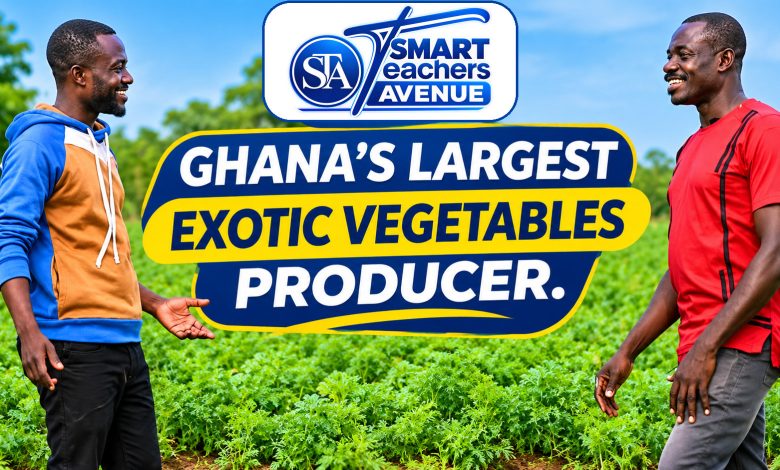
Mr Yank’s (Yaw Nkrumah) Vegetable Farming Journey is a remarkable account of how determination, practical knowledge and careful reinvestment can turn a small beginning into a growing agricultural enterprise. Starting with just GH₵1, a cutlass and a sharpening stone, the farmer has built an operation spanning approximately 20 acres and employing about 20 workers.
In a discovery interview led by Atta Smart for Smart Teachers Avenue, viewers are taken through the farm to hear directly from Mr Yank’s about his background, business decisions, farming techniques, challenges and the opportunities he believes agriculture offers young people.
His experience carries an important message: a person does not always need substantial capital before taking the first step towards building a business.
Mr Yank’s Vegetable Farming Journey: A Beginning That Almost Looked Impossible
Mr Yank did not originally plan to become a large-scale vegetable farmer.
According to the interview, he completed his secondary education in 1990. At the time, he was interested in languages, particularly English and French. However, financial difficulties at home made it difficult for him to continue his education.
He later travelled to the Eastern Region, where he joined his brother in trading second-hand clothing. After some time, he realised that the business was not taking him in the direction he wanted.
He returned home to look for another opportunity.
That decision became an important turning point in Mr Yank’s Vegetable Farming Journey.
Mr Yank’s Vegetable Farming Journey Started With Just GH₵1
When he considered returning to trading, his mother gave him GH₵1 to support the journey.
But instead of using the money for transport, he decided to try something different.
He bought a cutlass and a sharpening stone and started a small garden-egg farm.
His decision was influenced by an experience from his school days. While in secondary school, he had practised gardening to support himself financially. That experience had introduced him to the possibility of earning an income through farming.
He remembered what he had learned and put it into practice.
The small garden-egg farm became his starting point. As the business developed, he saved and reinvested his earnings before gradually moving into more demanding vegetable production.
It is this gradual development that makes Mr Yank’s Vegetable Farming Journey worth examining. He did not begin with a large farm, expensive equipment or substantial financial backing. He began with what he could afford.
END-OF-TERM EXAMINATIONS FROM CRECHE TO SHS
Get quality End-of-Term Examination Questions with Marking Schemes for learners from Creche to SHS, carefully prepared to support effective assessment.
Mr Yank’s Vegetable Farming Journey: How He Expanded Into Cabbage and Carrot Production
After establishing himself through gardening, Mr Yank moved into the production of exotic vegetables, particularly cabbage and carrots.
He explained that a former teacher played an important role in introducing him to cabbage and carrot cultivation. The teacher’s guidance gave him knowledge that later became useful in developing his farming business.
Today, his operation covers approximately 20 acres of land, according to the interview.
The farm is not limited to one crop. Cabbage, carrots, green pepper, cucumber and lettuce all feature in his farming activities.
However, he explained that crop selection and land management require careful planning.
Mr Yank’s Vegetable Farming Journey and the Importance of Crop Rotation
One important practice discussed during the interview was crop rotation.
Mr Yank explained that he does not continuously plant cabbage on the same land without changing crops.
He alternates cabbage and carrots to help manage problems associated with repeatedly cultivating the same crop.
This approach is part of his effort to maintain productive farmland and reduce the risks associated with continuous cultivation.
The interview also showed how much attention goes into preparing the land before planting. The soil is cleared and prepared, while beds and planting spaces are arranged according to the crop being cultivated.
For cabbage, seedlings are raised separately before being transplanted into prepared beds.
This is followed by regular watering, fertiliser application and other farm management activities.
Mr Yank’s Vegetable Farming Journey: Why Every Farming Stage Matters
Cabbage production, as explained by Mr Yank, requires close attention throughout its growing period.
After transplanting, the seedlings are watered for about 10 days. Fertiliser and organic manure are then applied according to the condition and fertility of the soil.
He also explained that the farm’s fertiliser requirements may differ depending on the land.
Where the soil is sufficiently fertile, fewer applications may be needed. Less fertile soil, however, may require more frequent attention.
The farmer described cabbage production as highly intensive, with a growing period of approximately three months.
It requires consistent supervision, labour and time. In some situations, workers may have to water the crops during the night.
His explanation makes one thing clear: commercial vegetable farming requires more than simply planting seeds and waiting for harvest.

Mr Yank’s Vegetable Farming Journey: Building a Workforce and a Business That Can Operate Without Him
The growth of the farm has also created employment opportunities.
During the interview, Mr Yank disclosed that he currently works with approximately 20 male workers. He explained that the number had previously been higher, reaching about 37, but economic conditions made it difficult to maintain that workforce.
An interesting part of his management approach is how he trains workers and gives them responsibilities.
He explained that he gradually introduced younger workers to the farming activities and taught them the techniques he had developed.
Over time, some workers became experienced enough to manage different sections of the farm.
He now has people responsible for particular areas, allowing the operation to continue even when he is not physically present.
This is an important business lesson from Mr Yank’s Vegetable Farming Journey: growth is not only about acquiring more land. It is also about developing people who can help manage the business.
The Market Challenge: Producing More Does Not Always Mean Earning More
Despite the farm’s growth, Mr Yank explained that vegetable production comes with serious business challenges.
One of his major concerns is market pricing.
He said that when vegetables become abundant, buyers and market conditions can influence the prices farmers receive. This can affect the income farmers earn, even when production costs remain high.
For him, the problem is not necessarily finding buyers. His bigger concern is the price at which the produce is sold.
This is an important distinction.
A farmer may successfully cultivate a large quantity of vegetables, but if market prices fall during harvest, the financial returns may be disappointing.
DETAILED LESSON PLANS & SCHEMES OF WORK
Get detailed lesson plans and Schemes of Work for Nursery, KG, Primary, JHS and SHS to help you prepare, plan and teach effectively.
Mr Yank’s Vegetable Farming Journey Highlights the Need for Processing and Storage Facilities
Another major concern raised during the interview was the limited availability of processing facilities and storage infrastructure.
Mr Yank explained that farmers can produce large quantities of vegetables but may struggle to preserve or process them when the market becomes saturated.
He also raised concerns about limited access to export opportunities.
Without adequate storage, processing and organised marketing systems, farmers can find themselves under pressure to sell their produce at prices they would not normally accept.
These concerns formed a significant part of his discussion about what could improve agricultural production in Ghana.
READ RELATED RESOURCES HERE: ADUMAN SHS TEACHERS INTERDICTED: 7 IMPORTANT FACTS ABOUT THE GES INVESTIGATION
Mr Yank’s Vegetable Farming Journey and the Need for Stronger Farmer Cooperation
Mr Yank also spoke about the difficulty of organising farmers to work together.
He recalled previous efforts to bring farmers together to discuss marketing strategies and improve their bargaining position.
However, he said that some farmers were unwilling to support the proposed arrangements because they suspected that the organisers had personal interests.
He believes that farmers need stronger cooperation if they are to approach government and other stakeholders with a united voice.
He also discussed concerns about agricultural support programmes, including the handling of subsidised farming inputs and the limited resources available to agricultural extension officers.
His argument was that farmers need practical support that reaches them and helps them maintain production.
Mr Yank’s Vegetable Farming Journey: What Cabbage, Carrots and Green Pepper Can Offer
The interview also explored the differences between the crops cultivated on the farm.
Mr Yank explained that cabbage can attract relatively high prices, depending on its size and prevailing market conditions.
He mentioned that a bag of cabbage could sometimes sell for between GH₵800 and GH₵1,000.
Carrots also form part of the farm’s production, although he explained that their market prices and packaging differ from those of cabbage.
Green pepper was another crop he discussed with considerable interest.
He showed a section of the farm where a small portion of green pepper had reportedly generated about GH₵1,800 in sales. He also explained that harvesting could continue at intervals rather than taking place all at once.
These figures were shared by the farmer during the interview. They should not be treated as guaranteed returns for anyone considering vegetable farming. Actual earnings depend on production costs, crop performance, market prices and other conditions.
The Benefits of Farming: More Than Just Making Money
When asked what farming had done for him, Mr Yank explained that the business had helped him provide for his family.
He said the income had enabled him to support his children’s education, provide shelter and acquire additional land for farming.
He also described the satisfaction he feels when he sees his vegetables growing successfully.
For him, farming is not simply a commercial activity. It is something he enjoys and has committed many years of his life to developing.
The business has also allowed him to diversify into other activities, including the sale of agrochemicals, hardware and cement.
His experience demonstrates how an established agricultural business can create opportunities beyond the farm itself.
READ RELATED RESOURCES HERE: GES AND SPECIAL OLYMPICS GHANA RENEW PARTNERSHIP TO STRENGTHEN INCLUSIVE EDUCATION
Mr Yank’s Vegetable Farming Journey: His Advice to Young People
One of the strongest messages from the interview was his encouragement to young people to consider agriculture.
He advised them not to limit themselves to a narrow selection of business opportunities.
According to him, farming can be beneficial despite the difficulties involved.
He spoke openly about the challenges of production, pricing and the hard work required. However, he also explained how farming had helped him improve his family’s living conditions.
He further stressed that anyone interested in entering the sector should be willing to learn.
His own experience shows that knowledge, patience and consistent effort can make a difference.
READ RELATED RESOURCES HERE: GHANAIAN DRONE INVENTOR BUILDS IMPRESSIVE DRONES AND ROBOTS FROM A SMALL ROOM IN ACCRA
Mr Yank’s Vegetable Farming Journey Shows Why Starting Small Matters
Mr Yank’s story is not a promise that everyone who starts with GH₵1 will build a 20-acre farm.
Rather, it shows the importance of making productive use of available resources.
He started with garden eggs before moving into more expensive vegetable production. He saved, reinvested, learned from experience and gradually expanded.
That progression is worth paying attention to.
Young people interested in farming should understand the crops they intend to cultivate, the cost of inputs, the nature of their land, the labour required and the market they hope to serve.
Starting small can be a practical way to gain experience before committing larger amounts of money.
Mr Yank’s Vegetable Farming Journey: An Open Invitation to Learn
Mr Yank also made it clear during the interview that he welcomes people who want to learn about his farming activities.
He said that interested individuals can visit him, learn about his experience and receive guidance on production and marketing.
He also indicated that he could assist people seeking buyers for their produce.
This willingness to share knowledge adds another dimension to the story. His farm is not only a place of production; it is also an opportunity for others to observe and learn from practical experience.
READ RELATED RESOURCES HERE: GES TEACHER RECRUITMENT: 5 IMPORTANT WARNINGS AS GES DECLARES PORTAL NOT OPEN
A Smart Teachers Avenue Discovery: Lessons Beyond the Farm
Mr Yank’s Vegetable Farming Journey is one of the stories uncovered through Smart Teachers Avenue’s discovery conversations, led by Atta Smart.
The interview offers a closer look at a Ghanaian entrepreneur whose progress has come through practical learning, persistence and years of hard work.
It also brings attention to challenges that go beyond individual effort. Farmers need reliable markets, fair pricing, storage facilities, processing opportunities, effective agricultural support and stronger cooperation.
These issues matter because agricultural production does not end when a crop is harvested. Farmers also need systems that help them preserve, distribute and sell what they produce.
For young people considering agriculture, Mr Yank’s experience offers a useful starting point for understanding both the opportunities and the responsibilities involved.
His journey began with very little, but he did not allow that beginning to determine the limits of what he could achieve.
The lesson is simple: start with what you have, learn the work, manage your resources carefully and keep improving.
Smart Teachers Avenue will continue highlighting people whose experiences offer practical lessons, fresh perspectives and opportunities for others to learn.
Share your experience and ideas in the comments. Your strategy could help another teacher take the first step.
Follow Smart Teachers Avenue on Facebook, TikTok and YouTube for practical teacher development, professional growth and financial education.
YOU CAN CONTACT US ON ↓
📞 Phone: +233 503910155 / +233233910155
📧 Email: info.teachersavenue@gmail.com
💬 WhatsApp: Click Here To WhatsApp Us
Follow Smart Teachers Avenue and Stay connected with us for daily educational resources, financial education, teaching tips and school leadership insights.
📘 Facebook – FOLLOW HERE
🎵 TikTok – FOLLOW HERE
▶️ YouTube – SUBSCRIBE HERE
✈️ Telegram Channel – JOIN HERE
👥 Telegram Community Chat: – JOIN HERE
👥 Facebook Community Chat: – JOIN HERE
WhatsApp Channel – FOLLOW HERE for daily updates, teaching resources and exclusive educational content.
Join our growing community of teachers across Ghana and beyond who trust Smart Teachers Avenue as their preferred platform for teaching resources, professional development, financial education and school leadership.