WHY EVERY TEACHER NEEDS A FINANCIAL AND CAREER PLAN
YOUR SALARY, SKILLS AND CAREER SHOULD NOT BE LEFT TO CHANCE—HERE’S WHY EVERY TEACHER NEEDS A CLEAR PLAN FOR WHERE THEY ARE GOING.


A financial stability plan can help teachers move beyond simply living from month to month and begin working deliberately toward their financial and professional goals.
What happens when a teacher reaches the end of every month without knowing where the next salary will go?
What happens when another year passes without a clear financial goal or career direction?
According to a recent Smart Teachers Avenue video presented by Atta Smart, an educational psychologist and financial educator, many teachers may be moving from month to month and year to year without deliberately planning their financial and professional future.
The message is straightforward: teachers need to plan.
Financial stability should not be left to chance, and career development should not simply be determined by what other people are doing.
Start With a Financial Stability Plan
The first area the video encourages teachers to consider is their financial stability.
For some teachers, the monthly salary can become a cycle of receiving money, spending it and then waiting for the next salary.
The speaker describes this as a hand-to-mouth lifestyle.
According to the video, some teachers may have already exhausted their salary before the third week of the month. When this happens repeatedly, they may turn to bank overdrafts or other forms of short-term financial support to get through the rest of the month.
But the speaker cautions teachers against becoming too comfortable with overdrafts.
The point is not simply that accessing an overdraft is automatically wrong. Rather, teachers are encouraged to understand that financial institutions earn interest from the money they provide.
The bigger question is therefore:
Why should a teacher continually depend on borrowed money before the next salary arrives?
The video encourages teachers to sit down and develop a financial stability plan instead.
READ RELATED RESOURCES HERE:Teacher Calls for Uniform and Allowance for Ghanaian Teachers
Don’t Ignore Small Amounts
Financial planning does not necessarily begin with having a large amount of money.
The speaker encourages teachers not to dismiss small amounts because they may appear insignificant.
Small amounts can gradually become larger when they are consistently saved with a purpose.
The important part is having a reason for saving.
Perhaps a teacher wants to establish a business.
Perhaps the goal is to raise capital for an investment.
Whatever the objective may be, the video encourages teachers to identify it and save toward it gradually.
Instead of simply saying:
“I am saving money.”
A teacher can have a clearer purpose:
“I am saving toward the capital I need to start this business.”
That gives the saving a destination.
Save With a Purpose
The video makes an important distinction: teachers should not simply save randomly without knowing what they are working toward.
If a teacher has a particular business or investment in mind, the required capital can become a target.
The teacher can then save gradually until the target is reached.
Once the necessary capital has been accumulated, the money can be used for the intended purpose.
According to the speaker, this is part of what financial stability planning looks like.
It is not simply about having money in a bank account.
It is about knowing why you are saving and what you intend to do with the money when you reach your target.
Learn Skills That Can Create Other Opportunities
The video also encourages teachers to consider learning additional skills.
If a teacher needs a particular skill, the speaker suggests making the effort to learn it.
Importantly, the video points out that not every skill requires paying for formal training.
A teacher could learn from a colleague, someone nearby or another person who already has the skill.
Where paying for training is necessary, the speaker suggests that it can also be considered an investment in something that may generate value later.
The underlying message is that teachers should not limit themselves to their existing abilities when they are looking for ways to improve their financial situation.
Learning a useful skill can open another avenue.
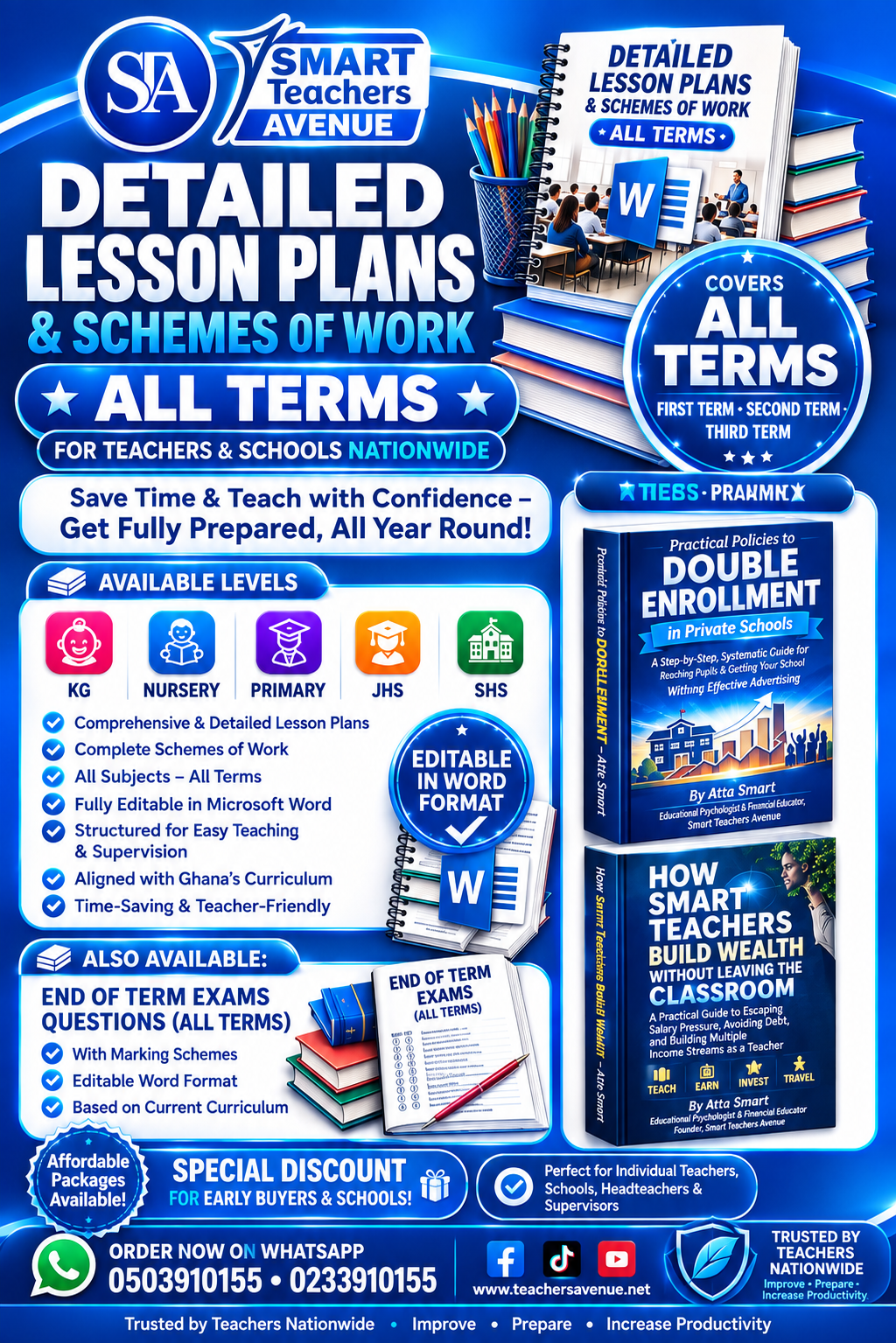
DETAILED LESSON PLANS & SCHEMES OF WORK
Get detailed lesson plans and Schemes of Work for Nursery, KG, Primary, JHS and SHS to help you prepare, plan and teach effectively.
Build Other Sources of Income
Another major theme in the video is the importance of having other sources of income.
The speaker points to teachers who do not immediately rush to withdraw their entire salary because they have other avenues through which they receive money.
The point is not that these teachers do not value their salaries.
They do.
The difference, according to the video, is that they have developed additional sources of income.
This means their financial situation is not entirely dependent on waiting for the next monthly salary.
The video presents this as one of the outcomes teachers can work toward through financial education, saving, skills development and purposeful planning.
Financial Planning Is Only One Part of the Picture
The speaker then moves from money to another important area: career direction.
A teacher can have a financial plan and still lack a clear idea of where they want their professional life to go.
The video therefore encourages teachers to ask themselves:
Where do I want to see myself in five years?
Where do I want to be in ten years?
These questions can help a teacher think beyond the immediate demands of the current school year.
END-OF-TERM EXAMINATIONS FROM CRECHE TO SHS
Get quality End-of-Term Examination Questions with Marking Schemes for learners from Creche to SHS, carefully prepared to support effective assessment.
Decide Where You Want Your Career to Go
Career planning requires teachers to think about their desired direction.
A teacher at the basic level, for example, may need to ask what academic or professional level they want to reach.
Do you want to pursue a first degree?
Do you want to obtain a master’s degree?
Do you want to pursue a PhD?
Or is there another professional direction you want to take?
The video encourages teachers to identify their own targets and then prepare toward them.
If higher education is part of the desired career path, the teacher can begin preparing for it rather than waiting until the opportunity suddenly appears.
The important thing is to establish a target and work toward it.
READ RELATED RESOURCES HERE: GOOD NEWS FOR ALL TEACHERS | CHECK DETAILS AND TAKE ACTION NOW!
Don’t Build Your Career Around Other People’s Decisions
One of the strongest points in the video is the warning against simply copying what other people are doing.
You see a colleague pursuing a master’s degree, so you decide to pursue one.
Someone else starts another programme, so you immediately want to do the same.
But the video challenges teachers to ask whether that decision actually fits their own vision.
The person pursuing a master’s degree may have a completely different objective.
They may want to move into another profession.
They may want to enter a different business.
They may have a specific career plan that you know nothing about.
Following their decision without understanding your own purpose can therefore leave you with a qualification without a clear idea of what you want to do with it.
Your Vision Should Come Before Your Decision
The message is not that teachers should not pursue further education.
Rather, the video encourages teachers to understand why they are pursuing it.
Before deciding on a course or qualification, ask:
What do I want to achieve with this?
Where does it fit into my career plan?
What direction am I trying to move toward?
Having a clear reason can help a teacher make decisions based on personal goals rather than pressure or comparison.
Plan Your Financial and Professional Future
The two sides of the message—financial planning and career direction—ultimately come together.
A teacher can ask:
What do I want my financial situation to look like in the coming years?
And:
What do I want my career to look like in the coming years?
From there, the teacher can begin identifying the steps required.
Financially, that may mean saving gradually toward a specific goal, learning a useful skill or developing another source of income.
Professionally, it may mean identifying a course, qualification or career target and preparing toward it.
The important thing is that the teacher is making deliberate decisions rather than simply allowing circumstances or other people’s choices to determine the direction of their life.
READ RELATED RESOURCES HERE: One Parent Can Destroy Your School’s Reputation
What Are You Planning For?
The Smart Teachers Avenue video ends by inviting teachers to share what they want to achieve.
Perhaps you want to establish a business.
Perhaps you want to develop another source of income.
Perhaps there is a particular course you want to pursue.
Perhaps you have a career direction you have been thinking about but have not yet started working toward.
Whatever the goal may be, the first step is to identify it.
Let’s Hear From Teachers
What are you currently planning for?
Is there a business you want to establish?
Is there a skill you want to learn?
Is there a course you want to pursue?
Or is there another financial or career goal you want to work toward?
Share your thoughts in the comments.
According to Smart Teachers Avenue, your response can help guide future discussions and provide more tailored ideas around the areas teachers want to develop.
This article is based on a Smart Teachers Avenue video presented by Atta Smart, an educational psychologist and financial educator, discussing financial stability planning, purposeful saving, additional income, skills development and career direction for teachers. The article organises the key ideas from the original video into a written story for the Smart Teachers Avenue website.
Share your experience and ideas in the comments. Your strategy could help another teacher take the first step.
Follow Smart Teachers Avenue on Facebook, TikTok and YouTube for more financial education, professional growth and practical conversations for teachers and educators.
YOU CAN CONTACT US ON:
📞 Phone: +233 503910155 / +233233910155
📧 Email: info.teachersavenue@gmail.com
💬 WhatsApp: Click Here To WhatsApp Us
Follow Smart Teachers Avenue and Stay connected with us for daily educational resources, financial education, teaching tips and school leadership insights.
📘 Facebook – FOLLOW HERE
🎵 TikTok – FOLLOW HERE
▶️ YouTube – SUBSCRIBE HERE
✈️ Telegram Channel – JOIN HERE
👥 Telegram Community Chat: – JOIN HERE
👥 Facebook Community Chat: – JOIN HERE
WhatsApp Channel – FOLLOW HERE for daily updates, teaching resources and exclusive educational content.
Join our growing community of teachers across Ghana and beyond who trust Smart Teachers Avenue as their preferred platform for teaching resources, professional development, financial education and school leadership.