BREAK TIME: 3 POWERFUL WAYS TEACHERS CAN STAY PROFESSIONAL
BREAK TIME SHOULD NOT MEAN LEAVING PUPILS UNSUPERVISED; A SIMPLE STAFF ROTATION SYSTEM CAN HELP KEEP LEARNERS SAFE WHILE TEACHERS HANDLE OTHER RESPONSIBILITIES.

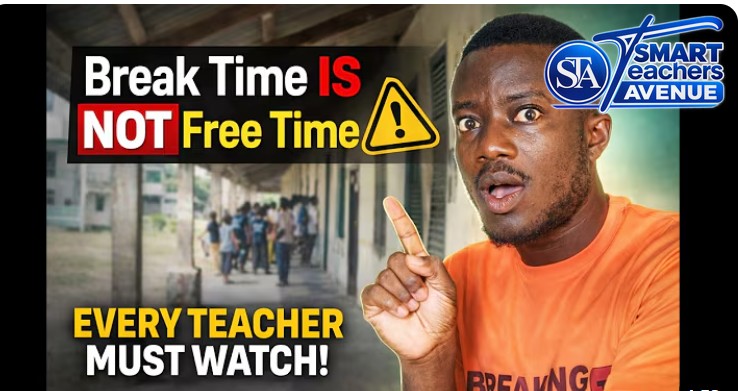
Break time is not simply a period when pupils leave the classroom and teachers are completely free to do whatever they want.
For teachers, it is also an important period to ensure that pupils remain safe while they play, eat, interact, and move around the school compound.
But this raises an important question: How can teachers supervise pupils during break time and still get enough time to rest, mark exercises, revise notes or attend to other responsibilities?
Smart Teachers Avenue addresses this question in a practical video titled “Break Time Is NOT Free Time – What Every Teacher Must Do.”
The video explains how schools can organize break-time supervision without requiring every teacher to leave the classroom with their own pupils.
BREAK TIME SUPERVISION IS A COLLECTIVE RESPONSIBILITY
One important lesson from the video is that break time supervision should not be the responsibility of only one teacher.
Instead, the entire staff can work together to ensure that pupils are properly monitored.
The number of teachers involved can depend on the size and structure of the school compound.
For a school with different sections or areas, about three or four teachers may be enough to cover strategic points where pupils are likely to gather or play.
The teachers do not necessarily have to move around with their own classes.
Instead, they can position themselves at vantage points where they can see large portions of the school compound.
READ RELATED RESOURCES HERE: The Mindset That Breaks Financial Struggles (Teachers & Youth Must Hear This!)
BREAK TIME: POSITION TEACHERS AT STRATEGIC POINTS
The second important practice is choosing the right locations for supervision.
A teacher stationed at a strategic point may be able to monitor several areas of the school at once.
For example, if one side of the school compound is close to a main road, a teacher can be positioned at a suitable point from where pupils moving toward that area can easily be seen.
The teacher can then caution pupils and redirect them when necessary.
Another teacher can monitor the opposite side of the school, while another supervises the school field or another busy area.
This approach can provide wider coverage without requiring every teacher to leave the classroom.
The goal is not simply to stand somewhere during break time.
The goal is to see, identify and respond to situations that could put pupils at risk.
DETAILED LESSON PLANS & SCHEMES OF WORK
Get detailed lesson plans and Schemes of Work for Nursery, KG, Primary, JHS and SHS to help you prepare, plan and teach effectively.
BREAK TIME SUPERVISION DOES NOT MEAN EVERY TEACHER MUST LEAVE CLASS
A common concern raised by teachers is that they also need time during break to rest and attend to other responsibilities.
Teachers may need to eat, drink water, revise their notes, mark exercises or prepare for their next lesson.
The approach discussed in the video provides a solution.
If only a selected number of teachers are responsible for break-time supervision, the remaining teachers can use the period to attend to their own responsibilities.
This means the school does not have to choose between pupil safety and teacher welfare.
Both can be addressed through proper organization.
ROTATE BREAK TIME SUPERVISION AMONG TEACHERS
Another practical strategy is rotation.
Instead of assigning the same teachers to supervise pupils every day or every week, the responsibility can be shared among members of staff.
For example, school management could prepare a timetable showing which teachers are responsible for break-time supervision during a particular week.
If four teachers are assigned, they can organize themselves around the different sections of the school compound.
The following week, another group of teachers can take over.
This is similar to how teacher-on-duty responsibilities are organized in many schools.
A rotation system can make the responsibility more manageable and ensure that no particular teacher carries the extra duty continuously.
DETAILED LESSON PLANS & SCHEMES OF WORK
Get detailed lesson plans and Schemes of Work for Nursery, KG, Primary, JHS and SHS to help you prepare, plan and teach effectively.
BREAK TIME: PLAN THE SUPERVISION BEFORE IT STARTS
Effective supervision requires preparation.
Teachers assigned to break-time duty should know which areas they are responsible for and where they should position themselves.
They should also communicate with one another so that important areas are not left uncovered.
The size of the school compound should determine how many teachers are needed.
A smaller school may require fewer teachers, while a larger school with several sections may require more.
The important thing is to ensure that pupils can be monitored effectively.
READ RELATED RESOURCES HERE: Download 2023-2024 First Term Schemes of Work For Basic 7-9
WHY BREAK TIME SUPERVISION MATTERS
The main purpose of the arrangement is pupil safety.
Pupils can become involved in risky activities during break time if there is inadequate supervision.
A teacher positioned strategically can identify potential problems early and intervene before they become serious.
At the same time, a well-organized system recognizes that teachers also have legitimate responsibilities during break.
That is why the video emphasizes collective responsibility and rotation rather than expecting every teacher to supervise pupils continuously.
BREAK TIME: A SIMPLE SYSTEM CAN PROTECT PUPILS
The message from Smart Teachers Avenue is straightforward.
Teachers do not necessarily need to follow their own pupils around the school compound during break time.
Instead, school management can organize a supervision system involving selected teachers positioned at strategic points.
The responsibility can then be rotated among staff members.
This can help schools create a safer environment for pupils while allowing other teachers to use their break period for rest, marking, preparation and other professional responsibilities.
For teachers, professionalism is not only about what happens inside the classroom.
It is also about how they contribute to the safety and effective running of the entire school.
READ RELATED RESOURCES HERE: Teacher Calls for Uniform and Allowance for Ghanaian Teachers
What system does your school use to supervise pupils during break time?
Share your experience and ideas in the comments.
Share your experience and ideas in the comments. Your strategy could help another teacher take the first step.
Follow Smart Teachers Avenue on Facebook, TikTok and YouTube for practical teacher development, professional growth and financial education.
YOU CAN CONTACT US ON ↓
📞 Phone: +233 503910155 / +233233910155
📧 Email: info.teachersavenue@gmail.com
💬 WhatsApp: Click Here To WhatsApp Us
Follow Smart Teachers Avenue and Stay connected with us for daily educational resources, financial education, teaching tips and school leadership insights.
📘 Facebook – FOLLOW HERE
🎵 TikTok – FOLLOW HERE
▶️ YouTube – SUBSCRIBE HERE
✈️ Telegram Channel – JOIN HERE
👥 Telegram Community Chat: – JOIN HERE
👥 Facebook Community Chat: – JOIN HERE
WhatsApp Channel – FOLLOW HERE for daily updates, teaching resources and exclusive educational content.
Join our growing community of teachers across Ghana and beyond who trust Smart Teachers Avenue as their preferred platform for teaching resources, professional development, financial education and school leadership.