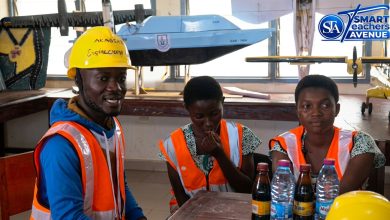
17-YEAR-OLD GHANAIAN STUDENT INVENTOR BUILDS A HELICOPTER, EXCAVATOR AND MORE
A young technical student is drawing attention with self-developed engineering projects, including a flying helicopter model, a working excavator and an Android game controller. His story also raises questions about the support available to talented young innovators in Ghana.


(17-year-old Ghanaian student inventor and engineering innovator)and he is attracting attention for his ability to design and assemble different mechanical and electronic projects, including a helicopter model capable of flying, a miniature excavator, a boat and an Android game controller.
The young innovator, known as Safo in the discovery interview, is a final-year student at a technical senior high school in Ghana. His projects were showcased during a visit by Smart Teachers Avenue, led by Mr Atta Smart, as part of its ongoing effort to discover and highlight exceptional talents within Ghanaian communities.
What makes the story particularly significant is not simply the number of items he has produced. It is the fact that he has developed these projects while still in secondary school, working with limited resources and relying heavily on his personal curiosity, research and practical experimentation.
The visit also provided an opportunity to hear directly from his teachers and school authorities about his development, the encouragement he has received and the support he needs to take his abilities further.
17-Year-Old Ghanaian Student Inventor and innovator Demonstrates Remarkable Engineering Projects
During the interview, Safo presented several projects he had designed and assembled. Each demonstration offered a glimpse into his interest in mechanical systems, electronics and practical engineering.
Among the projects displayed were an Android game controller, a miniature excavator, a boat and a helicopter model.
These were not merely objects placed on a table for display. The student demonstrated how some of them functioned, explaining the basic mechanisms and components involved in their operation.
1. An Android Game Controller Built by a Secondary School Student
One of the first projects demonstrated was an Android game controller that can be connected to a mobile phone using an OTG cable.
Safo explained how the controller connects to the phone and allows the user to operate compatible games using physical controls rather than relying entirely on the phone’s touchscreen.
He identified the analogue controls and demonstrated the connection process during the interview.
The project reflects his interest in understanding how electronic devices communicate and how existing technologies can be adapted for practical use.
2. A Miniature Excavator That Moves and Rotates
Another impressive project was a miniature excavator designed to reproduce some of the movements of a real excavating machine.
During the demonstration, the student showed how the model could move forward and backward. He also demonstrated its rotating movement and the operation of its excavating arm.
He explained that the model uses electrical connections and a hydraulic arrangement to facilitate some of its movements.
The demonstration showed his ability to combine mechanical structures, electrical components and control mechanisms to produce a functional model.
3. A Boat Model Designed to Float on Water
Safo also presented a boat model among the projects he had developed.
Although the interview did not provide a detailed technical explanation of every component or its full operating capabilities, the boat formed part of the range of practical models he had assembled.
It further illustrates the variety of areas he is exploring, rather than limiting his interest to a single type of machine.
4. A Helicopter Model That Successfully Took Flight
Perhaps the most eye-catching demonstration was the small helicopter model.
During the visit, Safo operated the model using its controller, allowing it to lift into the air. The demonstration attracted an excited reaction from the interviewer and school representatives.
The helicopter also featured indicator lights, which the student explained were used to show when the device had been switched on.
For a student still completing secondary education, developing a model capable of taking flight is a notable practical achievement. However, it should be understood as a student-built model, not a certified aircraft or a passenger-carrying helicopter.
END-OF-TERM EXAMINATIONS FROM CRECHE TO SHS
Get quality End-of-Term Examination Questions with Marking Schemes for learners from Creche to SHS, carefully prepared to support effective assessment.
How the 17-Year-Old Ghanaian Student Inventor and innovator Developed His Skills
Safo’s work did not begin with the projects showcased during the visit.
In the interview, he explained that he uses research to develop his ideas. He referred to mobile phones and computers as resources that help him find information and understand how to construct the things he wants to build.
His projects are therefore connected to a process of curiosity, independent learning, experimentation and practical application.
The interview also suggested that he has been developing his abilities over time, with school staff observing his progress from his early days at the institution.
The important lesson is that practical talent can emerge while a student is still in school. With the right guidance, learning opportunities and resources, such abilities can be developed further.
Teachers Recognised His Talent and Created Opportunities for Him
The school’s support for Safo was a major part of the discovery.
The SRC Patron explained that the school noticed his abilities when he entered in his first year. According to him, the teachers recognised that the student had a particular interest and capacity for practical work.
The school subsequently included him in a group where students could develop and present practical projects.
The SRC Patron said that his skills improved over time, especially when he was given access to computers and other learning resources.
He also described Safo as someone who could receive an idea and develop a model from it.
The Assistant Head in charge of Academics, Thomas Aka, equally expressed amazement at the student’s work. He recalled his first reaction as one of surprise and admiration.
He explained that members of the school community had encouraged Safo, with some staff members contributing money to help him purchase materials and components.
The Headmistress, Mrs Gladys Safo Asare, also expressed happiness about the student’s abilities. She said the school was interested in encouraging him so that his talent could be developed for the benefit of the institution and the country.
These accounts show that the student’s progress has not taken place in complete isolation. Encouragement from teachers, school leadership and other members of the school community has formed part of his journey.

17-Year-Old Ghanaian Student Inventor and innovator Needs Scholarships, Equipment and Mentorship
Despite the projects already demonstrated, Safo’s next steps will require more than encouragement.
During the interview, the student appealed for assistance to enable him to continue developing his skills. The school representatives also identified financial support, learning materials and further educational opportunities as important needs.
The SRC Patron specifically appealed for opportunities that could connect the student with engineering institutions, professionals and people who can help him improve his practical abilities.
A scholarship or structured technical training opportunity could provide a pathway for him to receive more advanced instruction and work with people who have experience in engineering and related fields.
DETAILED LESSON PLANS & SCHEMES OF WORK
Get detailed lesson plans and Schemes of Work for Nursery, KG, Primary, JHS and SHS to help you prepare, plan and teach effectively.
Why Engineering Institutions and Companies Should Take an Interest
Engineering institutions, technical universities, technology companies and professional engineers could play an important role in supporting young people with practical abilities.
For Safo, such support could include:
- Scholarship opportunities: Financial assistance to pursue further education and develop his engineering knowledge.
- Technical mentorship: Guidance from experienced engineers and technicians who can assess his work and help him improve his designs.
- Tools and equipment: Access to suitable materials, components and workshop facilities.
- Practical training: Opportunities to learn in a structured engineering environment and gain experience with more advanced equipment.
- Innovation partnerships: Connections with institutions and organisations interested in developing promising student projects.
The objective should not simply be to celebrate the projects. It should be to help the student understand the technical principles behind them, improve their design and learn how to test them safely and effectively.
READ RELATED RESOURCES HERE: GES RECRUITMENT PORTAL EXPECTED TO OPEN TODAY, NOVEMBER 23, AFTER TECHNICAL DELAY
The School Also Needs Better Technical Workshops and Equipment
The interview revealed that the challenges extend beyond Safo’s personal circumstances.
The Assistant Head in charge of Academics, Thomas Aka, described the condition of the school’s technical workshops and facilities as a major concern.
He explained that some of the equipment provided when the school began operating more than three decades ago was still being used. He also expressed concern that students sometimes return from classroom lessons without having adequate opportunities to practise what they have learned.
According to him, some of the workshops lack functional machines, while the school’s technical facilities require significant improvement.
The SRC Patron also spoke about the absence of a dedicated drawing studio and the need for better infrastructure to support technical education.
The Headmistress added that students require materials and equipment to develop their practical abilities. She noted that the school sometimes supports Safo with items such as batteries and electrical components.
These concerns raise an important question about the relationship between technical education and practical learning.
Students studying technical and engineering-related subjects need more than theoretical instruction. They also need functional workshops, suitable equipment, materials and opportunities to apply what they learn.
READ RELATED RESOURCES HERE: GHANAIAN TEACHER DEVELOPS AI TALKING ROBOTS TO TRANSFORM CLASSROOM LEARNING
Beyond Safo: Other Students at the School Are Also Showing Innovation
Another important part of the discovery was the school’s wider culture of practical work.
The Assistant Head in charge of Academics explained that students have contributed to projects around the school, including the production of desks and electrical work.
The Headmistress also confirmed that students undertake practical activities and produce items used within the institution.
This suggests that Safo’s story is part of a wider conversation about the value of technical education and the abilities of students when they are given opportunities to practise their skills.
The school leadership believes that more support from government, non-governmental organisations, private companies and individuals could help improve the learning environment.
The appeal is therefore not limited to one student. It also concerns the facilities and resources needed to support other young people who may have similar abilities.
A New Invention Could Be on the Way: The School Mentions a Food-Processing Machine
During the interview, the Assistant Head in charge of Academics revealed that another project was being developed at the school: a food-processing machine designed to handle several stages of preparing traditional foods.
He described a proposed system that could process ingredients such as cassava, plantain and cocoyam through stages including peeling, washing, boiling and drying.
He indicated that approximately GH¢200,000 would be needed to make the project a reality.
The project was mentioned as another example of the practical ideas emerging within the school. Its development and performance would, however, depend on securing the necessary resources and completing the work.
This part of the interview reinforces the need to look at technical schools not only as places where students prepare for examinations, but also as environments where practical solutions can be explored.
17-Year-Old Ghanaian Student Inventor: What Could Happen With the Right Support?
Safo’s story presents an opportunity to consider what can happen when young people with practical abilities receive the right support.
A student who is already experimenting with electronic controllers, mechanical models and flying devices could benefit from structured engineering education, professional supervision and access to better facilities.
The next stage should involve improving the quality of his designs, documenting how they work, testing their performance and understanding the engineering principles behind them.
Such a process could help him move from building individual models to developing more advanced projects.
It could also create opportunities for him to share his knowledge with other students and inspire more young people to explore engineering, robotics and technology.
However, talent alone does not guarantee success. Access to education, resources, mentorship, discipline and sustained opportunities will all matter.
READ RELATED RESOURCES HERE: MR YANKS VEGETABLE FARMING JOURNEY: HOW GH₵1 GREW INTO A 20-ACRE FARM
Smart Teachers Avenue Calls Attention to a Young Talent Worth Supporting
The discovery by Smart Teachers Avenue, led by Mr Atta Smart, has brought attention to a student whose practical abilities deserve further development.
Through the interview, viewers were able to see some of Safo’s projects, hear from the teachers who have supported him and understand the challenges facing the school.
The central message is clear: young people with practical talents need more than public recognition. They need opportunities, resources and institutions willing to help them grow.
Safo is still a student, and the projects demonstrated during the visit represent work that can be improved through further learning, testing and professional guidance.
For potential sponsors, engineering institutions, technology companies, philanthropists and other well-meaning individuals, this is an opportunity to consider how meaningful support could change the direction of a young person’s future.
The school has made its appeal. The student has demonstrated his interest and commitment. The next question is whether the wider community will respond.
Could this young Ghanaian student become one of the country’s future engineering talents if given the right opportunity?
His story deserves attention, but more importantly, it deserves a chance to develop.
Share your experience and ideas in the comments. Your strategy could help another teacher take the first step.
Follow Smart Teachers Avenue on Facebook, TikTok and YouTube for practical teacher development, professional growth and financial education.
YOU CAN CONTACT US ON ↓
📞 Phone: +233 503910155 / +233233910155
📧 Email: info.teachersavenue@gmail.com
💬 WhatsApp: Click Here To WhatsApp Us
Follow Smart Teachers Avenue and Stay connected with us for daily educational resources, financial education, teaching tips and school leadership insights.
📘 Facebook – FOLLOW HERE
🎵 TikTok – FOLLOW HERE
▶️ YouTube – SUBSCRIBE HERE
✈️ Telegram Channel – JOIN HERE
👥 Telegram Community Chat: – JOIN HERE
👥 Facebook Community Chat: – JOIN HERE
WhatsApp Channel – FOLLOW HERE for daily updates, teaching resources and exclusive educational content.
Join our growing community of teachers across Ghana and beyond who trust Smart Teachers Avenue as their preferred platform for teaching resources, professional development, financial education and school leadership.