

GHANA’S REMARKABLE MONKEY CEMETERY: DISCOVER THE SACRED MONKEYS OF BOABENG-FIEMA
Discover the fascinating Boabeng-Fiema Monkey Sanctuary in Ghana's Bono East Region, where sacred monkeys roam freely, coexist with local communities and receive special burial ceremonies when they die.

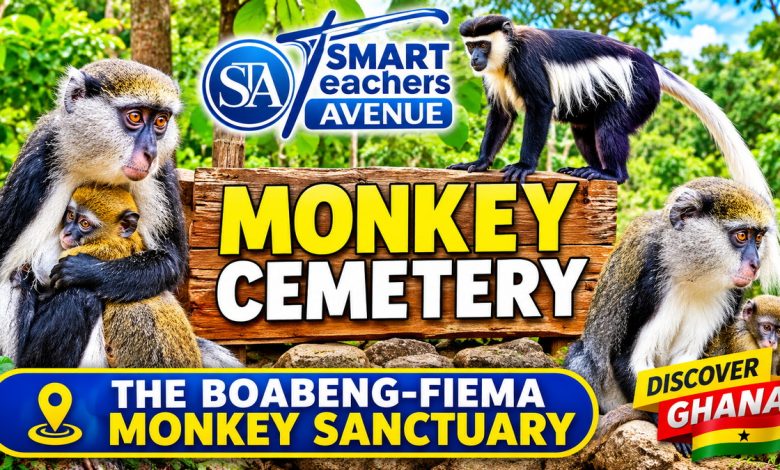
Boabeng-Fiema Monkey Sanctuary in Ghana’s Bono East Region offers a remarkable experience where monkeys are traditionally regarded as sacred, live alongside local communities and receive special burial ceremonies when they die.
Imagine visiting a community where monkeys are not treated as ordinary wild animals but are regarded as special members of the community.
Even more surprising, when one of these monkeys dies, it is given a burial ceremony similar to that performed for a human being.
This is not a fictional story. It is one of the fascinating cultural and wildlife traditions associated with the Boabeng-Fiema Monkey Sanctuary in Ghana.
In a special discovery tour led by Mr. Atta Smart of Smart Teachers Avenue, viewers are taken into the forest to explore this remarkable sanctuary, encounter different species of monkeys and learn about the traditions behind the famous monkey cemetery.
Located in the Bono East Region, the Boabeng-Fiema Monkey Sanctuary offers a unique combination of wildlife, cultural heritage and traditional conservation practices.
BOABENG-FIEMA MONKEY SANCTUARY: A PLACE WHERE MONKEYS ARE TREATED AS SACRED
The Boabeng-Fiema Monkey Sanctuary is located around the twin communities of Boabeng and Fiema in the Nkoranza North area of Ghana’s Bono East Region.
Unlike many wildlife destinations where animals are protected mainly through modern conservation systems, this sanctuary has a remarkable history rooted in traditional beliefs.
According to local tradition, the monkeys are regarded as children of the gods of the community.
For generations, these beliefs have influenced how residents interact with the animals.
The monkeys are traditionally protected from hunting and killing. They are also allowed to move around the surrounding communities, creating an unusual relationship between wildlife and human settlements.
The Forestry Commission identifies the sanctuary as an important example of traditional conservation supported by formal protection measures.
This makes the Boabeng-Fiema Monkey Sanctuary an important destination for anyone interested in Ghana’s cultural heritage and wildlife conservation.
END-OF-TERM EXAMINATIONS FROM CRECHE TO SHS
Get quality End-of-Term Examination Questions with Marking Schemes for learners from Creche to SHS, carefully prepared to support effective assessment.
BOABENG-FIEMA MONKEY SANCTUARY AND THE UNUSUAL MONKEY CEMETERY
Perhaps the most fascinating part of the discovery tour is the monkey cemetery.
Yes, there is an actual cemetery within the sanctuary where deceased monkeys are buried.
According to the traditional practices explained during the tour, monkeys that die are given special burial treatment.
They are buried with care, reflecting the cultural significance attached to their lives within the community.
The cemetery contains burial markers that remind visitors of the special relationship between the people and the animals.
This practice is one of the most remarkable features of the Boabeng-Fiema Monkey Sanctuary.
It also demonstrates how traditional beliefs can influence wildlife protection and shape the relationship between people and nature.
During the tour, Mr. Atta Smart explores the cemetery and invites viewers to understand why these monkeys receive such special treatment.
The discovery raises an interesting question: what can modern societies learn from communities that have developed traditional systems for protecting wildlife?

BOABENG-FIEMA MONKEY SANCTUARY: MEET THE TWO FAMOUS MONKEY SPECIES
The sanctuary is particularly known for two species of monkeys: the Mona monkey and the black-and-white colobus monkey.
Although both species live within the sanctuary, they have different characteristics and behaviours.
BOABENG-FIEMA MONKEY SANCTUARY: THE BLACK-AND-WHITE COLOBUS MONKEYS
One of the fascinating species encountered during the tour is the black-and-white colobus monkey.
These monkeys are recognised by their distinctive black-and-white appearance.
They are generally shy and prefer to remain in the trees rather than move close to people.
During the discovery tour, the guide explains that visitors may find it difficult to observe them closely because they often retreat or hide when people approach.
Their behaviour makes spotting them in the forest a particularly interesting experience.
The black-and-white colobus monkeys are among the species that have benefited from the traditional protection practices of the Boabeng and Fiema communities.
DETAILED LESSON PLANS & SCHEMES OF WORK
Get detailed lesson plans and Schemes of Work for Nursery, KG, Primary, JHS and SHS to help you prepare, plan and teach effectively.
BOABENG-FIEMA MONKEY SANCTUARY: THE MONA MONKEYS
Another important species found in the sanctuary is the Mona monkey.
Unlike the more reserved colobus monkeys, Mona monkeys are generally more accustomed to human presence.
They are known to move around the surrounding communities and can sometimes be seen near homes and other public spaces.
According to the tour guide’s explanation, these monkeys have their own feeding habits and preferences.
The differences between the two species make the Boabeng-Fiema Monkey Sanctuary an interesting destination for wildlife enthusiasts, researchers and tourists.
BOABENG-FIEMA MONKEY SANCTUARY: WHAT MAKES THESE MONKEYS SPECIAL?
Beyond their appearance, the monkeys have several interesting characteristics.
During the tour, viewers are shown the hands of the black-and-white colobus monkeys.
Their hands have five fingers, a feature that immediately attracts attention because of their resemblance to human hands.
The guide also explains that their feeding habits differ from what some visitors might expect.
These observations provide an opportunity to learn more about animal behaviour and the biodiversity found within Ghana’s forests.
READ RELATED RESOURCES HERE: GES NON-TEACHING STAFF PROMOTION INTERVIEWS 2026: CHECK YOUR SHORTLISTING STATUS NOW
BOABENG-FIEMA MONKEY SANCTUARY: THE HISTORY BEHIND ITS PROTECTION
The story of the sanctuary goes beyond tourism.
Its establishment is closely connected to the traditional beliefs of the Boabeng and Fiema communities.
According to the Forestry Commission, the monkeys were protected for generations through traditional taboos and community enforcement.
However, changing social conditions and the weakening of some traditional enforcement practices created challenges for their continued protection.
This made additional conservation measures necessary.
The area was subsequently supported by formal protection arrangements through district-level by-laws and the involvement of the Wildlife Division.
The sanctuary was established as a protected area in 1974.
Its development is particularly important because it demonstrates how indigenous conservation practices can work alongside formal wildlife protection systems.
The Boabeng-Fiema Monkey Sanctuary therefore represents more than a place to observe animals.
It is also an example of how cultural traditions can contribute to environmental protection.
BOABENG-FIEMA MONKEY SANCTUARY: WHY THIS GHANAIAN DESTINATION DESERVES ATTENTION
Ghana has several remarkable tourist destinations, but some of its most interesting attractions do not always receive the attention they deserve.
The Boabeng-Fiema Monkey Sanctuary is one such destination.
It offers visitors the opportunity to experience wildlife in an environment where traditional beliefs and conservation practices remain closely connected.
For students, the sanctuary provides an opportunity to learn about biodiversity, animal behaviour, environmental conservation and Ghanaian cultural heritage.
For researchers, it offers an interesting setting for studying the relationship between traditional knowledge and wildlife protection.
For tourists, it provides an experience that combines forest exploration, cultural discovery and encounters with different monkey species.
The sanctuary also demonstrates the potential of community-based tourism to support local development while encouraging the protection of natural resources.
Its importance extends beyond the two communities because it contributes to Ghana’s wider tourism and conservation landscape.
READ RELATED RESOURCES HERE: THE BIG MISTAKE: WHY TEACHERS STRUGGLE TO BUILD THEIR HOUSES
BOABENG-FIEMA MONKEY SANCTUARY: WHERE IS IT LOCATED AND HOW CAN YOU VISIT?
The Boabeng-Fiema Monkey Sanctuary is situated in the Nkoranza North area of the Bono East Region.
It is approximately 22 kilometres north of Nkoranza, according to the regional tourism information provided by the Middle Belt Development Authority.
Visitors can explore the sanctuary through guided tours and learn about the monkeys, the forest and the traditions of the surrounding communities.
The sanctuary also provides visitor accommodation facilities, making it possible for tourists and researchers to spend more time in the area.
Anyone planning a visit can obtain further information through the sanctuary’s official website:
A visit offers more than an opportunity to take photographs. It provides a chance to appreciate a unique example of Ghana’s cultural and environmental heritage.
READ RELATED RESOURCES HERE: GES AND SPECIAL OLYMPICS GHANA RENEW PARTNERSHIP TO STRENGTHEN INCLUSIVE EDUCATION
BOABENG-FIEMA MONKEY SANCTUARY: A DISCOVERY WORTH SHARING WITH THE WORLD
The discovery tour led by Mr. Atta Smart of Smart Teachers Avenue provides viewers with an opportunity to experience one of Ghana’s remarkable wildlife destinations.
From the unusual monkey cemetery to the different species living within the forest, the tour reveals a fascinating side of Ghana that deserves greater recognition.
It also reminds us that environmental protection does not always begin with modern laws and institutions. In some communities, traditional beliefs and cultural practices have played an important role in protecting wildlife for generations.
The Boabeng-Fiema Monkey Sanctuary is a powerful example of this relationship between culture, nature and conservation.
As Smart Teachers Avenue continues its discovery journey across Ghana and the African continent, stories like this help bring lesser-known destinations, people and traditions into the spotlight.
Have you ever visited a place where monkeys are buried with special funeral ceremonies?
This is one Ghanaian destination worth adding to your travel and discovery list.
Smart Teachers Avenue – Discovering Ghana, Celebrating Africa and Sharing Stories That Matter.
Share your experience and ideas in the comments. Your strategy could help another teacher take the first step.
Follow Smart Teachers Avenue on Facebook, TikTok and YouTube for practical teacher development, professional growth and financial education.
YOU CAN CONTACT US ON ↓
📞 Phone: +233 503910155 / +233233910155
📧 Email: info.teachersavenue@gmail.com
💬 WhatsApp: Click Here To WhatsApp Us
Follow Smart Teachers Avenue and Stay connected with us for daily educational resources, financial education, teaching tips and school leadership insights.
📘 Facebook – FOLLOW HERE
🎵 TikTok – FOLLOW HERE
▶️ YouTube – SUBSCRIBE HERE
✈️ Telegram Channel – JOIN HERE
👥 Telegram Community Chat: – JOIN HERE
👥 Facebook Community Chat: – JOIN HERE
WhatsApp Channel – FOLLOW HERE for daily updates, teaching resources and exclusive educational content.
Join our growing community of teachers across Ghana and beyond who trust Smart Teachers Avenue as their preferred platform for teaching resources, professional development, financial education and school leadership.






One Comment