TWO-YEAR EXAMINATION BAN: 7 CRITICAL REASONS GHANAIAN PARENTS AND SCHOOLS MUST TAKE THE NEW GES DIRECTIVE SERIOUSLY
GES moves to enforce examination discipline as parents, school heads and education stakeholders face renewed responsibility to protect the integrity of Ghana's BECE and WASSCE examinations.

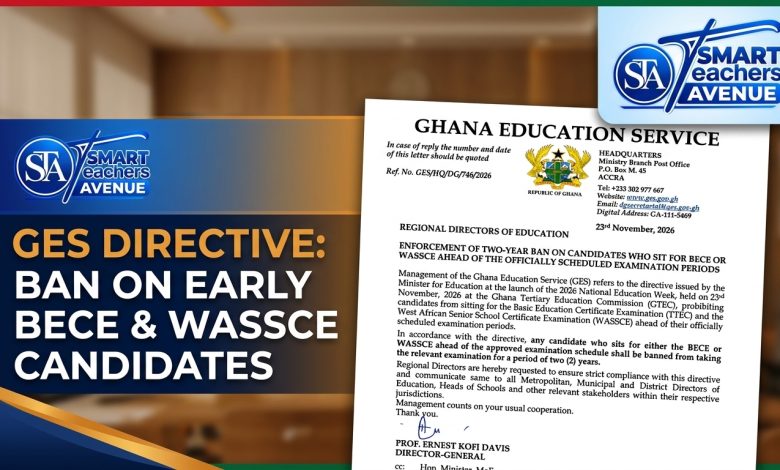
A new directive from the Ghana Education Service (GES) has placed parents, school heads, teachers and education stakeholders on notice: the practice of allowing candidates to sit national examinations ahead of their officially scheduled periods will no longer be treated lightly.
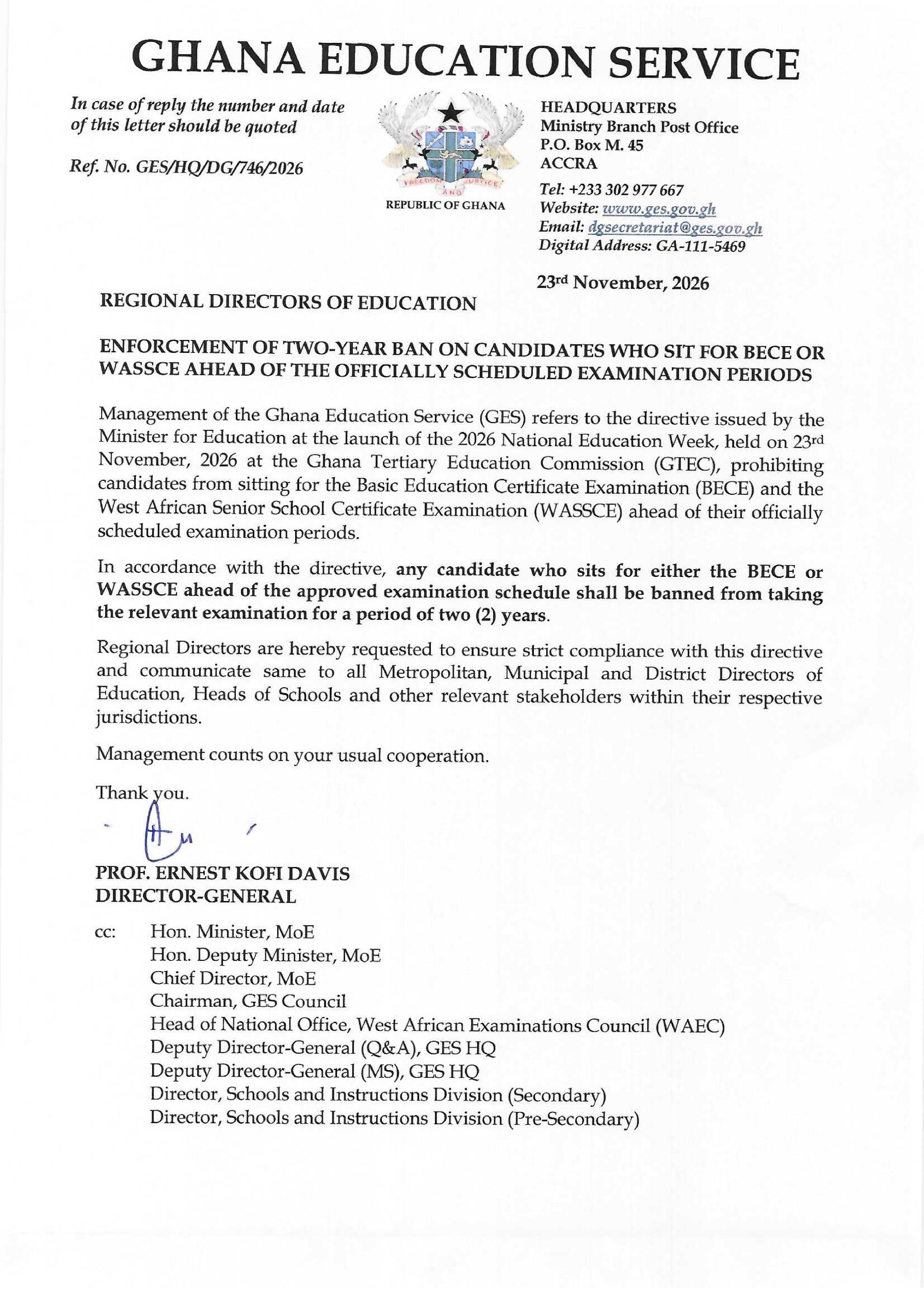
In a letter dated 23 November 2026, the Director-General of the Ghana Education Service, Professor Ernest Kofi Davis, formally communicated the enforcement of a two-year examination ban on candidates who sit for either the Basic Education Certificate Examination (BECE) or the West African Senior School Certificate Examination (WASSCE) ahead of their officially scheduled examination periods.
The letter, referenced GES/HQ/DG/746/2026, was addressed to all Regional Directors of Education, directing them to ensure strict compliance and communicate the instruction to Metropolitan, Municipal and District Directors of Education, heads of schools and other relevant stakeholders.
Under the directive, any candidate who sits for either examination ahead of the approved examination schedule shall be banned from taking the relevant examination for a period of two years.
This is a serious development that deserves the attention of every parent, teacher, school administrator and education stakeholder.
The issue is no longer simply about how early a student can complete school or how quickly a candidate can obtain an examination certificate. It is about educational discipline, fairness, proper academic progression and the responsibility of protecting the integrity of Ghana’s examination system.
WHAT DOES THE NEW TWO-YEAR EXAMINATION BAN MEAN?
The directive follows an announcement by the Minister for Education, Haruna Iddrisu, at the opening of the 2026 National Education Week at the Ghana Tertiary Education Commission (GTEC) on 23 November 2026.
The Minister directed the GES to prevent pupils who attempt to sit the BECE before their expected examination year from taking the examination for two years.
His concern was that some parents encourage their children, particularly those in JHS 1 and JHS 2, to advance prematurely to JHS 3 to write the BECE ahead of their classmates.
According to the Minister, the practice undermines fairness and creates difficulties for education authorities in planning the number of pupils expected to complete basic education and sit the examination each year. [External link 1: Ghana News Agency report]
The subsequent GES letter formally communicates the enforcement requirement to regional education authorities.
An important distinction: While the Minister’s public announcement focused particularly on premature BECE candidates, the GES letter expressly refers to candidates who sit for either BECE or WASSCE ahead of their officially scheduled examination periods. Parents and school authorities should therefore pay attention to the actual wording of the GES communication.
END-OF-TERM EXAMINATIONS FROM CRECHE TO SHS
Get quality End-of-Term Examination Questions with Marking Schemes for learners from Creche to SHS, carefully prepared to support effective assessment.
WHY THE TWO-YEAR EXAMINATION BAN MATTERS TO GHANA’S EDUCATION SYSTEM
Some may consider the directive too strict, particularly where a child appears academically gifted and capable of completing an examination earlier than expected.
However, academic ability alone should not be the only consideration when determining whether a learner is ready to progress through the education system.
Education involves more than passing examinations. It includes intellectual development, social maturity, practical learning, emotional development and the acquisition of competencies that prepare learners for the next stage of life.
The two-year examination ban brings an important conversation back to the centre of Ghana’s education system: should education be treated as a race, or should learners be allowed to develop through a properly organised academic process?
There are several reasons this directive deserves serious attention.
1. It promotes fairness and equal educational opportunities
Every child deserves a fair opportunity to learn, develop and demonstrate their abilities within an organised education system.
Allowing some learners to bypass the expected academic progression simply because their parents want them to obtain certificates earlier could create an uneven system.
The two-year examination ban reinforces the principle that national examinations should follow approved academic schedules rather than individual preferences.
2. It protects the integrity of national examinations
BECE and WASSCE are important national assessments. Their credibility depends on proper registration, examination administration and adherence to established procedures.
When candidates are permitted to sit examinations outside the officially scheduled periods, it raises questions about the consistency of examination administration.
Enforcing the two-year examination ban sends a message that examination procedures must be respected.
3. It discourages unnecessary pressure from parents
Not every parent who pushes a child to write an examination early has bad intentions. Some genuinely believe their children are academically advanced and should be given the opportunity to progress faster.
However, good intentions do not automatically make every decision educationally appropriate.
Parents must understand that childhood education is not a competition between families. A child should not be pushed into an examination simply because another child has already written it.
The two-year examination ban should encourage parents to reconsider the pressure they place on their children.
4. It supports proper educational planning
The Minister specifically identified effective educational planning as one of the reasons for the directive.
Education authorities need reliable information about the number of learners expected to complete each level of education and participate in national examinations.
Unscheduled examination entries can complicate forecasting, registration, resource allocation and administrative preparation.
A properly enforced examination schedule can help education authorities plan more effectively.
5. It encourages students to follow the approved academic progression
Each stage of education is intended to prepare learners for the next.
Completing an examination earlier does not necessarily mean a learner has acquired all the knowledge, competencies and experiences expected at that educational level.
The two-year examination ban should therefore remind students that academic progression involves more than obtaining certificates.
6. It strengthens accountability among school administrators
School heads and teachers must take this directive seriously.
They are not merely responsible for preparing candidates for examinations. They also have a responsibility to ensure that students follow the appropriate academic and administrative procedures.
School authorities should verify students’ eligibility before supporting examination registration.
Allowing irregular arrangements to continue could expose students to serious consequences.
7. It reminds stakeholders that educational development is a collective responsibility
The responsibility for protecting Ghana’s examination system cannot rest solely on the Ghana Education Service.
Parents, teachers, school owners, tutors, examination administrators and community leaders all have roles to play.
The two-year examination ban should encourage cooperation rather than blame-shifting.
No stakeholder should encourage a practice that could ultimately disadvantage the very children they claim to be helping.

WHAT PARENTS NEED TO UNDERSTAND ABOUT THE TWO-YEAR EXAMINATION BAN
Parents are among the most important stakeholders in this discussion.
It is understandable that every parent wants to see their child succeed. Some parents invest heavily in extra classes, private tuition and additional academic support because they believe their children have exceptional abilities.
However, there is a difference between supporting a child’s academic development and pushing that child beyond the officially approved examination schedule.
Parents should:
-
Confirm their children’s appropriate examination year with school authorities.
-
Avoid pressuring school heads to register children prematurely.
-
Seek professional academic guidance before making decisions about accelerated progression.
-
Understand the possible consequences of violating the directive.
-
Encourage their children to focus on learning rather than competing with classmates.
The two-year examination ban is a reminder that parental ambition must be balanced with educational responsibility.
READ RELATED RESOURCES HERE: GES TEACHER RECRUITMENT PORTAL OPENING POSTPONED
THE RESPONSIBILITY OF SCHOOL HEADS AND TEACHERS
School administrators must not treat this communication as another circular to be received, acknowledged and forgotten.
The GES letter specifically directs Regional Directors to ensure compliance and communicate the directive to education authorities and school heads within their jurisdictions.
School heads should take practical steps to prevent avoidable violations.
DETAILED LESSON PLANS & SCHEMES OF WORK
Get detailed lesson plans and Schemes of Work for Nursery, KG, Primary, JHS and SHS to help you prepare, plan and teach effectively.
What should schools do?
-
Review the examination eligibility and registration procedures applicable to their students.
-
Verify the academic level and expected examination year of every prospective candidate.
-
Communicate the directive clearly to parents and guardians.
-
Advise teachers and academic coordinators against facilitating premature examination entries.
-
Seek clarification from the appropriate education authorities where eligibility is uncertain.
What should teachers do?
Teachers should guide learners and parents with accurate information. They should not encourage shortcuts that could expose students to unnecessary academic setbacks.
Teachers also have an opportunity to explain why completing the expected learning programme matters beyond examination performance.
READ RELATED RESOURCES HERE: GHANAIAN TEACHER DEVELOPS AI TALKING ROBOTS TO TRANSFORM CLASSROOM LEARNING
POSSIBLE CONSEQUENCES OF IGNORING THE TWO-YEAR EXAMINATION BAN
The most immediate consequence identified in the GES letter is a two-year restriction from taking the relevant examination.
For a learner who sits the examination prematurely, this could mean losing two important examination opportunities and experiencing delays in their educational plans.
Other possible consequences include:
-
Disruption of the learner’s academic progression.
-
Additional financial pressure on parents and guardians.
-
Uncertainty in school placement and educational planning.
-
Increased administrative difficulties for schools and education authorities.
-
Reduced confidence in examination registration and enforcement procedures.
These are potential implications, not additional penalties specified in the letter.
It is also important to avoid assuming that every student who demonstrates exceptional academic ability is automatically ineligible for any form of accelerated learning. The specific issue addressed by the directive is sitting the national examination ahead of the officially approved examination period.
OUR POSITION: EDUCATION IS NOT A RACE
At Smart Teachers Avenue, we believe this development deserves a broader conversation.
Ghana’s education system should encourage academic excellence, but excellence must not be confused with unnecessary speed.
A child who completes an academic programme at the expected time is not necessarily less intelligent than one who attempts to finish earlier.
Likewise, allowing children to develop at the appropriate pace should never be interpreted as limiting their potential.
What matters is whether learners are acquiring the knowledge, skills, discipline and competencies required to succeed at the next stage of their education.
The two-year examination ban should therefore not be viewed merely as a punishment. It should also serve as an opportunity to reconsider how parents, teachers and school administrators approach academic progression.
We must ask ourselves whether our desire for quick academic achievements is sometimes taking priority over the actual learning and development of children.
READ RELATED RESOURCES HERE: THE BIG MISTAKE: WHY TEACHERS STRUGGLE TO BUILD THEIR HOUSES
FINAL MESSAGE TO PARENTS, SCHOOL HEADS AND EDUCATION STAKEHOLDERS
The message from the Ghana Education Service is clear: the approved examination schedule must be respected.
Parents must exercise caution. School heads must enforce the relevant procedures. Teachers must provide proper guidance, and education authorities must ensure that the directive is communicated and implemented consistently.
The consequences of premature examination entry could be significant for learners and their families.
Every stakeholder must therefore take responsibility before an avoidable decision becomes a two-year setback for a child.
Education should prepare children for life, not simply rush them towards certificates.
Share your experience and ideas in the comments. Your strategy could help another teacher take the first step.
Follow Smart Teachers Avenue on Facebook, TikTok and YouTube for practical teacher development, professional growth and financial education.
YOU CAN CONTACT US ON ↓
📞 Phone: +233 503910155 / +233233910155
📧 Email: info.teachersavenue@gmail.com
💬 WhatsApp: Click Here To WhatsApp Us
Follow Smart Teachers Avenue and Stay connected with us for daily educational resources, financial education, teaching tips and school leadership insights.
📘 Facebook – FOLLOW HERE
🎵 TikTok – FOLLOW HERE
▶️ YouTube – SUBSCRIBE HERE
✈️ Telegram Channel – JOIN HERE
👥 Telegram Community Chat: – JOIN HERE
👥 Facebook Community Chat: – JOIN HERE
WhatsApp Channel – FOLLOW HERE for daily updates, teaching resources and exclusive educational content.
Join our growing community of teachers across Ghana and beyond who trust Smart Teachers Avenue as their preferred platform for teaching resources, professional development, financial education and school leadership.
Smart Teachers Avenue encourages parents, teachers, school administrators and all education stakeholders to read, understand and take the new GES directive seriously.
Source: Ghana Education Service official letter dated 23 November 2026, Ref. No. GES/HQ/DG/746/2026.