
CORPORAL PUNISHMENT IN SCHOOLS: 5 IMPORTANT DEVELOPMENTS EVERY TEACHER AND PARENT MUST KNOW
Education Minister Haruna Iddrisu has reaffirmed Ghana's ban on corporal punishment, warned of disciplinary sanctions against offenders and announced plans for a school-abuse reporting hotline and the return of Parent-Teacher Associations.

Corporal punishment in schools has once again become a major subject of discussion following fresh remarks by the Minister for Education, Hon. Haruna Iddrisu, in Parliament on Wednesday, November 25, 2026.
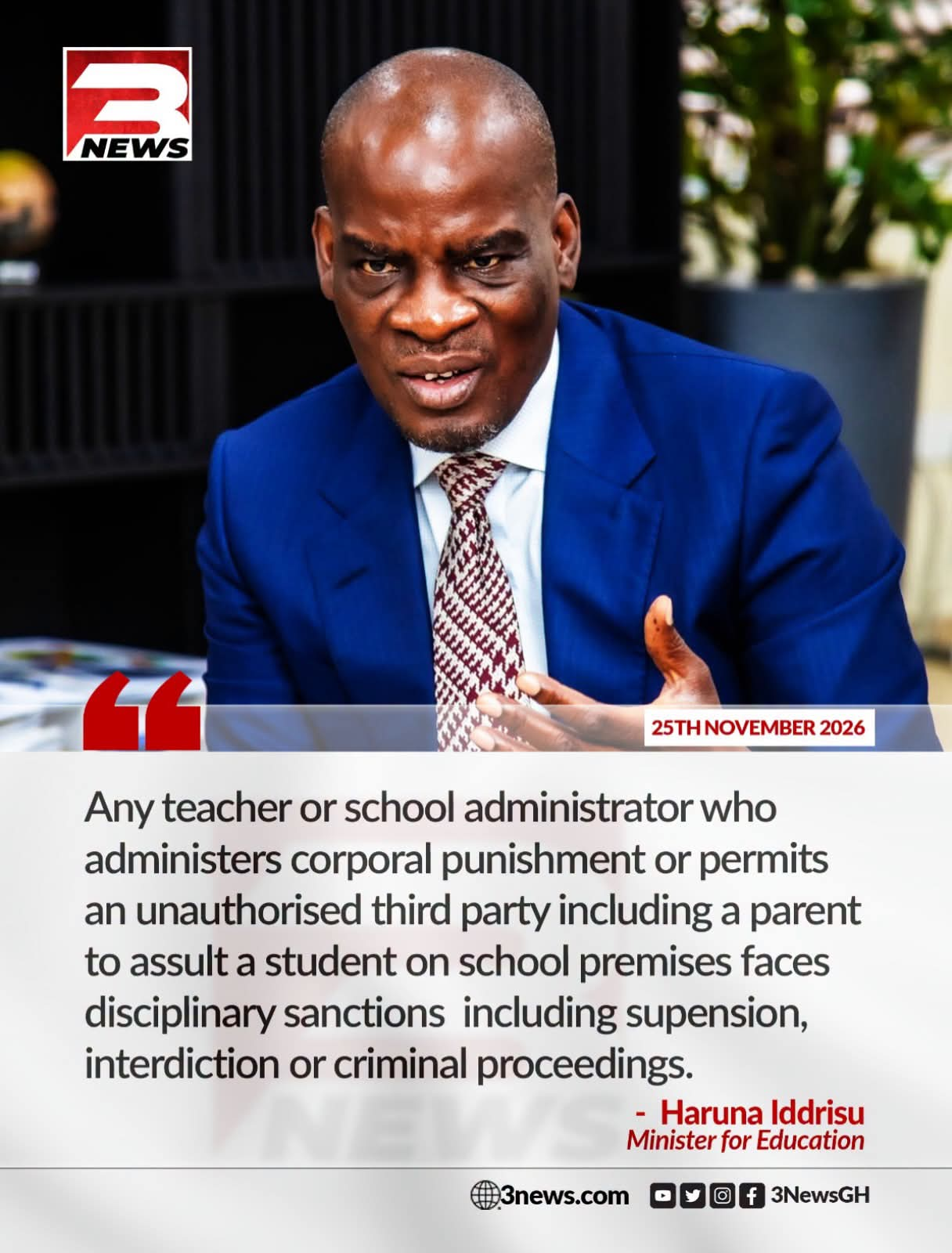
The Minister warned that teachers and school administrators who administer physical punishment or allow unauthorised individuals, including parents, to assault students on school premises could face disciplinary sanctions, including interdiction, dismissal and possible criminal proceedings.
His remarks came while responding to parliamentary questions concerning school discipline, student welfare and the enforcement of Ghana’s existing ban on corporal punishment.
However, the announcement went beyond disciplinary warnings. The Minister also outlined plans to establish a dedicated school-abuse reporting hotline in partnership with MTN and indicated the government’s intention to reintroduce Parent-Teacher Associations (PTAs) to strengthen parental involvement in school management.
These developments have important implications for teachers, school heads, parents and learners across Ghana.
CORPORAL PUNISHMENT IN SCHOOLS: WHAT THE MINISTER ANNOUNCED
Speaking in Parliament, Haruna Iddrisu reaffirmed the government’s position that physical punishment should not be used as a method of disciplining learners in public and private pre-tertiary schools.
He explained that teachers and school administrators must respect the rights and freedoms of children while ensuring that appropriate disciplinary standards are maintained in educational institutions.
The Minister specifically warned against situations where teachers administer corporal punishment or permit unauthorised persons, including parents, to assault students on school premises.
According to reports of his parliamentary response, offenders could face administrative sanctions and, where applicable, criminal proceedings under the Children’s Act, 1998 (Act 560).
The warning is particularly significant because it addresses not only teachers who physically punish students but also school authorities who allow unauthorised individuals to use violence against learners within school premises.
END-OF-TERM EXAMINATIONS FROM CRECHE TO SHS
Get quality End-of-Term Examination Questions with Marking Schemes for learners from Creche to SHS, carefully prepared to support effective assessment.
THE EXISTING BAN ON CORPORAL PUNISHMENT IN SCHOOLS
An important clarification is that the ban on corporal punishment is not a new policy introduced in November 2026.
The Ghana Education Service (GES) prohibited corporal punishment in public and private pre-tertiary schools in 2017 through its Revised Code of Conduct for Staff and the Positive Discipline Toolkit.
The policy replaced earlier arrangements that allowed headteachers to authorise caning in certain circumstances.
In 2019, the prohibition was further reinforced through a GES circular following reports that some teachers continued to use physical punishment despite the policy.
During his parliamentary response, the Minister defended the existing policy, explaining that it was intended to protect children’s fundamental rights and freedoms.
He also observed that children today are increasingly aware of their rights and expect those rights to be respected.

CORPORAL PUNISHMENT IN SCHOOLS: WHAT DISCIPLINARY METHODS SHOULD TEACHERS USE?
The prohibition of physical punishment does not mean that schools are expected to abandon discipline.
Instead, the GES Positive Discipline Toolkit outlines alternative approaches that teachers and school administrators can use to manage student behaviour.
These include:
- Counselling: Helping learners understand their behaviour and make better decisions.
- Withdrawal of privileges: Temporarily removing certain privileges as a consequence of misconduct.
- Detention: Using appropriate supervised detention periods where permitted by school rules.
- Reflection periods: Giving learners an opportunity to reflect on their actions and understand their consequences.
- Restorative tasks: Encouraging learners to take responsibility and make amends for inappropriate behaviour.
The Minister also indicated that school-based guidance and counselling units were being strengthened to help address behavioural challenges more systematically.
DETAILED LESSON PLANS & SCHEMES OF WORK
Get detailed lesson plans and Schemes of Work for Nursery, KG, Primary, JHS and SHS to help you prepare, plan and teach effectively.
CORPORAL PUNISHMENT IN SCHOOLS: THE RESPONSIBILITY OF SCHOOL LEADERS
Headteachers and school administrators have an important responsibility to ensure that disciplinary procedures within their institutions comply with GES policies.
They must not authorise physical punishment or allow parents and other unauthorised persons to assault learners on school premises.
School leaders are also expected to promote safe learning environments where teachers can maintain order through appropriate, non-violent disciplinary measures.
READ RELATED RESOURCES HERE: 17-YEAR-OLD GHANAIAN STUDENT INVENTOR BUILDS A HELICOPTER, EXCAVATOR AND MORE
DISCIPLINARY SANCTIONS FOR TEACHERS AND SCHOOL ADMINISTRATORS
One of the most significant aspects of the Minister’s statement was the warning about possible consequences for educators and school administrators who violate the corporal punishment policy.
The reported sanctions include:
- Formal queries.
- Demotion.
- Interdiction.
- Dismissal.
- Possible criminal proceedings under the Children’s Act, 1998 (Act 560), where applicable.
These consequences are intended to reinforce compliance with the existing policy and discourage physical abuse within educational institutions.
The Minister also indicated that School Improvement Support Officers and District Education Directors are expected to conduct regular monitoring visits to ensure that schools comply with the established guidelines.
It is important to note that these are potential sanctions. The appropriate action in an individual case will depend on the circumstances and applicable disciplinary and legal procedures.
GOVERNMENT PLANS AN MTN SCHOOL-ABUSE REPORTING HOTLINE
Another major development announced by the Minister is the proposed establishment of a dedicated hotline through a partnership between the Ministry of Education and telecommunications company MTN.
The hotline is intended to provide students, parents and members of the public with a direct channel to report corporal punishment and other forms of abuse in schools.
According to the Minister, the proposed reporting facility will be located in the office of the Deputy Minister for Education and jointly managed by the Minister and the Director-General of the Ghana Education Service.
The initiative follows concerns about reported incidents of abuse in educational institutions, including developments at Obuasi Senior High Technical School.
The proposed hotline is expected to make it easier for aggrieved students, parents and other members of the public to bring complaints to the attention of the Ministry and GES.
However, as of the publication of this report, a public hotline number has not yet been announced. The public should therefore wait for official communication before attempting to use the proposed service.
READ RELATED RESOURCES HERE: TWO-YEAR EXAMINATION BAN: 7 CRITICAL REASONS GHANAIAN PARENTS AND SCHOOLS MUST TAKE THE NEW GES DIRECTIVE SERIOUSLY
GOVERNMENT INTENDS TO REINTRODUCE PARENT-TEACHER ASSOCIATIONS
Beyond the enforcement of the corporal punishment policy, Haruna Iddrisu also discussed the government’s intention to reintroduce Parent-Teacher Associations across pre-tertiary schools.
The Minister suggested that the absence of an effective PTA system had weakened parental participation in school management and contributed to challenges involving student discipline.
The proposed reintroduction is intended to strengthen cooperation between parents and teachers and encourage families to take a more active role in supporting the education and development of their children.
PTAs can provide an important platform for discussing student behaviour, academic performance, school welfare and other issues affecting the learning environment.
The Minister maintained that protecting children’s rights should go hand in hand with supporting teachers and ensuring that parents fulfil their responsibilities.
It is important to clarify that the reintroduction was presented as a government intention, not as confirmation that all PTAs have already been formally restored.
WHAT THE ANNOUNCEMENT MEANS FOR TEACHERS AND PARENTS
The Minister’s parliamentary remarks raise important questions about how discipline should be maintained in schools while protecting the rights and welfare of learners.
For teachers, the message is that professional discipline must be exercised within the boundaries of GES policies. Educators should familiarise themselves with the Positive Discipline Toolkit and use appropriate non-violent methods when addressing misconduct.
For school administrators, the announcement reinforces the need to ensure that disciplinary practices within their institutions comply with established regulations. They must also prevent unauthorised individuals from assaulting learners on school premises.
For parents, the proposed return of PTAs highlights the importance of constructive cooperation with teachers and school authorities. Concerns about a child’s behaviour or treatment at school should be addressed through appropriate channels rather than through physical confrontation.
Ultimately, a safe and effective learning environment requires cooperation among teachers, parents, school administrators and education authorities.
READ RELATED RESOURCES HERE: NTC ALERT: NEW POST-TEST LINK ISSUED FOR TEACHERS
SMART TEACHERS AVENUE: THE WAY FORWARD
The discussion surrounding corporal punishment in schools should not be reduced to a conflict between teachers’ authority and children’s rights.
Schools need discipline, but that discipline must be consistent with established policies and the protection of learners.
Teachers also need institutional support, cooperation from parents, clear disciplinary guidelines and effective channels for reporting misconduct.
The proposed hotline and reintroduction of PTAs could provide additional structures for improving communication, accountability and student welfare if they are properly implemented.
As these developments unfold, teachers and school administrators are encouraged to familiarise themselves with the existing GES guidelines and ensure that their disciplinary practices remain professional and appropriate.
Smart Teachers Avenue will continue to follow developments from the Ministry of Education and the Ghana Education Service and provide further updates as additional official information becomes available.
The goal should be clear: safe schools, protected learners, supported teachers and stronger cooperation between homes and educational institutions.
Share your experience and ideas in the comments. Your strategy could help another teacher take the first step.
Follow Smart Teachers Avenue on Facebook, TikTok and YouTube for practical teacher development, professional growth and financial education.
YOU CAN CONTACT US ON ↓
📞 Phone: +233 503910155 / +233233910155
📧 Email: info.teachersavenue@gmail.com
💬 WhatsApp: Click Here To WhatsApp Us
Follow Smart Teachers Avenue and Stay connected with us for daily educational resources, financial education, teaching tips and school leadership insights.
📘 Facebook – FOLLOW HERE
🎵 TikTok – FOLLOW HERE
▶️ YouTube – SUBSCRIBE HERE
✈️ Telegram Channel – JOIN HERE
👥 Telegram Community Chat: – JOIN HERE
👥 Facebook Community Chat: – JOIN HERE
WhatsApp Channel – FOLLOW HERE for daily updates, teaching resources and exclusive educational content.
Join our growing community of teachers across Ghana and beyond who trust Smart Teachers Avenue as their preferred platform for teaching resources, professional development, financial education and school leadership.