IF YOU’RE A TEACHER, STOP DOING THIS IMMEDIATELY! 🚫
TEACHERS CAN SUPPORT THEIR PROFESSIONAL AND PERSONAL GROWTH BY AVOIDING NEGATIVE COMPARISON, STOPPING NEGATIVE TALK ABOUT THE PROFESSION AND CONTINUOUSLY INVESTING IN SELF-GROWTH.


THERE ARE THREE THINGS TEACHERS SHOULD STOP DOING IF THEY WANT TO PROTECT THEIR CONFIDENCE, STRENGTHEN THEIR PROFESSIONAL IMAGE AND CONTINUE GROWING IN THE TEACHING PROFESSION.
Teaching is a profession that requires continuous learning, confidence and a willingness to improve. However, according to a recent Smart Teachers Avenue video presented by Atta Smart, there are certain habits and attitudes that can gradually weaken a teacher’s confidence, motivation and professional growth.
The speaker identifies three things teachers should stop doing if they want to become better professionals and maintain a positive outlook about their work.
These include comparing themselves negatively with others, speaking negatively about the teaching profession and neglecting personal and professional growth.
1. STOP COMPARING YOURSELF NEGATIVELY WITH OTHER PROFESSIONALS
The first of the three things teachers should stop doing is constantly comparing themselves with people in other professions.
Teachers may look at security personnel, health workers or people in other sectors and compare their salaries, working conditions or financial situations with their own.
According to the video, comparison itself is not necessarily the problem. A teacher can observe what others are doing and use it positively as motivation to improve.
The problem comes when comparison becomes negative.
When a teacher constantly thinks that another profession is better, that others earn more or that teaching has little value, it can gradually affect that teacher’s confidence and joy.
Instead of asking why someone else appears to be doing better, teachers are encouraged to ask:
What can I learn from them?
What can I do to improve myself?
What steps can I take to improve my own situation?
The speaker also connects this issue to financial literacy. Rather than allowing salary comparisons to create frustration, teachers can learn more about managing their finances and explore practical ways of improving their financial situation.
Smart Teachers Avenue has previously discussed financial education specifically for teachers, including the importance of managing income, controlling unnecessary spending and making deliberate financial decisions.
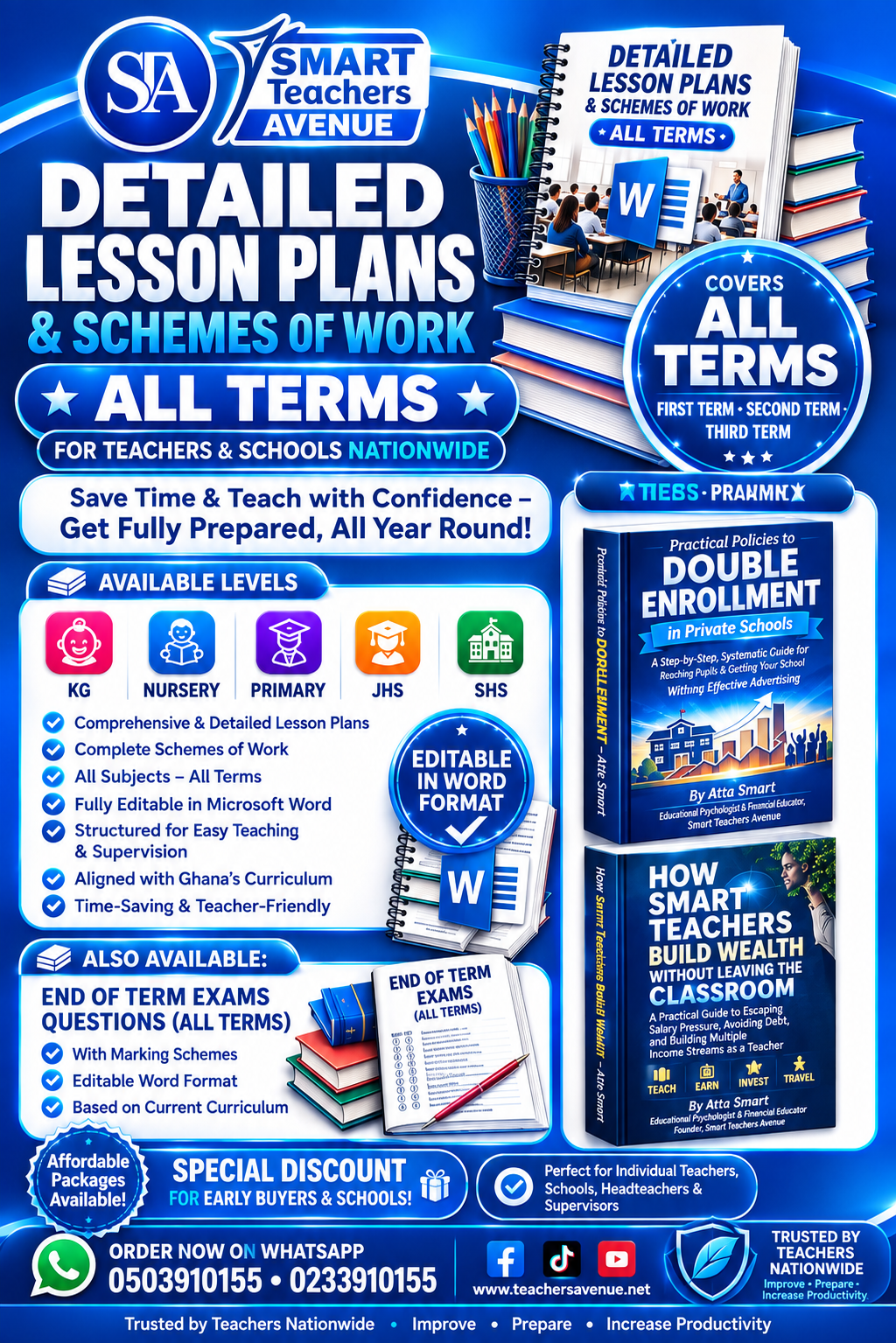
DETAILED LESSON PLANS & SCHEMES OF WORK
Get detailed lesson plans and Schemes of Work for Nursery, KG, Primary, JHS and SHS to help you prepare, plan and teach effectively.
LEARN INSTEAD OF COMPARING
A positive comparison can become a learning opportunity.
If another professional appears to be progressing financially, professionally or personally, teachers can study what that person is doing and ask what lessons can be applied to their own lives.
The goal should not be to become someone else.
The goal should be to become a better version of yourself.
2. STOP SPEAKING NEGATIVELY ABOUT THE TEACHING PROFESSION
The second of the three things teachers should stop doing is constantly speaking negatively about teaching.
The speaker points out that words can influence how people perceive things. When teachers repeatedly say things such as:
“Teaching is not good.”
“If I get another job, I will leave teaching.”
“I am only using teaching as a stepping stone.”
Such statements can gradually influence the teacher’s own perception of the profession.
The video does not suggest that teachers should never consider changing careers. A teacher can make plans for another career or pursue a different opportunity.
The concern is about developing a mindset that constantly describes teaching as worthless or one of the worst professions.
According to the speaker, teachers should recognise that the profession also has opportunities, value and fulfilment when approached with the right mindset.
END-OF-TERM EXAMINATIONS FROM CRECHE TO SHS
Get quality End-of-Term Examination Questions with Marking Schemes for learners from Creche to SHS, carefully prepared to support effective assessment.
YOUR WORDS CAN SHAPE YOUR PERCEPTION
If a teacher continually speaks negatively about the profession, that negativity can influence how the teacher approaches the work.
Instead of constantly focusing on what is wrong, teachers can also identify what they can do to improve their professional lives.
This includes developing skills, learning from colleagues, improving classroom practice and becoming more active in professional development.
For example, Smart Teachers Avenue has previously highlighted practical professional habits such as marking registers on time, preparing lesson plans and notes, and marking learners’ exercises.
The broader lesson is that professional growth is not only about complaining about the profession. It is also about asking what you can do to become more effective within it.
READ RELATED RESOURCES HERE: STOP COMPLAINING: WHY FINANCIAL EDUCATION FOR TEACHERS MATTERS
3. STOP NEGLECTING YOUR PERSONAL AND PROFESSIONAL GROWTH
The third issue raised in the video is neglecting self-growth.
According to the speaker, some teachers may become comfortable once they are given a classroom and begin teaching regularly.
But becoming a teacher should not be the end of the learning journey.
It should be the beginning of continuous professional development.
A teacher can grow professionally, personally and financially.
KEEP LEARNING AFTER YOU BECOME A TEACHER
The speaker warns that when teachers stop learning, they may eventually find themselves unable to keep up when new responsibilities or opportunities arise.
For example, there may come a time when teachers are expected to lead a programme, teach a different subject, take on a new responsibility or participate in a professional activity.
A teacher who has continued developing their skills may be better prepared for such opportunities.
But someone who has stopped learning may struggle.
That is why teachers are encouraged to invest in themselves.
Learn something new.
Improve your teaching skills.
Develop professionally.
Build your personal capacity.
Learn about financial matters.
Continue improving.
PROFESSIONAL GROWTH SHOULD NOT STOP AT THE CLASSROOM
The video encourages teachers to think about growth in different areas.
There is professional growth, which can involve improving teaching skills and professional knowledge.
There is personal growth, which involves developing yourself as an individual.
There is also financial growth, which involves becoming more knowledgeable and responsible about your finances.
These areas can complement one another.
A teacher who continues learning can become more confident, more capable and better prepared to take advantage of opportunities.
READ RELATED RESOURCES HERE: 2026/2027 First Term Schemes of Work Ghana
3 THINGS TEACHERS SHOULD STOP DOING: THE BIGGER MESSAGE
The three points raised in the video are connected.
Stop comparing yourself negatively with others.
Stop speaking negatively about your profession.
Stop neglecting your personal and professional growth.
Instead, teachers are encouraged to learn from others, develop a healthier mindset about their profession and continue investing in themselves.
This does not mean ignoring genuine challenges within the teaching profession.
Teachers can still raise legitimate concerns about salaries, working conditions and other professional issues.
But those concerns should not prevent individual teachers from taking steps to improve themselves.
Teachers can advocate for better conditions while also developing their skills, improving their financial knowledge and strengthening their professional capacity.
WHAT CAN TEACHERS DO DIFFERENTLY?
The message from the video challenges teachers to look inward and ask some important questions.
Am I comparing myself negatively with other professionals?
Do I constantly speak negatively about teaching?
Have I stopped investing in my own growth?
If the answer to any of these questions is yes, it may be time to reconsider those habits.
Professional growth does not happen automatically.
It requires continuous learning, self-reflection and deliberate action.
WHICH ONE IS THE MOST DANGEROUS?
The speaker ends with a challenge to teachers:
Among these three things, which one do you think is the most dangerous for teachers?
- Comparing yourself negatively with others?
- Speaking negatively about the teaching profession?
- Neglecting your personal and professional growth?
Share your answer in the comment section.
And if you found this message valuable, share it with another teacher who may need to hear it.
READ RELATED RESOURCES HERE: STOP COMPLAINING: WHY FINANCIAL EDUCATION FOR TEACHERS MATTERS
This article is based on a Smart Teachers Avenue video presented by Atta Smart, Lead Educator and Financial Coach.
Share your experience and ideas in the comments. Your strategy could help another teacher take the first step.
Follow Smart Teachers Avenue on Facebook, TikTok and YouTube for more conversations and stories about teachers, education and the people behind the classroom.
You can contact us
📞 Phone: +233 503910155 / +233233910155
📧 Email: info.teachersavenue@gmail.com
💬 WhatsApp: Click Here To WhatsApp Us
Follow Smart Teachers Avenue and Stay connected with us for daily educational resources, financial education, teaching tips and school leadership insights.
📘 Facebook – FOLLOW HERE
🎵 TikTok – FOLLOW HERE
▶️ YouTube – SUBSCRIBE HERE
✈️ Telegram Channel – JOIN HERE
👥 Telegram Community Chat: – JOIN HERE
👥 Facebook Community Chat: – JOIN HERE
WhatsApp Channel – FOLLOW HERE for daily updates, teaching resources and exclusive educational content.
Join our growing community of teachers across Ghana and beyond who trust Smart Teachers Avenue as their preferred platform for teaching resources, professional development, financial education and school leadership.